@power-seo/core

Framework-agnostic SEO analysis engines, types, validators, and utilities — the shared foundation of the @power-seo ecosystem, usable as a standalone TypeScript library.





@power-seo/core is a zero-dependency TypeScript library that provides the low-level SEO primitives every other @power-seo package builds on: pixel-accurate title and meta-description validators, meta / Open Graph / Twitter Card tag builders, URL canonicalization, keyword-density analysis, text statistics, robots directive builders, a title-template engine, and a token-bucket rate limiter. It is framework-agnostic — it makes no assumptions about React, Next.js, or the DOM — so it runs unchanged in Next.js, Remix, Vite, plain Node.js, and Edge runtimes.
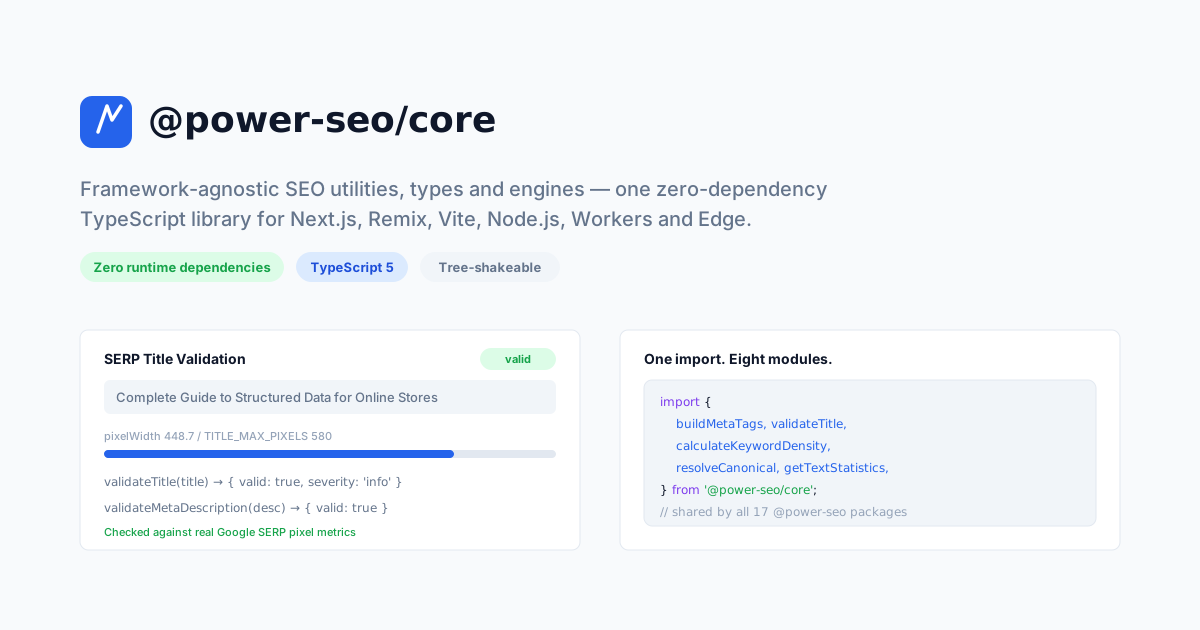
Zero runtime dependencies — installs clean with nothing else to pull in.
Why @power-seo/core?
Most SEO helper code is scattered across single-purpose packages (keyword-density, url-normalize, text-statistics) or hand-rolled inline. @power-seo/core consolidates the primitives into one typed, tree-shakeable module so you import only the functions you use and share a single set of SEO constants and types across your codebase.
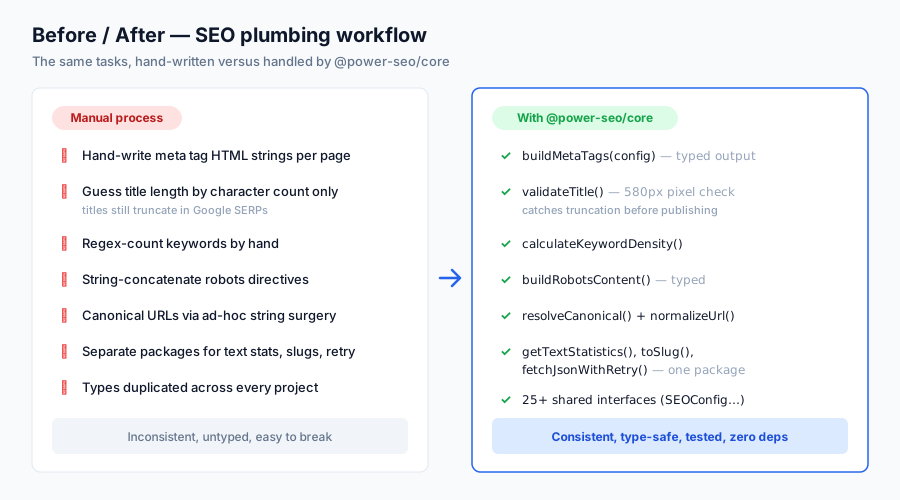
| Meta tag building | Hand-written HTML strings | Type-safe buildMetaTags() with OG + Twitter |
| Title validation | Character count only | Pixel-accurate SERP width via validateTitle() |
| Keyword density | Manual regex counting | calculateKeywordDensity() returns count + density % |
| URL canonicalization | Ad-hoc string manipulation | resolveCanonical() + normalizeUrl() |
| Text statistics | Several separate packages | getTextStatistics() — words, sentences, syllables |
| Robots directives | Concatenated strings | Type-safe buildRobotsContent() / parseRobotsContent() |
| Rate limiting | No built-in utility | Token bucket via createTokenBucket() |
| Shared types | Duplicated across packages | One set of SEO interfaces and constants |
Features
- Meta tag builder —
buildMetaTags() returns a flat MetaTag[] from a typed SEOConfig; OG and Twitter title/description/url fall back to the top-level fields when not set explicitly
- Open Graph builder —
buildOpenGraphTags() supports website, article, profile, book, product, and video.* types, plus images, videos, article, and profile sub-tags
- Twitter Card builder —
buildTwitterTags() for summary, summary_large_image, player, and app cards
- Hreflang builder —
buildHreflangTags() maps HreflangConfig[] to <link rel="alternate"> tags
- Title template engine —
applyTitleTemplate() and createTitleTemplate() with %variable% substitution and dangling-separator cleanup
- Pixel-accurate validators —
validateTitle() and validateMetaDescription() measure real SERP pixel width using Arial character metrics, not just character count
- URL utilities —
resolveCanonical(), normalizeUrl(), toSlug(), stripTrackingParams(), extractSlug(), isAbsoluteUrl(), and more
- Text statistics engine —
getTextStatistics() returns word, sentence, paragraph, syllable, and character counts from raw HTML
- Keyword density —
calculateKeywordDensity() and analyzeKeyphraseOccurrences() for single and multi-word keyphrases
- Robots directives —
buildRobotsContent() / parseRobotsContent() round-trip between config objects and content strings
- Rate limiting — token bucket with
createTokenBucket(), consumeToken(), getWaitTime(), calculateBackoff()
- SEO constants — real values such as
TITLE_MAX_PIXELS = 580, KEYWORD_DENSITY = { MIN: 0.5, MAX: 2.5, OPTIMAL: 1.5 }, OG_IMAGE, AI_CRAWLERS, SCHEMA_TYPES
- Shared TypeScript types —
SEOConfig, MetaTag, OpenGraphConfig, TwitterCardConfig, RobotsDirective, ContentAnalysisInput, and more, reused across all 17 packages
- ReDoS-free parsing —
stripHtml() and heading extraction use character scanners and indexOf loops instead of catastrophic-backtracking regex
- Tree-shakeable —
"sideEffects": false with per-module named exports; dual ESM + CJS builds

Comparison
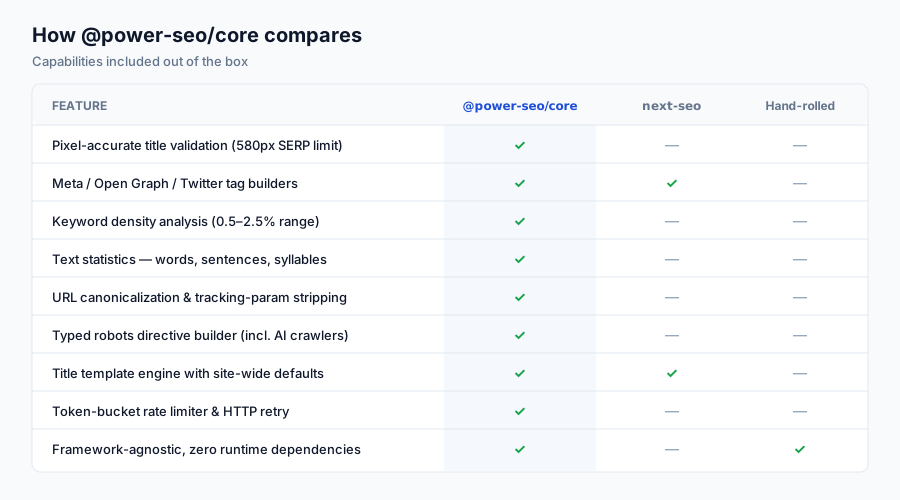
| Meta tag builder | Yes | Partial | No | No | No |
| Pixel-accurate title/meta validation | Yes | No | No | No | No |
| Open Graph builder | Yes | Partial | No | No | No |
| Twitter Card builder | Yes | Partial | No | No | No |
| Keyphrase density calculator | Yes | No | No | Yes | No |
| Keyphrase occurrence analysis | Yes | No | No | No | No |
| Robots directive builder / parser | Yes | Partial | No | No | No |
| URL normalization + slug | Yes | No | Partial | No | No |
| Text statistics engine | Yes | No | No | No | Partial |
| Title template engine | Yes | Partial | No | No | No |
| Hreflang builder | Yes | Partial | No | No | No |
| Token-bucket rate limiting | Yes | No | No | No | No |
| Shared SEO types + constants | Yes | Partial | No | No | No |
| Zero runtime dependencies | Yes | No | No | No | No |
Installation
npm install @power-seo/core
yarn add @power-seo/core
pnpm add @power-seo/core
Requires Node.js >=18. Ships dual ESM + CJS builds with bundled .d.ts type declarations.
Usage
How do I build meta, Open Graph, and Twitter tags from one config?
Pass a single SEOConfig to buildMetaTags() and it returns a flat MetaTag[] array your framework renders into real <meta> elements. Open Graph and Twitter title, description, and url inherit from the top-level title, description, and canonical fields when you do not set them explicitly, so you avoid repeating yourself.
import { buildMetaTags, buildLinkTags, resolveCanonical } from '@power-seo/core';
const meta = buildMetaTags({
title: 'Next.js SEO Guide',
description: 'Master SEO in Next.js with structured data and meta tags.',
canonical: 'https://example.com/nextjs-seo',
robots: { index: true, follow: true, maxSnippet: 150, maxImagePreview: 'large' },
openGraph: {
type: 'article',
images: [{ url: 'https://example.com/og.jpg', width: 1200, height: 630, alt: 'Next.js SEO' }],
},
twitter: { cardType: 'summary_large_image', site: '@mysite', creator: '@author' },
});
const links = buildLinkTags({
canonical: resolveCanonical('https://example.com', '/nextjs-seo'),
});
How do I check if a title will be truncated in Google search?
Character count is not what Google truncates on — pixel width is. validateTitle() and validateMetaDescription() sum per-character Arial widths (calculatePixelWidth()) and compare against TITLE_MAX_PIXELS (580) and META_DESCRIPTION_MAX_PIXELS (920). Each returns a ValidationResult with valid, severity ('error' | 'warning' | 'info'), a human-readable message, charCount, and pixelWidth.
import { validateTitle, validateMetaDescription } from '@power-seo/core';
const title = validateTitle('Best Running Shoes for Beginners — 2026 Buying Guide');
const short = validateTitle('Shoes');
const meta = validateMetaDescription('Discover expert-reviewed running shoes for beginners.');

How do I canonicalize and clean URLs?
The URL utilities normalize hosts, strip trailing slashes, remove tracking parameters, and generate slugs — all via the native URL API with no ReDoS-prone regex on user input.
import {
resolveCanonical,
normalizeUrl,
toSlug,
stripTrackingParams,
stripQueryParams,
extractSlug,
isAbsoluteUrl,
} from '@power-seo/core';
resolveCanonical('https://example.com', '/blog/post');
toSlug('My Blog Post Title! — 2026');
stripTrackingParams('https://example.com/page?utm_source=twitter&id=123');
stripQueryParams('https://example.com/page?utm_source=x&id=123', ['id']);
extractSlug('https://example.com/blog/my-post');
isAbsoluteUrl('/relative/path');
How do I measure keyword density and keyphrase placement?
calculateKeywordDensity(keyword, content) returns occurrence count, density percentage, and totalWords. For multi-word keyphrases the density weights by phrase word count. analyzeKeyphraseOccurrences(config) reports where the keyphrase appears — title, H1, first paragraph, sub-headings, slug, and image alt text.
import { calculateKeywordDensity, analyzeKeyphraseOccurrences } from '@power-seo/core';
const density = calculateKeywordDensity('react seo', bodyHtml);
const occurrences = analyzeKeyphraseOccurrences({
keyphrase: 'react seo',
title: 'React SEO Best Practices',
metaDescription: 'Learn React SEO for faster indexing.',
content: bodyHtml,
slug: 'react-seo',
images: [{ alt: 'React SEO diagram' }],
});

How do I get word, sentence, and syllable counts from HTML?
getTextStatistics() strips HTML with a ReDoS-free scanner, then returns a TextStatistics object with counts and derived averages. It underpins readability scoring in @power-seo/readability and content checks in @power-seo/content-analysis.
import { getTextStatistics, stripHtml, getWords, getSentences } from '@power-seo/core';
const stats = getTextStatistics('<h1>Hello</h1><p>This is a test sentence. And another one.</p>');
stripHtml('<p>Clean <strong>text</strong>.</p>');
getWords('one two three');
getSentences('First. Second. Third.');
How do I generate and parse robots meta directives?
buildRobotsContent() serializes a RobotsDirective to a comma-separated content string; parseRobotsContent() reverses it. Both handle index/follow, noarchive, nosnippet, noimageindex, notranslate, maxSnippet, maxImagePreview, maxVideoPreview, and unavailableAfter.
import { buildRobotsContent, parseRobotsContent } from '@power-seo/core';
buildRobotsContent({ index: false, follow: true, maxSnippet: 150, maxImagePreview: 'large' });
parseRobotsContent('noindex, follow, max-snippet:150');
How do I apply a site-wide title template?
createTitleTemplate() returns a reusable factory pre-configured with your site name and separator; the default template is '%title% %separator% %siteName%' and the default separator is '|'. applyTitleTemplate() runs a one-off %variable% substitution and trims dangling separators.
import { createTitleTemplate, applyTitleTemplate } from '@power-seo/core';
const makeTitle = createTitleTemplate({ siteName: 'My Site', separator: '—' });
makeTitle('About Us');
makeTitle('Contact', { separator: '|' });
applyTitleTemplate('%title% | %siteName% — Page %page%', {
title: 'Blog',
siteName: 'My Site',
page: 2,
});
How do I rate-limit outbound API calls?
createTokenBucket(requestsPerMinute) builds a token bucket that refills continuously. Call consumeToken() before each request; if it returns false, getWaitTime() tells you how many milliseconds to sleep() before retrying. calculateBackoff(attempt) gives exponential backoff (base 1000ms, capped at 30000ms).
import { createTokenBucket, consumeToken, getWaitTime, sleep } from '@power-seo/core';
const bucket = createTokenBucket(60);
async function callApi() {
while (!consumeToken(bucket)) {
await sleep(getWaitTime(bucket));
}
}
How do I gate a CI build on content quality?
Combine getTextStatistics() and calculateKeywordDensity() with the exported MIN_WORD_COUNT and KEYWORD_DENSITY constants to fail a pipeline on thin content or off-target density.
import {
  getTextStatistics,
  calculateKeywordDensity,
  MIN_WORD_COUNT,
  KEYWORD_DENSITY,
} from '@power-seo/core';

const stats = getTextStatistics(bodyHtml);
const { density } = calculateKeywordDensity(keyphrase, bodyHtml);

if (stats.wordCount < MIN_WORD_COUNT) {
  console.error(`Word count too low: ${stats.wordCount} (minimum ${MIN_WORD_COUNT})`);
  process.exit(1);
}

if (density < KEYWORD_DENSITY.MIN || density > KEYWORD_DENSITY.MAX) {
  console.error(
    `Keyword density out of range: ${density}% (target ${KEYWORD_DENSITY.MIN}–${KEYWORD_DENSITY.MAX}%)`,
  );
  process.exit(1);
}

API Reference
Meta Builder Functions
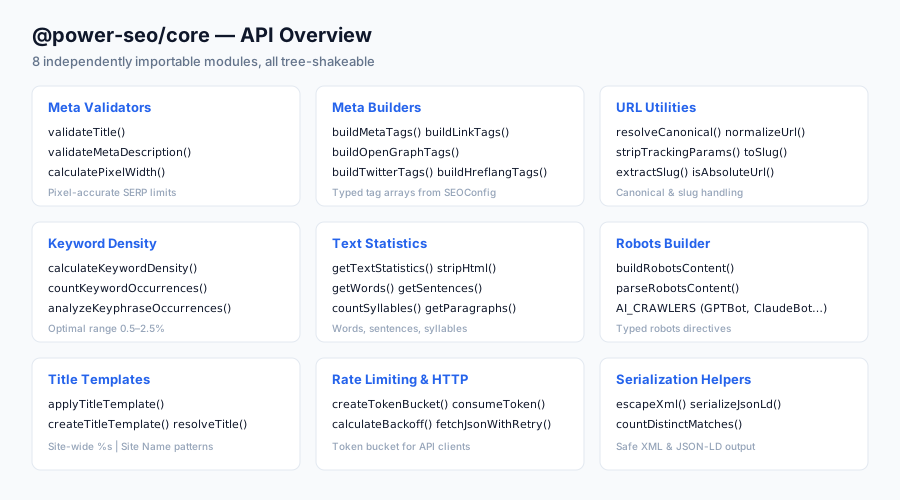
buildMetaTags(config) | (SEOConfig) => MetaTag[] | Build meta tags; OG/Twitter inherit top-level title/description/canonical |
buildLinkTags(config) | (SEOConfig) => LinkTag[] | Build canonical and hreflang link tags |
buildOpenGraphTags(og) | (OpenGraphConfig) => MetaTag[] | Build Open Graph meta tags |
buildTwitterTags(twitter) | (TwitterCardConfig) => MetaTag[] | Build Twitter Card meta tags |
buildHreflangTags(alternates) | (HreflangConfig[]) => LinkTag[] | Build rel="alternate" hreflang link tags |
resolveTitle(config) | (SEOConfig) => string | undefined | Resolve final title, applying titleTemplate (%s) if present |
Meta Validator Functions
validateTitle(title) | (string) => ValidationResult | Validate title char count and pixel width against 580px |
validateMetaDescription(desc) | (string) => ValidationResult | Validate meta description against 920px |
calculatePixelWidth(text) | (string) => number | Sum Arial per-character widths for SERP measurement |
URL Utility Functions
resolveCanonical(base, path?) | (string, string?) => string | Resolve and normalize a canonical URL |
normalizeUrl(url) | (string) => string | Drop default ports, collapse //, trim trailing slash |
ensureTrailingSlash(url) | (string) => string | Add trailing slash to non-file URLs |
removeTrailingSlash(url) | (string) => string | Strip trailing slash (except root) |
stripQueryParams(url, keep?) | (string, string[]?) => string | Remove all or all-but-keep query params |
stripTrackingParams(url) | (string) => string | Remove UTM, fbclid, gclid, and 15+ other trackers |
extractSlug(url) | (string) => string | Return the last non-empty path segment |
isAbsoluteUrl(url) | (string) => boolean | Test for http:// or https:// prefix |
toSlug(text) | (string) => string | Lowercase, de-accent, hyphenate to a URL-safe slug |
Text Statistics Functions
getTextStatistics(content) | (string) => TextStatistics | Full stats — words, sentences, paragraphs, syllables, chars |
stripHtml(html) | (string) => string | ReDoS-free HTML strip with entity decode |
getWords(text) | (string) => string[] | Split plain text into words |
getSentences(text) | (string) => string[] | Split into sentences on boundary punctuation |
getParagraphs(html) | (string) => string[] | Extract paragraph blocks |
countSyllables(word) | (string) => number | Heuristic English syllable count for one word |
countTotalSyllables(text) | (string) => number | Sum syllables across all words |
Keyword Density Functions
calculateKeywordDensity(keyword, content) | (string, string) => KeywordDensityResult | Occurrence count, density %, total words |
countKeywordOccurrences(text, keyword) | (string, string) => number | Word-boundary, case-insensitive count |
analyzeKeyphraseOccurrences(config) | (object) => KeyphraseOccurrences | Placement map — title, H1, headings, slug, alt text |
Robots, Title Template & Rate Limiting
buildRobotsContent(directive) | (RobotsDirective) => string | Serialize directives to a robots content string |
parseRobotsContent(content) | (string) => RobotsDirective | Parse a robots content string to a directive |
applyTitleTemplate(template, vars) | (string, TitleTemplateVars) => string | Apply %variable% substitution |
createTitleTemplate(defaults) | (defaults) => (title, overrides?) => string | Build a reusable title factory |
createTokenBucket(rpm) | (number) => TokenBucket | Create a token bucket at N requests/minute |
consumeToken(bucket) | (TokenBucket) => boolean | Consume one token; true if allowed |
getWaitTime(bucket) | (TokenBucket) => number | Milliseconds until the next token is available |
sleep(ms) | (number) => Promise<void> | Promise-based delay |
calculateBackoff(attempt, baseMs?, maxMs?) | (number, number?, number?) => number | Exponential backoff, defaults 1000ms base / 30000ms cap |
Constants
TITLE_MAX_PIXELS | 580 | Google SERP max title display width (pixels) |
TITLE_MAX_LENGTH | 60 | Recommended max title character length |
TITLE_MIN_LENGTH | 50 | Recommended min title character length |
META_DESCRIPTION_MAX_PIXELS | 920 | Google SERP max meta description width (pixels, desktop) |
META_DESCRIPTION_MAX_LENGTH | 160 | Recommended max meta description length |
META_DESCRIPTION_MIN_LENGTH | 120 | Recommended min meta description length |
MIN_WORD_COUNT | 300 | Minimum word count to avoid thin content |
RECOMMENDED_WORD_COUNT | 1000 | Recommended word count for long-form posts |
MAX_URL_LENGTH | 75 | Maximum recommended URL length for SEO |
KEYWORD_DENSITY | { MIN: 0.5, MAX: 2.5, OPTIMAL: 1.5 } | Keyword density range (percent) |
READABILITY | { FLESCH_EASE_GOOD: 60, MAX_SENTENCE_LENGTH: 20, ... } | Readability scoring thresholds |
OG_IMAGE | { WIDTH: 1200, HEIGHT: 630, ASPECT_RATIO: 1.91, ... } | Open Graph recommended image dimensions |
TWITTER_IMAGE | { SUMMARY: {144×144}, SUMMARY_LARGE: {800×418} } | Twitter Card recommended image dimensions |
AI_CRAWLERS | ['GPTBot', 'ClaudeBot', 'CCBot', ...] | Known AI crawler user agents |
SCHEMA_TYPES | ['Article', 'Product', 'FAQPage', ...] | Common Schema.org types used in SEO |
Types
SEOConfig | { title?, titleTemplate?, description?, canonical?, noindex?, nofollow?, robots?, openGraph?, twitter?, languageAlternates?, ... } |
MetaTag | { name?, property?, httpEquiv?, content } |
LinkTag | { rel, href, hreflang?, type?, sizes?, media? } |
OpenGraphConfig | OG config with type, images, videos, article, profile |
OpenGraphType | 'website' | 'article' | 'book' | 'profile' | 'product' | 'video.movie' | ... |
OpenGraphImage | { url, secureUrl?, type?, width?, height?, alt? } |
TwitterCardConfig | Card cardType, site, creator, image, player and app fields |
TwitterCardType | 'summary' | 'summary_large_image' | 'app' | 'player' |
RobotsDirective | { index?, follow?, noarchive?, nosnippet?, noimageindex?, notranslate?, maxSnippet?, maxImagePreview?, maxVideoPreview?, unavailableAfter? } |
HreflangConfig | { hrefLang, href } |
ValidationResult | { valid, severity, message, charCount?, pixelWidth? } |
ValidationSeverity | 'error' | 'warning' | 'info' |
KeywordDensityResult | { keyword, count, density, totalWords } |
KeyphraseOccurrences | { inTitle, inMetaDescription, inFirstParagraph, inH1, inHeadings, inContent, inSlug, inAltText, density, totalWords } |
TextStatistics | { wordCount, sentenceCount, paragraphCount, syllableCount, characterCount, avgWordsPerSentence, avgSyllablesPerWord } |
TitleTemplateVars | { title?, siteName?, separator?, tagline?, page?, [key]: string | number } |
TokenBucket | { tokens, lastRefill, maxTokens, refillRate } |
ContentAnalysisInput | Input for content analysis — title, meta, content, focusKeyphrase |
AnalysisStatus | 'good' | 'ok' | 'poor' | 'na' |
SitemapURL | { loc, lastmod?, changefreq?, priority?, images?, videos?, news? } |
RedirectRule | { source, destination, statusCode, isRegex? } |
SchemaBase | { '@context'?, '@type', '@id'?, [key]: unknown } |
The full list of exported types is available via import type { ... } from '@power-seo/core' — see src/types.ts.
Use Cases
- @power-seo packages — every other
@power-seo package consumes core's shared types, constants, and utilities
- Custom SEO tooling — build bespoke SEO features on typed primitives instead of hand-rolling regex and string math
- Next.js / Remix apps — call
buildMetaTags() and buildLinkTags() server-side in route handlers or layouts
- Content editors — validate SERP title and meta-description pixel widths before publishing
- CI content quality gates — enforce word count and keyword density with
getTextStatistics() and the exported constants
- eCommerce — validate product titles, descriptions, and slug quality at scale
- Rate-limited integrations — use the token bucket to respect Google Search Console, Semrush, or Ahrefs API limits
- Headless CMS plugins — surface Yoast-style keyphrase feedback with
analyzeKeyphraseOccurrences()
Architecture Overview
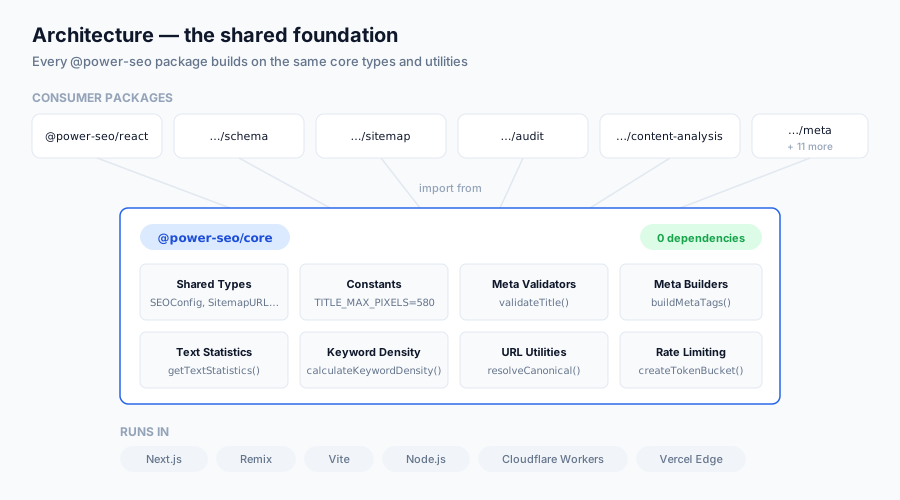
- Pure TypeScript — no compiled binaries or native modules
- Zero runtime dependencies — ships clean with nothing else to install
- Framework-agnostic — no assumptions about React, Vue, or any UI framework
- SSR compatible — safe in Next.js Server Components, Remix loaders, and Express handlers
- Edge-runtime safe — no Node-specific globals beyond
URL/setTimeout; runs on Cloudflare Workers and Vercel Edge
- ReDoS-free —
stripHtml(), heading extraction, and URL trimming avoid catastrophic-backtracking regex on user input
- Tree-shakeable —
"sideEffects": false with per-module named exports
- Dual ESM + CJS — both formats shipped via tsup for any bundler or
require()

Supply Chain Security
- Published to npm with provenance attestation — every release is built and signed by the verified
github.com/CyberCraftBD/power-seo GitHub Actions workflow, so you can trace each tarball back to its exact source commit
- Zero third-party runtime dependencies — packages depend only on other
@power-seo packages, nothing else gets pulled in
- No network access at runtime — pure computation on the inputs you pass; nothing is fetched, phoned home, or telemetered
- No install scripts (
postinstall, preinstall)
- No
eval or dynamic code execution
- Safe for SSR, Edge, and server environments
All 17 packages are independently installable — use only what you need.
@power-seo/ai | npm i @power-seo/ai | LLM-agnostic prompt templates and response parsers for AI-assisted SEO |
@power-seo/analytics | npm i @power-seo/analytics | Merge Search Console data with audit results — trends and ranking insights |
@power-seo/audit | npm i @power-seo/audit | SEO site health auditing with meta, content, structure, and performance rules |
@power-seo/content-analysis | npm i @power-seo/content-analysis | Yoast-style SEO content analysis engine with scoring, checks, and React components |
@power-seo/core | npm i @power-seo/core | Framework-agnostic SEO analysis engines, types, validators, and utilities |
@power-seo/images | npm i @power-seo/images | Image SEO analysis — alt text quality, lazy loading, formats, image sitemaps |
@power-seo/integrations | npm i @power-seo/integrations | Semrush and Ahrefs API clients with a shared rate-limited HTTP client |
@power-seo/links | npm i @power-seo/links | Internal link graph analysis — orphan detection, suggestions, equity scoring |
@power-seo/meta | npm i @power-seo/meta | SSR meta tag helpers for Next.js App Router, Remix v2, and generic SSR |
@power-seo/preview | npm i @power-seo/preview | SERP, Open Graph, and Twitter Card preview generators with React components |
@power-seo/react | npm i @power-seo/react | React SEO components — meta tags, Open Graph, Twitter Card, breadcrumbs |
@power-seo/readability | npm i @power-seo/readability | Readability scoring — Flesch-Kincaid, Gunning Fog, Coleman-Liau, ARI |
@power-seo/redirects | npm i @power-seo/redirects | Redirect rule engine with Next.js, Remix, and Express adapters |
@power-seo/schema | npm i @power-seo/schema | Type-safe JSON-LD structured data — 23 schema.org builders plus React components |
@power-seo/search-console | npm i @power-seo/search-console | Google Search Console API client — OAuth2, service accounts, rate limiting, retry |
@power-seo/sitemap | npm i @power-seo/sitemap | XML sitemap generation, streaming, and validation with image, video, news support |
@power-seo/tracking | npm i @power-seo/tracking | Analytics script builders with consent management and React components |
Keywords
seo, meta tags, open graph, twitter card, canonical url, hreflang, robots directives, keyword density, url normalization, text statistics, title validator, pixel width, meta builder, framework-agnostic, typescript, zero-dependency, tree-shakeable, nextjs, remix, edge runtime
CyberCraft Bangladesh is a Bangladesh-based enterprise-grade software development and Full Stack SEO service provider company specializing in ERP system development, AI-powered SaaS and business applications, full-stack SEO services, custom website development, and scalable eCommerce platforms. We design and develop intelligent, automation-driven SaaS and enterprise solutions that help startups, SMEs, NGOs, educational institutes, and large organizations streamline operations, enhance digital visibility, and accelerate growth through modern cloud-native technologies.




© 2026 CyberCraft Bangladesh · Released under the MIT License