@power-seo/integrations
Typed Semrush and Ahrefs API clients for keyword research, domain overviews, backlinks, and keyword difficulty — built on a shared rate-limited HTTP client with automatic retry.





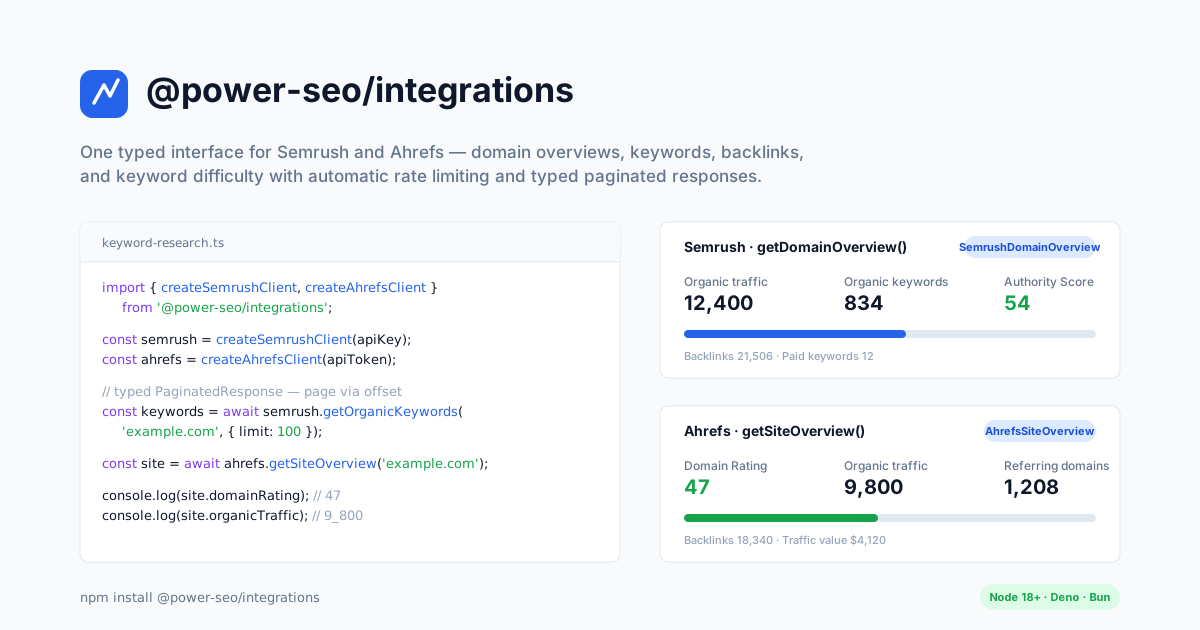
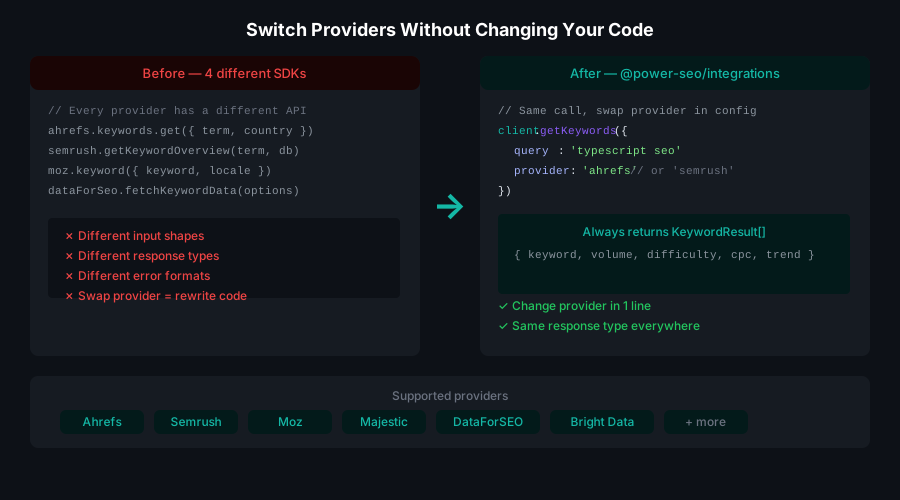
@power-seo/integrations is a TypeScript client library for the Semrush and Ahrefs SEO data APIs, aimed at developers building keyword research pipelines, backlink monitors, and SEO reporting tools in Node.js. Both clients share one HTTP layer — createHttpClient() — that enforces a token-bucket rate limit, retries retryable failures with exponential backoff, and normalizes every non-2xx response into a single IntegrationApiError with status, provider, and retryable fields. Every request parameter and response field is fully typed, so keyword volume, CPC, Domain Rating, and backlink data arrive as structured objects instead of hand-parsed payloads.
Network access note — this package's documented purpose is calling external APIs. HTTPS requests go exclusively to the endpoints you configure (api.semrush.com, api.ahrefs.com, or your own baseUrl), authenticated with your credentials. Nothing else is contacted.
Why @power-seo/integrations?
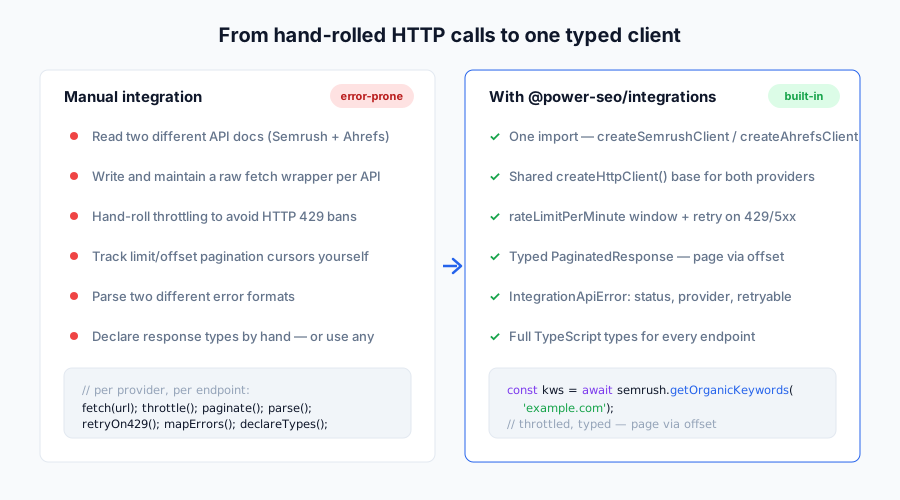
| Semrush API | ❌ Hand-write requests, parse column codes | ✅ Typed client — Or/Nq/Kd mapped to named fields |
| Ahrefs API | ❌ Manual bearer auth and query building | ✅ Typed client with token auth handled for you |
| Rate limiting | ❌ Manual throttle or 429 storms | ✅ Built-in token bucket (default 600 requests/minute) |
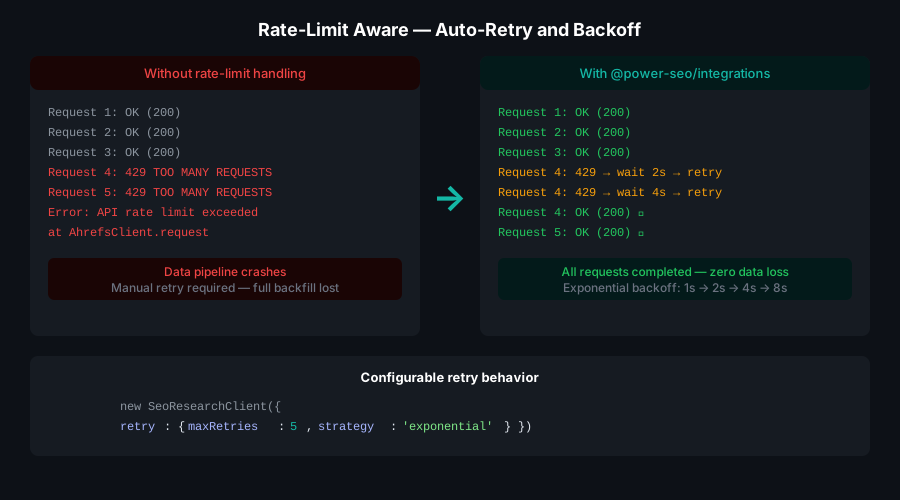
| Retry logic | ❌ Ad-hoc try/catch loops | ✅ Exponential backoff on 429/5xx, up to 3 retries by default |
| Pagination | ❌ Untyped offset bookkeeping | ✅ PaginatedResponse<T> with offset, limit, hasMore |
| Error handling | ❌ Raw HTTP errors, secrets leaking into logs | ✅ IntegrationApiError with sanitized, token-redacted body |
| TypeScript types | ❌ any everywhere | ✅ Full type coverage for every endpoint and response |
| Bundle size | ❌ Full vendor SDK in your bundle | ✅ Tree-shakeable — import only the client you use |
Features
- Semrush API client — domain overview (organic/paid traffic, keywords, backlinks, Authority Score), organic keywords with positions, backlink profile, keyword difficulty, and related keyword suggestions
- Ahrefs API client — site overview (Domain Rating, URL Rating, traffic value), organic keywords, backlinks with anchor text, keyword difficulty, and referring domains
- Shared HTTP client —
createHttpClient() works against any JSON REST API with query-param or bearer auth, a configurable per-minute rate limit, request timeout, and retry
- Token-bucket rate limiting — requests wait for a token instead of failing; the limit is configurable per client via
rateLimitPerMinute
- Retry with exponential backoff — 429 and 5xx responses are retried up to
maxRetries times with delays of 1s, 2s, 4s… capped at 30s
- Typed pagination — list endpoints return
PaginatedResponse<T> with data, total, offset, limit, and hasMore for clean cursor loops
- Sanitized errors — response bodies embedded in error messages are truncated and have bearer tokens and API keys redacted before they can reach your logs
- Tree-shakeable, dual ESM + CJS —
createSemrushClient, createAhrefsClient, and createHttpClient are independent named exports
Comparison
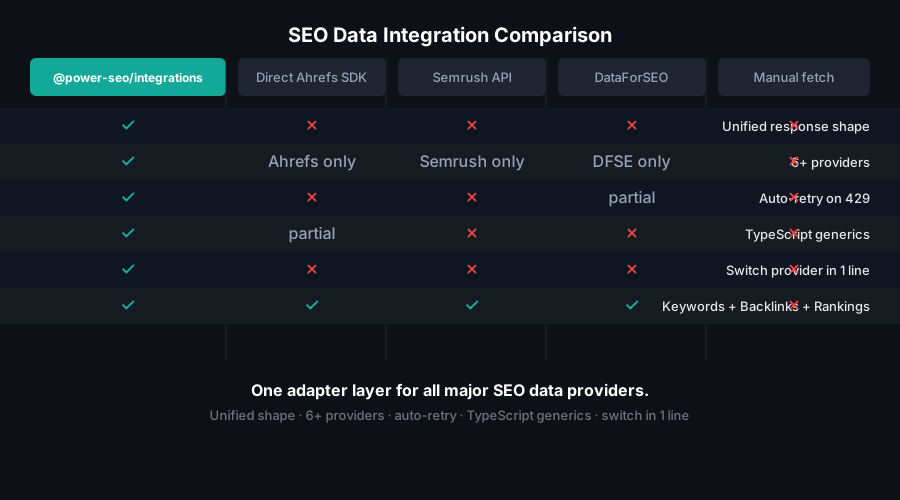
| Typed Semrush responses | ✅ | Manual | ❌ (column codes) |
| Typed Ahrefs responses | ✅ | Manual | ❌ (raw JSON) |
| Rate limiting | ✅ token bucket | Manual | ❌ |
| Retry with backoff | ✅ 429/5xx aware | Manual | ❌ |
| Consistent errors across vendors | ✅ IntegrationApiError | Manual | ❌ |
| Secret redaction in errors | ✅ | Rarely | ❌ |
| One HTTP layer for both APIs | ✅ | ❌ | ❌ |
| Tree-shakeable TypeScript | ✅ | — | — |
Installation
npm install @power-seo/integrations
yarn add @power-seo/integrations
pnpm add @power-seo/integrations
Requires Node.js 18+ (native fetch). Also runs in Deno, Bun, and edge runtimes that provide fetch, URL, and AbortController.
Usage
How do I query Semrush domain and keyword data in TypeScript?
Create a client with createSemrushClient(apiKey, config?) — the first argument is your Semrush API key as a plain string (sent as the key query parameter), and the optional second argument tunes rateLimitPerMinute, maxRetries, and timeoutMs. The client exposes five typed methods covering domain overview, organic keywords, backlinks, keyword difficulty, and related keywords. Regional database defaults to 'us' and list endpoints default to 100 rows per page.
import { createSemrushClient } from '@power-seo/integrations';
import type { SemrushDomainOverview } from '@power-seo/integrations';
const semrush = createSemrushClient(process.env.SEMRUSH_API_KEY!, {
rateLimitPerMinute: 60,
});
const overview: SemrushDomainOverview = await semrush.getDomainOverview('example.com', 'us');
const keywords = await semrush.getOrganicKeywords('example.com', { limit: 100, offset: 0 });
const backlinks = await semrush.getBacklinks('example.com', { limit: 100, offset: 0 });
const difficulty = await semrush.getKeywordDifficulty(['react seo', 'next.js seo'], 'us');
const related = await semrush.getRelatedKeywords('react seo', 'us');
How do I pull Ahrefs backlinks and Domain Rating?
Create a client with createAhrefsClient(apiToken, config?) — the first argument is your Ahrefs API token as a plain string, sent as an Authorization: Bearer header to api.ahrefs.com/v3. The client covers site overview, organic keywords, backlinks, keyword difficulty, and referring domains. List endpoints accept { limit, offset } and default to 100 rows per page.
import { createAhrefsClient } from '@power-seo/integrations';
import type { AhrefsSiteOverview } from '@power-seo/integrations';
const ahrefs = createAhrefsClient(process.env.AHREFS_API_TOKEN!);
const site: AhrefsSiteOverview = await ahrefs.getSiteOverview('example.com');
const keywords = await ahrefs.getOrganicKeywords('example.com', { limit: 200, offset: 0 });
const backlinks = await ahrefs.getBacklinks('example.com', { limit: 100 });
const kd = await ahrefs.getKeywordDifficulty(['react seo']);
const domains = await ahrefs.getReferringDomains('example.com', { limit: 50 });
How do I paginate through all results?
Every list endpoint returns a PaginatedResponse<T> carrying the page you asked for plus the cursor state: data (the rows), total (as reported by the API), and offset, limit, hasMore. hasMore is true while a page comes back full, so a simple loop that advances offset by limit walks the entire result set.
import type { SemrushKeywordData } from '@power-seo/integrations';

const all: SemrushKeywordData[] = [];
let offset = 0;
let hasMore = true;

while (hasMore) {
  const page = await semrush.getOrganicKeywords('example.com', { limit: 100, offset });
  all.push(...page.data);
  offset += page.limit;
  hasMore = page.hasMore;
}
How do I call another REST API with the shared rate-limited client?
createHttpClient(config) is exported directly, so the same rate limiting, timeout, retry, and error normalization work against any JSON REST API. Pass a baseUrl, an auth strategy (bearer header or query parameter), and optional limits. get() appends query params; post() JSON-encodes the body. Both return the parsed JSON typed as your generic parameter.
import { createHttpClient } from '@power-seo/integrations';
const http = createHttpClient({
baseUrl: 'https://api.example.com',
auth: { type: 'bearer', token: process.env.API_TOKEN! },
rateLimitPerMinute: 60,
maxRetries: 3,
timeoutMs: 30_000,
});
const result = await http.get<{ items: string[] }>('/endpoint', { q: 'seo' });
const created = await http.post<{ id: string }>('/endpoint', { name: 'report' });
How do I handle API errors and retries?
Every non-2xx response becomes an IntegrationApiError with status (HTTP status code), provider ('semrush', 'ahrefs', or 'unknown'), and retryable (true for 429 and 5xx). Retryable errors are retried automatically with exponential backoff (1s, 2s, 4s… capped at 30s) up to maxRetries times before being thrown; non-retryable errors (4xx other than 429) throw immediately. Error messages embed a sanitized response snippet — bearer tokens and API keys are redacted and the snippet is truncated to 200 characters.
import { createSemrushClient, IntegrationApiError } from '@power-seo/integrations';
const semrush = createSemrushClient(process.env.SEMRUSH_API_KEY!);
try {
const data = await semrush.getDomainOverview('example.com');
} catch (err) {
if (err instanceof IntegrationApiError) {
console.error(`${err.provider} API error ${err.status}: ${err.message}`);
console.error('Retryable:', err.retryable);
} else {
throw err;
}
}
API Reference
createSemrushClient(apiKey, config?)
function createSemrushClient(
  apiKey: string,
  config?: Partial<Omit<HttpClientConfig, 'baseUrl' | 'auth'>>,
): SemrushClient;
Targets https://api.semrush.com with query-parameter auth (key).
getDomainOverview | (domain, database?) | Promise<SemrushDomainOverview> | database defaults to 'us' |
getOrganicKeywords | (domain, options?) | Promise<PaginatedResponse<SemrushKeywordData>> | limit defaults to 100 |
getBacklinks | (domain, options?) | Promise<PaginatedResponse<SemrushBacklinkData>> | Root-domain backlink profile |
getKeywordDifficulty | (keywords[], database?) | Promise<SemrushKeywordDifficulty[]> | Batch lookup, one row per keyword |
getRelatedKeywords | (keyword, database?) | Promise<SemrushRelatedKeyword[]> | Related keyword suggestions |
createAhrefsClient(apiToken, config?)
function createAhrefsClient(
  apiToken: string,
  config?: Partial<Omit<HttpClientConfig, 'baseUrl' | 'auth'>>,
): AhrefsClient;
Targets https://api.ahrefs.com/v3 with Authorization: Bearer auth.
getSiteOverview | (domain) | Promise<AhrefsSiteOverview> | DR, UR, traffic, traffic value |
getOrganicKeywords | (domain, options?) | Promise<PaginatedResponse<AhrefsOrganicKeyword>> | limit defaults to 100 |
getBacklinks | (domain, options?) | Promise<PaginatedResponse<AhrefsBacklink>> | Anchor text + dofollow status |
getKeywordDifficulty | (keywords[]) | Promise<AhrefsKeywordDifficulty[]> | Batch lookup |
getReferringDomains | (domain, options?) | Promise<PaginatedResponse<AhrefsReferringDomain>> | Referring domains with DR |
createHttpClient(config)
function createHttpClient(config: HttpClientConfig): HttpClient;
HttpClient has two methods: get<T>(path, params?) and post<T>(path, body?).
HttpClientConfig
baseUrl | string | required | Base URL prepended to every request path |
auth | AuthStrategy | required | bearer header or query parameter credential |
rateLimitPerMinute | number | 600 | Token-bucket capacity; requests wait for a token |
maxRetries | number | 3 | Retries after the first attempt (429/5xx only) |
timeoutMs | number | 30000 | Per-request timeout enforced via AbortController |
AuthStrategy is one of:
{ type: 'bearer', token: string } — sent as an Authorization: Bearer header{ type: 'query', paramName: string, value: string } — appended as a query parameter
IntegrationApiError
message | string | Provider, status, and a sanitized response snippet |
status | number | HTTP status code of the failed response |
provider | string | 'semrush', 'ahrefs', or 'unknown' |
retryable | boolean | true when status === 429 or status >= 500 |
Types
All exported types, importable with import type:
import type {
AuthStrategy,
HttpClientConfig,
HttpClient,
PaginatedResponse,
SemrushClient,
SemrushPaginationOptions,
SemrushDomainOverview,
SemrushKeywordData,
SemrushBacklinkData,
SemrushKeywordDifficulty,
SemrushRelatedKeyword,
AhrefsClient,
AhrefsPaginationOptions,
AhrefsSiteOverview,
AhrefsOrganicKeyword,
AhrefsBacklink,
AhrefsKeywordDifficulty,
AhrefsReferringDomain,
} from '@power-seo/integrations';
PaginatedResponse<T> is { data: T[]; total: number; offset: number; limit: number; hasMore: boolean }. The IntegrationApiError class is a value export: import { IntegrationApiError } from '@power-seo/integrations'.
Use Cases
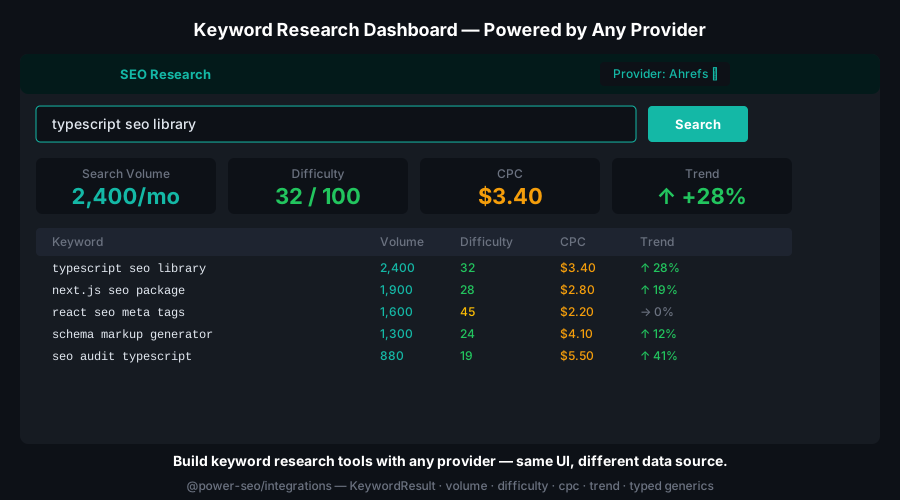
- Keyword research pipelines — pull volume, CPC, and difficulty from Semrush or Ahrefs to prioritize content topics programmatically
- Backlink monitoring — schedule periodic backlink and referring-domain snapshots for link-building tracking
- Competitor analysis — compare domain overview metrics (traffic, keywords, Authority Score, Domain Rating) across competitor domains
- Content brief generation — feed related-keyword and difficulty data into briefs alongside
@power-seo/content-analysis scoring
- SEO reporting dashboards — combine live vendor data with Search Console trends from
@power-seo/analytics and @power-seo/search-console
- Any rate-limited REST integration — reuse
createHttpClient() for internal or third-party JSON APIs that need throttling and retry
Architecture Overview
- Pure TypeScript — no native modules, no compiled binaries
- Runtime dependency:
@power-seo/core only — the token bucket (createTokenBucket), backoff (calculateBackoff), and retry loop (fetchJsonWithRetry) come from the core package; nothing third-party
- Native
fetch transport — works in Node.js 18+, Deno, Bun, Cloudflare Workers, and Vercel Edge; timeouts use AbortController
- Thin vendor adapters — each client maps raw vendor responses (Semrush column codes like
Or, Nq, Kd; Ahrefs snake_case fields) to stable camelCase types; the HTTP concerns live in one place
- Secret-safe errors — response snippets in error messages pass through redaction that strips bearer tokens and API-key-shaped JSON fields before truncating to 200 characters
- Tree-shakeable, dual ESM + CJS —
sideEffects: false, separate named exports, built with tsup
Supply Chain Security
- Published to npm with provenance attestation — every release is built and signed by the verified
github.com/CyberCraftBD/power-seo GitHub Actions workflow, so you can trace each tarball back to its exact source commit
- Zero third-party runtime dependencies — packages depend only on other
@power-seo packages, nothing else gets pulled in
- Network access only when you call it — HTTP requests go exclusively to the APIs you configure (Google Search Console / Semrush / Ahrefs); no telemetry, no phoning home
- No install scripts (
postinstall, preinstall)
- No
eval or dynamic code execution
- Safe for SSR, Edge, and server environments
All 17 packages are independently installable — use only what you need.
@power-seo/ai | npm i @power-seo/ai | LLM-agnostic prompt templates and response parsers for AI-assisted SEO |
@power-seo/analytics | npm i @power-seo/analytics | Merge Search Console data with audit results — trends and ranking insights |
@power-seo/audit | npm i @power-seo/audit | SEO site health auditing with meta, content, structure, and performance rules |
@power-seo/content-analysis | npm i @power-seo/content-analysis | Yoast-style SEO content analysis engine with scoring, checks, and React components |
@power-seo/core | npm i @power-seo/core | Framework-agnostic SEO analysis engines, types, validators, and utilities |
@power-seo/images | npm i @power-seo/images | Image SEO analysis — alt text quality, lazy loading, formats, image sitemaps |
@power-seo/integrations | npm i @power-seo/integrations | Semrush and Ahrefs API clients with a shared rate-limited HTTP client |
@power-seo/links | npm i @power-seo/links | Internal link graph analysis — orphan detection, suggestions, equity scoring |
@power-seo/meta | npm i @power-seo/meta | SSR meta tag helpers for Next.js App Router, Remix v2, and generic SSR |
@power-seo/preview | npm i @power-seo/preview | SERP, Open Graph, and Twitter Card preview generators with React components |
@power-seo/react | npm i @power-seo/react | React SEO components — meta tags, Open Graph, Twitter Card, breadcrumbs |
@power-seo/readability | npm i @power-seo/readability | Readability scoring — Flesch-Kincaid, Gunning Fog, Coleman-Liau, ARI |
@power-seo/redirects | npm i @power-seo/redirects | Redirect rule engine with Next.js, Remix, and Express adapters |
@power-seo/schema | npm i @power-seo/schema | Type-safe JSON-LD structured data — 23 schema.org builders plus React components |
@power-seo/search-console | npm i @power-seo/search-console | Google Search Console API client — OAuth2, service accounts, rate limiting, retry |
@power-seo/sitemap | npm i @power-seo/sitemap | XML sitemap generation, streaming, and validation with image, video, news support |
@power-seo/tracking | npm i @power-seo/tracking | Analytics script builders with consent management and React components |
Keywords
semrush api, ahrefs api, seo api client, keyword research api, backlink api, domain overview, keyword difficulty, keyword volume, rate limiting, token bucket, api pagination, typescript seo, seo data fetching, third-party seo integrations, referring domains, organic keywords, api retry backoff, seo reporting
CyberCraft Bangladesh is a Bangladesh-based enterprise-grade software development and Full Stack SEO service provider company specializing in ERP system development, AI-powered SaaS and business applications, full-stack SEO services, custom website development, and scalable eCommerce platforms. We design and develop intelligent, automation-driven SaaS and enterprise solutions that help startups, SMEs, NGOs, educational institutes, and large organizations streamline operations, enhance digital visibility, and accelerate growth through modern cloud-native technologies.




© 2026 CyberCraft Bangladesh · Released under the MIT License