
Product
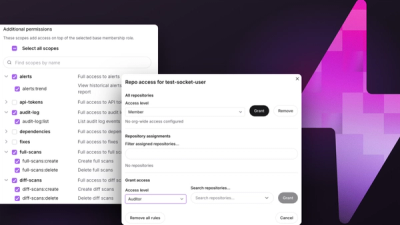
Introducing Repository Access Permissions and Custom Roles
Socket now supports Custom Roles and Repository Access Permissions so organizations can control who can access specific repositories and actions.
By Joe Werle - Jun 19, 2026
@powforge/mcp-identity
Advanced tools
MCP server exposing PowForge Depth-of-Identity oracle to Claude Code, Cursor, and any MCP-compatible agent. Three tools: doi_score_lookup (priced via L402), doi_sign_vouch (unsigned-event builder), doi_score_verify (offline schnorr verification). The Ligh
MCP server exposing the PowForge Depth-of-Identity oracle to Claude Code, Cursor, Continue, and any other Model Context Protocol-compatible agent.
Three tools, Lightning-Network paid, Schnorr-verifiable.
Most agent-auth systems issue a flat verified Y/N JWT. PowForge issues a continuous Depth-of-Identity score (0-100, four dimensions of irreversible work: social, access, vouch, economic) and prices the L402 invoice as a function of the caller's own DoI. High DoI → cheaper. Low DoI → more expensive. The price IS the trust signal.
This MCP package is the agent-side surface for that flow. It speaks to the live oracle at https://identity.powforge.dev/oracle/doi-score and gives MCP-aware clients three composable primitives.
npx -y @powforge/mcp-identity --install
That prints a JSON block ready to paste into your MCP config (e.g. ~/.config/Claude/claude_desktop_config.json):
{
  "mcpServers": {
    "powforge-identity": {
      "command": "npx",
      "args": ["-y", "@powforge/mcp-identity"]
    }
  }
}
Restart your MCP client. The three tools appear automatically.
doi_score_lookupFetch a Depth-of-Identity score for a Nostr pubkey from the PowForge oracle.
Input:
{
  "pubkey": "b4b12dfbc3dfdfa803bb72e344e761dc78db4ec2058c8db3f1c3ac63f9e42b44",
  "auth": {
    "macaroon": "<from prior 402>",
    "preimage": "<lightning preimage after paying invoice>"
  }
}
pubkey accepts either a 64-hex Nostr pubkey or an npub1... bech32 string. auth is optional on the first call — omit it to receive the L402 challenge.
Output (first call, payment required):
{
  "paid": false,
  "challenge": {
    "payment_required": true,
    "macaroon": "...",
    "invoice": "lnbc10n1...",
    "payment_hash": "8f51d2...",
    "price_sats": 1,
    "scope": "identity-score:lookup",
    "next_step": "Pay the bolt11 invoice. Re-invoke this tool with auth: { macaroon, preimage } to receive the signed score."
  }
}
Output (second call, after payment):
{
  "paid": true,
  "envelope": {
    "pubkey": "b4b12d...",
    "composite": 47,
    "rank": "established",
    "depth": {
      "social": { "score": 18, "...": "..." },
      "access": { "score": 12, "...": "..." },
      "vouch": { "score": 9, "...": "..." },
      "economic": { "score": 8, "...": "..." }
    },
    "signed_by": "b4b12d...",
    "signed_at": 1700000000,
    "valid_until": 1700003600,
    "signature": "<128-char hex schnorr>"
  }
}
Why the two-step flow? The MCP server is stateless and key-free by design. It never holds your Lightning credentials. Your wallet handles payment; you pass the preimage back in. This mirrors how lnget works in Lightning Labs' Lightning Agent Tools.
doi_sign_vouchBuild an UNSIGNED kind:33335 PowForge vouch event template. The MCP server intentionally never holds keys — you sign externally (via NIP-07 extension, hardware wallet, or scripts/vouch-publish.js) and publish to relays.
Input:
{
  "target": "<64-hex pubkey of the subject being vouched>",
  "depth": 47,
  "vouch_count": 5,
  "sats": 100,
  "content": "fellow builder"
}
sats and content are optional.
Output:
{
  "unsigned_event": {
    "kind": 33335,
    "created_at": 1700000000,
    "tags": [
      ["p", "<target>"],
      ["depth", "47"],
      ["vouch_count", "5"],
      ["sats", "100"]
    ],
    "content": "fellow builder"
  },
  "instructions": "Sign this event with your Nostr secret key, then publish to relays."
}
doi_score_verifyLocally verify a Schnorr-signed DoI score envelope. No network call. The default oracle pubkey is hardcoded as b4b12dfbc3dfdfa803bb72e344e761dc78db4ec2058c8db3f1c3ac63f9e42b44. Override via oracle_pubkey argument or the ORACLE_PUBKEY env var.
Input:
{
  "envelope": { "...": "the full signed JSON returned by a prior doi_score_lookup" },
  "oracle_pubkey": "<optional override>"
}
Output:
{ "valid": true, "oracle_pubkey": "b4b12d..." }
Or, on failure:
{ "valid": false, "oracle_pubkey": "b4b12d...", "reason": "signature_invalid" }
Reason codes: envelope_not_object, missing_signature, signed_by_mismatch, malformed_signature, malformed_pubkey, signature_invalid, verify_threw: <err>.
Use case: an agent receives a DoI score from a counterparty and wants to confirm the oracle really signed it before pricing/gating their interaction. No round-trip required.
| Var | Default | Purpose |
|---|---|---|
ORACLE_URL | https://identity.powforge.dev | Oracle base URL |
ORACLE_PUBKEY | b4b12d... | Override oracle's schnorr pubkey for verification |
| LiveAuth | @powforge/mcp-identity | |
|---|---|---|
| Identity signal | binary verified Y/N JWT | continuous 0-100 DoI score, four dims |
| Pricing | flat sats | function of caller's own DoI |
| Verification | server-side JWT check | offline schnorr (this package) |
| Vouch graph | none | NIP kind:33335, sqrt-diluted, cycle-detected |
| Open source | not yet (per HN, Mar 2026) | yes (this repo + @powforge/identity) |
| Bitcoin chaintip binding | none | freshness window via signed bitcoin_tip |
@powforge/identity — the SDK that computes DoI scores from raw Nostr events. The oracle wraps this SDK.@powforge/captcha — the human-vs-agent gate that pairs with this oracle for full agent-auth flows.MIT.
FAQs
MCP server exposing PowForge Depth-of-Identity oracle to Claude Code, Cursor, and any MCP-compatible agent. Three tools: doi_score_lookup (priced via L402), doi_sign_vouch (unsigned-event builder), doi_score_verify (offline schnorr verification). The Ligh
The npm package @powforge/mcp-identity receives a total of 17 weekly downloads. As such, @powforge/mcp-identity popularity was classified as not popular.
We found that @powforge/mcp-identity demonstrated a healthy version release cadence and project activity because the last version was released less than a year ago. It has 1 open source maintainer collaborating on the project.
Did you know?

Socket for GitHub automatically highlights issues in each pull request and monitors the health of all your open source dependencies. Discover the contents of your packages and block harmful activity before you install or update your dependencies.
Product
Socket now supports Custom Roles and Repository Access Permissions so organizations can control who can access specific repositories and actions.
Product
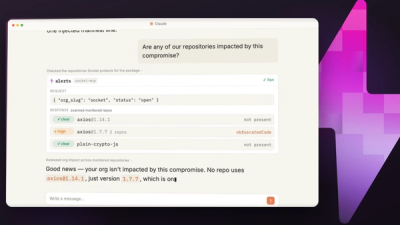
Socket MCP now lets AI assistants review org alerts, investigate threats using the Socket threat feed, and inspect package files in addition to dependency scoring.
Product
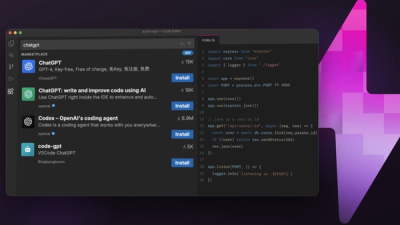
Socket Firewall blocks malicious VS Code and Open VSX extensions before install, protecting developers from compromised editor marketplaces.