

Security News
Risky Biz Podcast: AI Agents Are Raising the Stakes for Software Supply Chain Security
Open source attacks are accelerating as AI coding agents pull in dependencies faster, with less human review.
By Sarah Gooding - Jun 30, 2026
@primitivedotdev/cli
Advanced tools
Official Primitive CLI: deploy Primitive Functions, send and inspect mail, manage endpoints, all from the terminal. Wraps the @primitivedotdev/sdk runtime client with one-shot commands.
Official Primitive CLI. Deploy Primitive Functions, send and inspect mail, manage endpoints, all from the terminal.
brew install primitivedotdev/tap/primitive
primitive whoami
Or with npm:
npm install -g @primitivedotdev/cli
primitive whoami
# `prim` is installed as a short alias for the same CLI.
prim whoami
The same CLI is also published unscoped as primcli. npm install -g primcli installs an identical build with the same primitive/prim commands. Use whichever name you prefer; they track the same version.
Or with no install:
npx @primitivedotdev/cli@latest <command>
This package wraps the @primitivedotdev/sdk runtime client with one-shot commands. For in-handler use (calling Primitive from inside a Function), import createPrimitiveClient from @primitivedotdev/sdk/api directly; the CLI is for operator and deploy workflows.
primitive signin
primitive whoami
primitive functions templates
primitive functions init my-fn
cd my-fn && npm install && npm run build
primitive functions deploy --name my-fn --file ./dist/handler.js

primitive send --to alice@example.com --body "Hello!" --wait
primitive emails latest --limit 5
Run primitive --help for the full command list. Per-command help (primitive functions deploy --help) carries enough detail that an agent can compose any operation without leaving the terminal.
Use primitive signin or primitive login for existing accounts. With no email, both use browser approval; primitive signin browser and primitive login browser are the explicit browser forms.
Use primitive signin <email> --signup-code <code> --accept-terms, then primitive signin confirm <email> <code> for email-code sign-in. primitive login <email> and primitive otp <email> support the same email-code flow with matching confirm and resend subcommands.
Use primitive logout --force to remove local CLI credentials, pending email-code auth state, and stale credential locks without contacting Primitive. This is the recovery command when an interrupted auth command leaves the CLI saying another credential operation is already in progress.
Use primitive signup <email> for new account creation, then primitive signup confirm <email> <code> with the emailed verification code. Non-interactive signup is available with --accept-terms (pass --signup-code <code> too if you have one).
Use task-oriented commands for normal workflows:
primitive send --to alice@example.com --body "Hello"
primitive reply --id <inbound-email-id> --body "Thanks"
primitive reply --id <inbound-email-id> --body "See attached" --attachment ./report.pdf
primitive chat reply "See attached" --attachment ./report.pdf
primitive emails list
primitive emails get --id <inbound-email-id>
primitive sent list
primitive domains list
primitive functions templates
primitive functions init my-fn --template email-reply
primitive functions logs --id <function-id>
primitive deliveries replay --id <delivery-id>
Generated API commands remain available for compatibility and full schema parity, for example primitive emails:list-emails and primitive sending:reply-to-email.
The primitive payments command group drives non-custodial x402 USDC payments. One agent registers a payout address and requests a payment; the paying agent signs locally with its own wallet key and settles. The key never leaves your machine. Networks are base and base-sepolia. Amounts take a human USDC value (--amount-usdc 0.01) or token base units (--amount 10000, since USDC has 6 decimals). Your org is resolved automatically from your API key, so payout registration takes no org flag.
# Payee, one time: register the default address your org is paid at. Signs an
# ownership message locally with your wallet key. Org is auto-resolved.
primitive payments register-payout-address --network base-sepolia --label treasury

# Payee: request a payment with a human USDC amount. Prints a summary by default.
primitive payments charge --network base-sepolia --amount-usdc 0.01
# Capture the raw challenge JSON to hand to the payer.
primitive payments charge --network base-sepolia --amount-usdc 0.01 --json > challenge.json

# Payer: sign and settle the challenge locally. Reads the challenge inline,
# from a file, or piped on stdin.
primitive payments pay --challenge-file challenge.json
cat challenge.json | primitive payments pay

# Email-native flow: the payee issues a challenge over an email thread.
# Note: create-email-challenge takes --amount in token base units only; unlike
# `charge` it has no --amount-usdc. USDC has 6 decimals, so multiply by
# 1,000,000: 0.01 USDC is --amount 10000.
primitive payments create-email-challenge --from payee@your-domain.example \
  --to payer@their-domain.example --amount 10000 --network base-sepolia
# Payer: sign a received email challenge into an interaction.json payment step.
# This does NOT send; attach the output to your reply (e.g. with `primitive reply`).
primitive payments pay-email-step --challenge-file challenge.json > interaction.json

# Inspect a challenge by id, or list your registered payout addresses.
primitive payments get-challenge --id <challenge-id>
primitive payments list-payout-addresses

# Read and update the org spend policy (kill-switch, per-payment and daily caps,
# payee allowlist). The update merges: omitted fields keep their value.
primitive payments get-spend-policy
primitive payments update-spend-policy --max-per-payment 5000000
charge is the friendly verb that matches the SDK charge and accepts --amount-usdc; create-challenge is the lower-level command that takes base-unit --amount. Either creates a challenge. The signing commands print a human-readable summary by default; pass --json for raw JSON suitable for piping.
The two signing commands (register-payout-address and pay) need your wallet key. Set it in PRIMITIVE_X402_PRIVATE_KEY (a 0x-prefixed hex private key) so it never lands in shell history or the process list:
export PRIMITIVE_X402_PRIVATE_KEY=0x...
A hidden --private-key flag is available as an escape hatch for scripted use, but the environment variable is preferred. The non-signing commands (charge, get-challenge, list-payout-addresses, get-spend-policy, update-spend-policy) need only your Primitive API key. Run primitive payments <command> --help for the full flag list of any command.
@primitivedotdev/sdk CLIThe CLI previously shipped inside @primitivedotdev/sdk. The shipped surface area is identical; only the package name changes.
| Before | After |
|---|---|
npm install -g @primitivedotdev/sdk | npm install -g @primitivedotdev/cli |
npx @primitivedotdev/sdk@latest <cmd> | npx @primitivedotdev/cli@latest <cmd> |
@primitivedotdev/sdk continues to ship the runtime SDK (webhook, API client, contract, parser, openapi). Use it in your application code; use @primitivedotdev/cli in your shell and CI.
MIT
FAQs
Official Primitive CLI: deploy Primitive Functions, send and inspect mail, manage endpoints, all from the terminal. Wraps the @primitivedotdev/sdk runtime client with one-shot commands.
The npm package @primitivedotdev/cli receives a total of 3,823 weekly downloads. As such, @primitivedotdev/cli popularity was classified as popular.
We found that @primitivedotdev/cli demonstrated a healthy version release cadence and project activity because the last version was released less than a year ago. It has 2 open source maintainers collaborating on the project.
Did you know?

Socket for GitHub automatically highlights issues in each pull request and monitors the health of all your open source dependencies. Discover the contents of your packages and block harmful activity before you install or update your dependencies.
Security News
Open source attacks are accelerating as AI coding agents pull in dependencies faster, with less human review.
Research
/Security News
Malicious Chrome and Firefox extensions posed as free VPNs while stealing clipboard data through later extension updates.
Research
/Security News
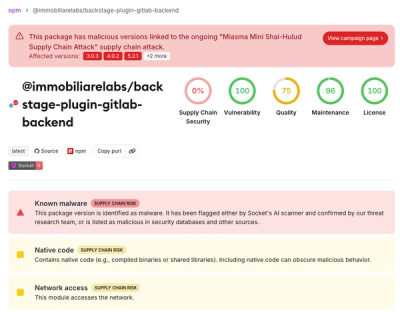
Miasma Mini Shai-Hulud hits @immobiliarelabs Backstage plugins, targeting GitLab and LDAP auth packages on npm.