
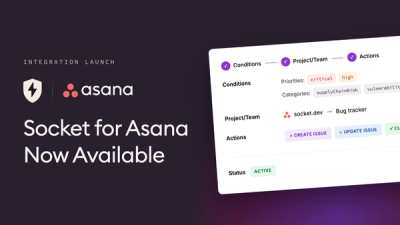
Product
Socket for Asana Is Now Available
Create and manage Asana tasks directly from Socket alerts, with manual task creation, automated ticketing rules, and two-way sync.
By Jeppe Hasseriis - Aug 25, 2026
@prismnetwork/agent-sdk
Advanced tools
Headless GPU leasing and renter-encrypted storage on Prism Network for wallet-holding agents.
Headless GPU leasing on Prism Network for autonomous agents. No browser, no Privy. An agent authenticates with a wallet signature, pays on-chain in USDG, and gets SSH access to a GPU.
npm install @prismnetwork/agent-sdk viem
viem is a peer dependency.
import { PrismAgent, DEFAULT_IMAGE } from "@prismnetwork/agent-sdk";

const agent = new PrismAgent({
  privateKey: process.env.AGENT_KEY,        // agent's wallet
  escrow: "0x62C042265991bEa17B07229322A01850974626dA",
});

await agent.authenticate();
const lease = await agent.lease({ image: DEFAULT_IMAGE, durationSeconds: 900, minVramMib: 16000 });
const out = await agent.run(lease, "nvidia-smi");
console.log(out.stdout);
agent.endLease(lease);
image must be an immutable digest-pinned reference (repo@sha256:...). DEFAULT_IMAGE is one; a plain tag is rejected.
@prismnetwork/agent-sdk/toolset exports PrismToolset, the framework-neutral
tool surface the MCP server and the framework plugins (elizaOS, Virtuals GAME)
wrap: wallet, listGpus, leaseAndRun, run, endLease, each returning a
human-readable string. It holds the wallet, the open leases and the per-lease
spending cap in one place, reads PRISM_AGENT_KEY/PRISM_ESCROW from the
environment by default, and answers the read-only questions from the public API
when no wallet is configured.
Cards, identity documents, API credentials and recovery codes go in the vault rather than on a leased box. Items are sealed here, on your machine, under a key derived from a wallet signature that is never transmitted, so Prism stores ciphertext and holds no way to read it.
await agent.vault.unlock();

const card = await agent.vault.put({ pan: "4111111111111111" }, { label: "billing" });
const value = await agent.vault.get(card.item_id, { json: true });
unlock() derives the key from a signature over a fixed statement. Ethereum's
ECDSA is deterministic, so the same wallet reproduces the same vault on any
machine — no recovery copy is held anywhere. Pass { passphrase } to require a
second factor beyond the wallet.
Every item carries the weakest workspace trust class it may ever be released
into. New items default to confidential, which is above anything the network
serves today, so releaseInto refuses rather than exposing a secret to a host
that can read it:
await agent.vault.releaseInto(lease, card.item_id, { json: true }); // throws on open capacity
Lowering an item's floor is deliberate and reseals the item. Allowed releases
are recorded and readable with agent.vault.releases().
The account, item slot, version and trust floor are authenticated into the ciphertext, so a service that moved an item between accounts, replayed an older version, or lowered its floor would produce a failed decrypt rather than a plausible wrong answer. See docs/VAULT.md.
A lease destroys its machine, so training output, checkpoints and a working directory need somewhere that outlives it. A workspace is that place: the SDK archives a directory off the leased box, seals it here under a key derived from your wallet, and uploads the ciphertext straight to object storage. Prism records the version, the size and the hash, and holds nothing that opens it.
await agent.workspace.unlock();

const ws = await agent.workspace.create("finetune-run");
const saved = await agent.workspace.save(lease, ws, "/root/out");

// On a later lease, onto a fresh machine.
await agent.workspace.restore(next, ws, "/root/out", { expectVersion: saved.version });
The workspace key comes from a different statement and a different salt than
the vault's, so opening one does not open the other. Pass { passphrase } to
require a second factor beyond the wallet.
A restore hashes the downloaded ciphertext and compares it to the digest recorded at save time before it decrypts anything, so bytes altered in storage are reported as tampering rather than as a wrong key. The account, workspace, version and trust floor are authenticated into the ciphertext, so a snapshot served for the wrong workspace, or under a floor that has been rewritten, fails to open rather than returning a plausible wrong answer.
An older snapshot is a different case worth being precise about: its own
associated data is genuine for its own version, so it decrypts cleanly and
nothing in the ciphertext gives it away. A restore therefore compares the
version it was granted against the version the record says is current, and
refuses a rollback on that basis. Pass expectVersion to pin a specific one,
and expectTrustClass to refuse a floor that has moved.
A restore names the lease it is landing on, and Prism refuses to issue the download at all when that lease's trust class is below the workspace's floor. The check is server-side deliberately: a client-side one would be a courtesy that a modified client could skip.
Bulk data never passes through Prism. Uploads and downloads use presigned URLs
that live fifteen minutes, and they are used from your process, never handed to
the leased machine. The machine only ever sees tar and base64, which is all
this needs from it.
Snapshots travel over the lease's SSH channel, which caps a single save at 64
MiB of archive; a larger directory is refused on the machine before anything is
transferred. New workspaces default to the open trust floor, unlike vault
items: their contents are the files you are already handing to a rented box.
Raise it at creation when they deserve more:
await agent.workspace.create("model-weights", { minTrustClass: "isolated" });
authenticate() fetches a challenge (GET /api/agent/challenge), signs the message with the wallet, and exchanges it for a session (POST /api/agent/session). The session is a bearer token used on every /api/agent/proxy/* call. No shared secret, no cookie. The wallet is the identity (subject = wallet:0x...).
lease() (and the lower-level fund()) reproduce the escrow's quote binding: clientReference = keccak256(quote_id), approve(escrow, maximum_escrow), then createLease(...), waiting 12 confirmations.
The wallet needs two balances on Robinhood Chain (id 4663): USDG (0x5fc5360D0400a0Fd4f2af552ADD042D716F1d168, 6 decimals) for the lease deposit, and native ETH for gas. Bridge from L1 to fund a fresh wallet. authenticate(), offers(), and quote() need neither, so the read paths work before you fund anything.
Node >= 20, viem ^2 (peer), and ssh + ssh-keygen on PATH for run() and
for workspace save and restore.
See example.mjs for a full run.
FAQs
Headless GPU leasing and renter-encrypted storage on Prism Network for wallet-holding agents.
We found that @prismnetwork/agent-sdk demonstrated a healthy version release cadence and project activity because the last version was released less than a year ago. It has 1 open source maintainer collaborating on the project.
Product
Create and manage Asana tasks directly from Socket alerts, with manual task creation, automated ticketing rules, and two-way sync.
Security News
Open VSX has removed three extension IDs from its malicious-extension list as the legitimate publishers they impersonated move to claim the names for themselves.
Product
Socket’s PHP and Composer support is now in Beta for all customers, with PHP reachability analysis generally available.