
Research
/Security News
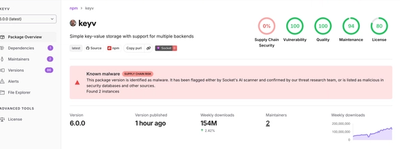
Popular npm Packages in the keyv and Cacheable Namespaces Compromised in Active Supply Chain Attack
Popular npm packages keyv and cacheable compromised.
By Socket Research Team - Aug 04, 2026
@quantakrypto/mcp
Advanced tools
quantakrypto MCP — post-quantum readiness for AI coding agents via the Model Context Protocol. Zero runtime dependencies (stdio JSON-RPC implemented in-house).
A Model Context Protocol (MCP) server that gives AI coding agents post-quantum
readiness superpowers. It scans code for classical (quantum-vulnerable) asymmetric
cryptography and recommends NIST post-quantum / hybrid migrations, all backed by
@quantakrypto/core.
node:readline, node:http, node:process).
The only dependency is @quantakrypto/core.stdio transport (the quantakrypto-mcp bin) for local agents
like Claude, and a hostable http transport for running quantakrypto as a remote
service (see HOSTING.md). quantakrypto also runs a hosted,
OAuth-gated instance at mcp.quantakrypto.com
you can connect to directly — see Hosted HTTP server.McpServer class; transports only do I/O.The published package exposes a quantakrypto-mcp binary that speaks MCP over stdio:
# Claude Code / Claude Desktop
claude mcp add quantakrypto npx @quantakrypto/mcp
Equivalently, in an MCP client config:
{
  "mcpServers": {
    "quantakrypto": {
      "command": "npx",
      "args": ["@quantakrypto/mcp"]
    }
  }
}
The bin is quantakrypto-mcp (→ dist/stdio.js). You can also run it directly:
node dist/stdio.js
MCP stdio transport is newline-delimited JSON: exactly one JSON-RPC 2.0
message per line on stdin/stdout (this is not HTTP-style Content-Length
framing). Supported methods:
| Method | Notes |
|---|---|
initialize | Replies with protocolVersion, capabilities.tools.listChanged = false, and serverInfo { name: "quantakrypto", version }. |
notifications/initialized | Notification; no response. |
ping | Replies {}. |
tools/list | Lists all tools with JSON-Schema inputSchema. |
tools/call | Runs a tool, returns { content: [...], isError? }. |
Unknown methods return JSON-RPC error -32601; bad params return -32602;
unparseable input returns -32700; non-request objects return -32600.
Each tool returns MCP content: { content: [{ type: "text", text }], isError? }.
scan_pathScan a file or directory for quantum-vulnerable cryptography.
{
  "type": "object",
  "properties": {
    "path":   { "type": "string", "description": "Path to scan." },
    "format": { "type": "string", "enum": ["summary", "json"] }
  },
  "required": ["path"]
}
Returns a readiness summary (or the raw ScanResult JSON when format: "json").
inventory_cryptoProduce a 0–100 readiness score plus counts by algorithm, category, and severity.
{
  "type": "object",
  "properties": { "path": { "type": "string" } },
  "required": ["path"]
}
explain_findingExplain a finding and its remediation. Provide a ruleId, an algorithm, or both.
{
  "type": "object",
  "properties": {
    "ruleId":    { "type": "string" },
    "algorithm": { "type": "string", "description": "RSA, ECDH, ECDSA, …" }
  }
}
suggest_hybridRecommend a PQC / hybrid migration from an algorithm or free-text context.
{
  "type": "object",
  "properties": {
    "algorithm": { "type": "string" },
    "context":   { "type": "string" }
  }
}
list_rulesList the quantakrypto detector catalog (ids + descriptions). No input.
{ "type": "object", "properties": {} }
generate_cbomScan a path and emit a CycloneDX 1.6 Cryptographic Bill of Materials (CBOM)
of the classical cryptographic assets found, for compliance / supply-chain
tooling. Reads the filesystem, so it is gated like scan_path over HTTP.
{
  "type": "object",
  "properties": { "path": { "type": "string" } },
  "required": ["path"]
}
These let an AI coding agent do a PQC migration through the deterministic engine ("the model proposes, the engine disposes"): the agent plans, edits, and re-verifies against the same detectors the CLI uses, so nothing is claimed fixed that the scanner still flags.
plan_migration — scan a path and return a prioritized, phased plan
(harvest-now-decrypt-later first, then signatures, then transport/certs), each
group with its PQC target and locations. Reads the filesystem, so it is gated
like scan_path over HTTP. { path }.get_fix_examples — before/after migration code for a classical
algorithm (or a finding's ruleId). No filesystem access.verify_fix — run the detectors over a code snippet (plus language or
filename) and report any classical crypto that remains. The agent's
fix-confirmation loop. No filesystem access.check_dependency — look a package name (+ ecosystem, default npm) up
in the vulnerable-dependency database. No filesystem access.score_delta — readiness-score / HNDL change between two finding sets
(before, after from scan_path --format json). No filesystem access.triage_findings — deterministic, offline, key-free. Emits a triage
REQUEST bundle (rubric + verdict schema + per-finding metadata + fingerprints)
for the host agent to reason over. It never calls a model. No filesystem access.apply_triage — deterministically attach the host agent's verdicts to
their findings (matched by fingerprint) and re-sort by exposure. Never
suppresses; malformed verdicts are ignored. No filesystem access.remediate_findings — deterministic, offline, key-free. Emits a fix
REQUEST bundle (rubric + fix schema + per-finding metadata + fingerprints) for
the host agent to fix: propose the corrected file, verify with verify_fix,
keep only verified fixes. Never merges. No filesystem access.Triage on the MCP plane keeps the "engine disposes" guarantee: the server stays offline and never holds an API key — the host agent (which already has the code open) does the reasoning, and
apply_triagerecords it deterministically. The BYOK client that calls a provider directly lives only inqscan --triage(for CI, where there is no host agent).
Beyond tools, the server exposes MCP resources and a prompt (advertised in
the initialize capabilities, all offline/static):
resources/list + resources/read — quantakrypto://rules (the full rule
catalog as JSON) and quantakrypto://guide/migration (a Markdown migration guide).prompts/list + prompts/get — the migrate prompt (optional path arg): a
ready-made "scan → triage → remediate → verify, draft PR only" workflow.Just want to use it? quantakrypto runs a hosted, OAuth-gated instance at
https://mcp.quantakrypto.com/mcp— no install, no token to manage:claude mcp add --transport http quantakrypto https://mcp.quantakrypto.com/mcpIt signs you in (Google / GitHub / email) and issues a 30-day token. Being multi-tenant, it exposes only the content-based tools — the filesystem/network tools (
scan_path,inventory_crypto,generate_cbom,plan_migration,probe_endpoint) are withheld; run the MCP locally for those. Source and ops:quantakrypto/mcp-gateway. The rest of this section is for running the package's ownhttp.tsyourself.
The same McpServer can be served over HTTP (a Streamable-HTTP-style JSON-RPC
endpoint) for remote deployments. The stdio transport trusts the local user and
is fully featured; the HTTP transport is hardened, because a hosted endpoint
is reachable by untrusted peers:
127.0.0.1 by default (not 0.0.0.0). Override via
QUANTAKRYPTO_MCP_HOST. Binding to a non-loopback host without a token is refused
at startup (it would be an open, unauthenticated tool relay).QUANTAKRYPTO_MCP_TOKEN and every /mcp request must
send Authorization: Bearer <token>, else 401. With no token set, only the
loopback bind is allowed.scan_path, inventory_crypto,
generate_cbom and plan_migration read arbitrary server paths, so over HTTP
they are exposed only when QUANTAKRYPTO_MCP_ALLOW_FS=1. The knowledge /
copilot tools that take no path (explain_finding, suggest_hybrid,
list_rules, get_fix_examples, verify_fix, check_dependency,
score_delta, triage_findings, apply_triage, remediate_findings) are
always available. tools/list and tools/call both reflect the gating.probe_endpoint (active
TLS/SSH probing) is the only tool that opens a socket. Over HTTP it is exposed
only when QUANTAKRYPTO_MCP_ALLOW_NETWORK=1 — a hosted server should not probe
arbitrary hosts. On the local stdio transport it is always available. It still
requires the per-call ownership attestation (i_own_this=true) and refuses
ranges/CIDRs regardless of transport.QUANTAKRYPTO_MCP_ALLOW_FS=1,
every scanned path must resolve inside the QUANTAKRYPTO_MCP_ROOT allow-list
(:-separated; the process CWD by default). .. traversal and out-of-root
absolute paths (e.g. /etc/passwd) are rejected — the server is not an
arbitrary-file-read oracle.POST /mcp rejects a browser request whose Origin
host is not loopback (or allow-listed via QUANTAKRYPTO_MCP_ALLOW_ORIGIN),
defending the default no-token loopback config against DNS-rebinding /
localhost-CSRF. Non-browser clients (no Origin) are unaffected.413 only on the cap,
400 on a transport error), a per-request tool timeout that aborts the
underlying scan (QUANTAKRYPTO_MCP_TIMEOUT_MS, default 30000 → 504), a
response-size cap (QUANTAKRYPTO_MCP_MAX_RESPONSE_BYTES, default 4 MiB), and
per-scan work budgets (QUANTAKRYPTO_MCP_MAX_FILES / QUANTAKRYPTO_MCP_MAX_BYTES)
so a single call cannot exhaust host resources.| Env var | Default | Purpose |
|---|---|---|
QUANTAKRYPTO_MCP_HOST (or HOST) | 127.0.0.1 | Bind interface. Non-loopback requires a token. |
PORT | 3000 | Listen port. |
QUANTAKRYPTO_MCP_TOKEN | (unset) | When set, requires Authorization: Bearer <token>. |
QUANTAKRYPTO_MCP_ALLOW_FS | (off) | 1/true exposes the filesystem tools over HTTP. |
QUANTAKRYPTO_MCP_ALLOW_NETWORK | (off) | 1/true exposes the networked probe_endpoint tool over HTTP. |
QUANTAKRYPTO_MCP_ROOT | (cwd) | :-separated allow-list of directories the FS tools may scan. |
QUANTAKRYPTO_MCP_ALLOW_ORIGIN | (loopback) | Comma-separated extra Origin hosts allowed on /mcp. |
QUANTAKRYPTO_MCP_TIMEOUT_MS | 30000 | Per-request deadline; aborts the in-flight scan on timeout. |
QUANTAKRYPTO_MCP_MAX_RESPONSE_BYTES | 4194304 | Response-body size cap. |
QUANTAKRYPTO_MCP_MAX_FILES | 25000 (cap 250000) | Max files a single scan may read. |
QUANTAKRYPTO_MCP_MAX_BYTES | 268435456 (cap 2 GiB) | Max cumulative bytes a single scan may read. |
# Local, knowledge tools only (default safe posture)
node dist/http.js

# Local with the filesystem tools enabled
QUANTAKRYPTO_MCP_ALLOW_FS=1 node dist/http.js

# Reachable from the network: a token is mandatory
QUANTAKRYPTO_MCP_HOST=0.0.0.0 QUANTAKRYPTO_MCP_TOKEN="$(openssl rand -hex 32)" node dist/http.js
Endpoints:
POST /mcp — one JSON-RPC 2.0 message; the JSON-RPC response is the
application/json body. Notifications get 202 with no body. An
mcp-session-id header is echoed or minted on each request.GET /health — liveness probe returning { "status": "ok" } (no auth).curl -s localhost:3000/health
curl -s localhost:3000/mcp \
-H 'content-type: application/json' \
-H 'authorization: Bearer YOUR_TOKEN' \
-d '{"jsonrpc":"2.0","id":1,"method":"tools/list"}'
See HOSTING.md for the full production design (auth, multi-tenant
sessions, rate limiting, scaling). A sample request/response transcript lives in
examples/transcript.jsonl.
import { createQuantakryptoServer } from "@quantakrypto/mcp";

const server = createQuantakryptoServer();
const res = await server.handle({ jsonrpc: "2.0", id: 1, method: "tools/list" });
npm run build   # tsc -b
npm test        # node --import tsx --test test/*.test.ts
Tests drive McpServer.handle directly (and the stdio loop via in-memory
streams) — no process spawning.
Apache-2.0
Questions, commercial support, or post-quantum readiness training for your team — visit quantakrypto.com or email hello@quantakrypto.com.
FAQs
quantakrypto MCP — post-quantum readiness for AI coding agents via the Model Context Protocol. Zero runtime dependencies (stdio JSON-RPC implemented in-house).
We found that @quantakrypto/mcp demonstrated a healthy version release cadence and project activity because the last version was released less than a year ago. It has 1 open source maintainer collaborating on the project.
Did you know?

Socket for GitHub automatically highlights issues in each pull request and monitors the health of all your open source dependencies. Discover the contents of your packages and block harmful activity before you install or update your dependencies.
Research
/Security News
Popular npm packages keyv and cacheable compromised.

Security News
A misconfiguration gave three Anthropic models internet access, and one, believing it was in a simulation, shipped a credential-stealing package to PyPI.

Security News
/Company News
Socket has joined the new Composer and Packagist sponsorship program as a launch sponsor, supporting the team that keeps PHP's package ecosystem secure.