

Product
PHP and Composer Support Is Now in Beta
Socket’s PHP and Composer support is now in Beta for all customers, with PHP reachability analysis generally available.
By Trevor Norris, Benjamin Barslev - Aug 21, 2026
@quantakrypto/qscan
Advanced tools
qScan — find quantum-vulnerable cryptography in any codebase (CLI). Zero runtime dependencies.
Find quantum-vulnerable cryptography in any codebase.
qscan walks a project and reports where it relies on classical asymmetric
cryptography (RSA, (EC)DH, ECDSA, EdDSA, DSA, …) — the algorithms broken by a
sufficiently large quantum computer, and the ones exposed to harvest-now,
decrypt-later (HNDL) attacks today. It scans source files, dependency
manifests, and configuration, then prints a readiness score and a concrete next
step.
@quantakrypto/core.human (default), json, SARIF 2.1.0 for code-scanning
dashboards, a CycloneDX 1.6 CBOM for compliance tooling, an ISO 27001
A.8.24 evidence report, and an OpenVEX 0.2.0 document for VEX pipelines.--parallel) and
git-aware incremental scanning (--changed).Inline crypto detection currently covers JavaScript/TypeScript, Python,
Go, Java/Kotlin/Scala (JCA + BouncyCastle), C#/.NET, Rust, Ruby,
PHP (openssl / phpseclib3 / libsodium), Elixir (:crypto / X509 / JOSE),
C/C++ (OpenSSL, Mbed TLS, wolfSSL), Swift (CryptoKit / Security),
Objective-C (Security SecKey*), and Dart/Flutter (pointycastle /
cryptography), and smart contracts (Solidity/Move/Cairo on-chain
signature verification) source — 14 languages. PEM key material, SSH keys (including
SSH-CA certificates), TLS/certificate config, reverse-proxy/gRPC TLS, WebAuthn/FIDO2,
code-signing, weak signature hashes (SHA-1/MD5), DKIM, SPIFFE/SPIRE, and dependency
manifests for seven ecosystems — npm (plus yarn.lock / pnpm-lock.yaml),
PyPI, Cargo, Go modules, Maven, RubyGems, and NuGet — are detected in any
file regardless of language.
qScan is honest about coverage: if a scan walks files but finds none in a
supported source language, it says so and will not present a bare 100/100
as a clean bill of health — the crypto may simply live in a language it can't
read yet. Always check the analyzed count in the report before relying on the
score.
npm install -g @quantakrypto/qscan
# or run without installing
npx @quantakrypto/qscan .
Requires Node ≥ 20.
qscan [path] [options]
path defaults to the current directory (.).
| Flag | Description | Default |
|---|---|---|
--format <human|json|sarif|cbom|evidence|vex> | Output format. | human |
--cbom | Alias for --format cbom (CycloneDX 1.6 CBOM). | — |
-o, --output <file> | Write the report to a file instead of stdout. | stdout |
--severity-threshold <level> | Exit 1 if any finding is at/above this level. One of critical, high, medium, low, info. | high |
--no-source | Skip scanning source files for inline crypto. | scan on |
--no-deps | Skip scanning dependency manifests. | scan on |
--no-config | Skip scanning config files (TLS/certificates). Toggles config detectors — not the config file below. | scan on |
--config <path> | Use this quantakrypto.config.json instead of auto-discovering one at the scan root. | auto |
--no-config-file | Disable quantakrypto.config.json auto-discovery. | discovery on |
--ignore <pattern> | Exclude paths matching <pattern>. Repeatable. | — |
--include <pattern> | Restrict the scan to paths matching <pattern>. Repeatable. | all files |
--max-file-size <bytes> | Skip files larger than <bytes>. | 2 MiB |
--no-default-ignores | Don't skip node_modules/.git/dist by default. | ignores on |
--scan-minified | Scan minified/generated/bundled files too. | skipped |
--changed | Incremental: scan only files git reports as changed. | off |
--since <git-ref> | With --changed, diff against <git-ref> (implies --changed). | working tree |
--parallel | Scan using a worker-thread pool when the workload is large enough. | off |
--concurrency <n> | Worker count for --parallel (implies --parallel). 0/1 forces serial. | CPU count |
--audit | Opt-in supply-chain checks (see below): dependency advisories via each ecosystem's own audit tool, plus a declared-source-repository (provenance) check. Findings merge into the report and the exit code; a missing tool or network hiccup degrades to a stderr diagnostic. | off |
--triage | BYOK LLM pass that re-ranks findings by real exposure and explains them. Never suppresses; never changes the exit code. Needs an API key. | off |
--triage-floor <level> | With --triage, only triage findings at/above this level. | medium |
--context <level> | How much source is shared with the LLM: metadata, snippet, function, file (secrets always redacted). | snippet |
--dry-run | With --triage, print the exact payload that would be sent and exit without contacting the provider. | off |
--llm-provider <name> | BYOK provider: anthropic or openai-compatible. | anthropic |
--llm-model <id> | Model id for the BYOK provider. | provider default |
--baseline <file> | Suppress findings whose fingerprint is in the baseline file. | — |
--write-baseline <file> | Write current findings as a baseline, then exit 0. | — |
--quiet | Suppress the human summary banner. | off |
-v, --version | Print version and exit. | — |
-h, --help | Print help and exit. | — |
| Code | Meaning |
|---|---|
0 | No findings at/above the threshold — or a baseline was written. |
1 | One or more findings at/above the severity threshold. |
2 | Usage error or I/O failure. |
quantakrypto.config.json)qScan auto-discovers a quantakrypto.config.json at the scan root and applies it
under a strict precedence: CLI flags > config file > built-in defaults
(per-key). It encodes include / exclude / maxFileSize / noDefaultIgnores
/ scanMinified, the detector-family toggles, severityThreshold, and a
baseline path so CI and local runs share one policy. Point at a file elsewhere
with --config <path>, or disable discovery with --no-config-file. See
docs/CONFIG.md for the full schema.
qScan — quantum-vulnerable cryptography report
root: ./examples/vulnerable-app  •  files scanned: 2  •  qscan v0.5.0

3 findings  (2 high, 1 medium)
2 exposed to harvest-now-decrypt-later (HNDL).
Readiness score: 70/100

Top findings
  high     rsa-keygen      src/crypto.js:5
           RSA is not quantum-safe.
           → Use ML-KEM-768 (hybrid X25519MLKEM768).
  high     dep-vulnerable  package.json:7
           Dependency "node-forge" provides classical asymmetric crypto.
  medium   ecdh-usage      src/crypto.js:13
           ECDH is not quantum-safe.
           → Use a hybrid KEM (X25519MLKEM768).

Next step: migrate src/crypto.js — Use ML-KEM-768 (hybrid X25519MLKEM768).
Color is emitted only when writing the human format to an interactive terminal
(and is suppressed by the NO_COLOR environment variable). Reports written to a
file or piped are always plain text.
A baseline records the fingerprints of findings you have already triaged.
qScan uses the canonical baseline shared across the whole monorepo
(@quantakrypto/core, the GitHub Action, and this CLI): a single on-disk format and a
single fingerprint algorithm, so a baseline written by one tool is understood by
the others.
A fingerprint is a full SHA-256 of ruleId|file|normalizedSnippet. It is
deliberately line-insensitive — unrelated edits that shift line numbers no
longer invalidate it — and the snippet's whitespace is normalized so
reformatting doesn't either. It ignores volatile fields like severity wording or
timestamps.
# 1. Accept the current state of the world.
qscan . --write-baseline qscan-baseline.json

# 2. From now on, fail only on findings that are NOT in the baseline.
qscan . --baseline qscan-baseline.json
The baseline file is plain JSON:
{
  "version": 1,
  "fingerprints": [
    "0f1e2d3c4b5a...full-sha256...",
    "a1b2c3d4e5f6...full-sha256..."
  ]
}
In CI you usually only care about what a change introduced. --changed restricts
the scan to the files git reports as modified, which is a large win on big repos:
# Files modified in the working tree (staged, unstaged, and untracked).
qscan . --changed

# Everything that changed since a base ref (e.g. a PR base).
qscan . --changed --since origin/main
Outside a git work tree the changed-file list is empty (nothing is scanned), rather than an error.
For large trees, route the scan through a worker-thread pool. qScan automatically
stays serial for small inputs, so --parallel is safe to leave on:
qscan . --parallel               # auto worker count (CPU cores)
qscan . --concurrency 4          # pin the worker count (implies --parallel)
--audit, opt-in)--audit layers three supply-chain checks on top of the normal scan. It is
opt-in because two of them shell out (dependency advisories) or make a network
request (provenance); a default qscan . stays offline. Every check degrades
gracefully — a missing tool, an unparseable output, or a network hiccup becomes
a qscan: audit: … diagnostic on stderr, never a hard failure. Any findings it
does produce merge into the report and the exit code, so a known-vulnerable
dependency can gate CI.
qscan . --audit                       # add advisory + provenance checks
qscan . --audit --format sarif -o qscan.sarif
Dependency advisories. For each ecosystem present at the scan root, qScan
runs that ecosystem's own audit tool and turns its advisories into
dependency findings (ruleId: dep-advisory, severity from the advisory,
<pkg>@<ver>: <summary> (<ID>), remediation = the patched version):
Cargo.toml / Cargo.lock → cargo audit --jsonrequirements*.txt / pyproject.toml → pip-audit --format jsonpackage-lock.json → npm audit --jsonThe tool must be on PATH; if it is not, that ecosystem is skipped with a
diagnostic (cargo audit not available, skipped). This complements the
built-in quantum-vulnerable-dependency database (which flags packages whose
purpose is classical public-key crypto) with known-CVE coverage.
PQC parameter / size verification (a default detector, always on — not
gated behind --audit). Flags code that has already reached for a
post-quantum KEM but got it subtly wrong: a pre-standard round-3 Kyber
(pqc_kyber, pqcrypto-kyber, Kyber768, …) used where FIPS 203 ML-KEM is
intended (pqc-prestandard-kem, confidence raised when a FIPS-203/ML-KEM/NIST
claim is in the same file), and an ML-KEM/Kyber byte size that names a
different parameter set than the code advertises (pqc-parameter-mismatch,
conservative — fires only on an exact size against a conflicting advertised
level).
Provenance / declared source repository. Reads the root manifest's
repository URL (package.json repository, Cargo.toml repository,
pyproject.toml [project.urls]). A manifest that declares no repository
yields an info finding (provenance-repo-missing); with --audit, a declared
URL that 404s or does not resolve yields provenance-repo-unresolved
(medium). The HEAD request is the only network call qScan itself makes;
transient network errors are skipped silently.
Emit a CycloneDX 1.6 cryptographic bill of materials — one
cryptographic-asset component per distinct (assetType, algorithm, discriminator),
with file:line occurrence evidence — for compliance and supply-chain tooling.
Findings are classified into their proper CycloneDX assetType: algorithm
(crypto usage), certificate (X.509), related-crypto-material (private/public
key material), and protocol (TLS):
qscan . --cbom -o qscan-cbom.json
# equivalently:
qscan . --format cbom -o qscan-cbom.json
The output is deterministic (sorted components and occurrences, stable serial number), so re-running on an unchanged tree produces byte-identical CBOMs.
Emit an OpenVEX 0.2.0 document so the quantum-readiness posture flows into the same supply-chain pipeline that already ingests CVE-based VEX:
qscan . --format vex -o qscan.openvex.json
One statement per rule (a synthetic QK-<ruleId> vulnerability), listing every
affected file:line product with status: "affected" and the rule's remediation
as the action_statement. PQC findings have no CVE, so qScan mints a stable
per-rule identifier rather than claiming one. qScan never reports not_affected
— only an operator can attest a mitigation — so downgrading a statement is left to
you to post-process. When --triage is also set, each verdict (exposure score /
priority / rationale) is carried in the statement's status_notes. Output is
deterministic (statements sorted by vulnerability, products deduped and sorted;
the @id derives from the finding set).
--triage adds an optional LLM pass that re-ranks and explains findings by
their real-world exposure. It is purely additive: it never suppresses a
finding and never changes the exit code (that is still computed from severity
alone), so it cannot mask a problem or gate CI. It is bring-your-own-key —
provide an API key via QK_LLM_API_KEY (or ANTHROPIC_API_KEY /
OPENAI_API_KEY); without a key, triage is skipped and the deterministic scan is
unaffected.
# Re-rank + annotate findings at/above the floor (default floor: medium).
qscan . --triage

# Only triage the most serious findings, with a specific provider/model.
qscan . --triage --triage-floor high --llm-provider anthropic --llm-model claude-sonnet-5

# See exactly what would be sent — contacts nothing, needs no key.
qscan . --triage --dry-run
--context controls how much source leaves the machine (metadata | snippet |
function | file, default snippet); secrets are always redacted. --dry-run
prints the exact, redacted payload and exits without contacting the provider,
so you can review what triage would send before enabling it.
qremediate)This package also ships a qremediate bin that applies fixes, not just
reports them. It scans, then for each finding a deterministic codemod proposes
a patch; every patch must clear a verify gate (the crypto finding is gone and
no new crypto finding is introduced) and a patch policy (only files that have
findings, plus dependency manifests) before it is offered.
qremediate .                 # print a unified diff of every verified fix (default; writes nothing)
qremediate . --mode apply    # write the verified fixes into the working tree
qremediate . --mode pr       # commit them to a new branch and open a DRAFT PR (never merges)
Deterministic codemod fixes are safe to apply directly. With --llm (BYOK, same
keys as --triage), an LLM can also propose fixes codemods can't:
qremediate . --llm --mode diff   # review LLM-proposed fixes as a diff first
qremediate . --llm --mode pr     # or stage them as a draft PR
Review LLM-proposed fixes before trusting them. The verify gate only confirms
the classical crypto finding was removed (a crypto-count check) — it is not a
full semantic safety review, so read every LLM-proposed change as a diff. Prefer
--mode diff or --mode pr for --llm fixes; --mode apply writes straight to
the working tree. Draft PRs are built in an isolated git worktree (your checkout is
never touched) and are never auto-merged.
Fail the build on any high-or-worse finding, while tolerating an accepted baseline:
# .github/workflows/qscan.yml
name: qscan
on: [push, pull_request]

jobs:
  quantum-readiness:
    runs-on: ubuntu-latest
    steps:
      - uses: actions/checkout@v4
      - uses: actions/setup-node@v4
        with:
          node-version: 20
      - name: Scan for quantum-vulnerable crypto
        run: npx @quantakrypto/qscan . --severity-threshold high --baseline qscan-baseline.json

      # Optional: upload SARIF to GitHub code scanning.
      - name: Generate SARIF
        if: always()
        run: npx @quantakrypto/qscan . --format sarif -o qscan.sarif
      - uses: github/codeql-action/upload-sarif@v3
        if: always()
        with:
          sarif_file: qscan.sarif
The CLI is a thin shell over runQscan, which @quantakrypto/action reuses:
import { runQscan, EXIT } from "@quantakrypto/qscan";

const { result, exitCode, suppressed } = await runQscan({
  path: "src",
  format: "json",
  severityThreshold: "high",
  baseline: "qscan-baseline.json",
});

console.log(`${result.findings.length} findings, exit ${exitCode}`);
if (exitCode === EXIT.FINDINGS) process.exitCode = 1;
runQscan never touches process or stdout — it returns the rendered report
string and a suggested exitCode, leaving I/O to the caller. The package also
re-exports the argument parser (parseArgs, defaultOptions), severity helpers
(severityRank, meetsThreshold), and the canonical baseline utilities from
@quantakrypto/core (fingerprintFinding, baselineFromFindings, applyBaseline,
loadBaseline, saveBaseline) plus their legacy aliases (fingerprint,
buildBaseline, readBaseline, writeBaseline) for source compatibility.
See examples/ for a sample vulnerable project and the commands
to scan it.
Apache-2.0
Questions, commercial support, or post-quantum readiness training for your team — visit quantakrypto.com or email hello@quantakrypto.com.
FAQs
qScan — find quantum-vulnerable cryptography in any codebase (CLI). Zero runtime dependencies.
We found that @quantakrypto/qscan demonstrated a healthy version release cadence and project activity because the last version was released less than a year ago. It has 1 open source maintainer collaborating on the project.
Product
Socket’s PHP and Composer support is now in Beta for all customers, with PHP reachability analysis generally available.
Product
Socket is bringing experimental protection to Firefox, scanning 97,000+ extensions in Mozilla's official directory for malware and risky updates.
Research
/Security News
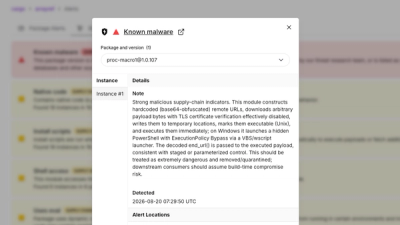
Three compromised Rust crates pulled in a malicious dependency that downloaded and executed cross-platform malware during Cargo builds.