

Product
PHP and Composer Support Is Now in Beta
Socket’s PHP and Composer support is now in Beta for all customers, with PHP reachability analysis generally available.
By Trevor Norris, Benjamin Barslev - Aug 21, 2026
@quilt-dev/cli
Advanced tools

The coordination layer for agent fleets. Same repo. Many agents. Clean commits.
quilt commit --mine
Everyone else ran toward isolation: a worktree per agent, a branch per agent,
reconcile at PR time. That trades one mess for another. You get node_modules,
.env, and build caches per worktree, agents blind to each other's in-flight
work, and a merge pile-up at the end. Quilt goes the other way: many agents,
one checkout, coordinating in the open.
The bet is that parallelism comes from coordination and visibility, not isolation and blindness. Agents claim the symbols they're about to touch, see each other's uncommitted work, get a heads-up when a function they depend on is changing, and each commits only its own hunks. Quilt is a cooperative protocol, like Git itself, and it keeps Git as the source of truth: every commit it makes is an ordinary Git commit.
git clone https://github.com/wkoverfield/quilt && cd quilt
npm install && npm run build
./examples/demo.sh
Two agents share one checkout, claim different functions in the same file without contending, one gets a heads-up that a function it depends on is changing, and each lands only its own work as a clean, correctly-attributed commit.
utils.js#formatPrice, not the whole file, so
agents editing different functions never contend. Powered by tree-sitter
(JS/TS/TSX today), with whole-file claims for everything else.commit --mine commits only yours even when they share a hunk.commit --mine. See the exact patch before anything moves..quilt/. No account, no daemon, no
hosted service.Quilt trusts Git and never rewrites it. Every commit Quilt produces is an ordinary Git commit.
npm install -g @quilt-dev/cli # puts the `quilt` command on your PATH
Or from source:
npm install        # install deps
npm run build      # compile to dist/
npm link           # put `quilt` on your PATH
Requires Node 20+ and git on the PATH.
quilt init
quilt start --actor wilson/codex-auth --type agent

# ... the agent edits files ...

quilt status                       # who owns what
quilt preview --mine               # exact patch that would be committed
quilt commit --mine -m "fix auth redirect"
quilt start --actor alice --type agent   # Alice's shell
# alice edits src/auth.ts
quilt status                              # claims Alice's edits

quilt start --actor bob --type agent     # Bob's shell
# bob edits src/theme.ts
quilt status                              # claims Bob's edits

quilt commit --mine -m "auth work"        # (as Alice) commits ONLY Alice's hunks
# Bob's changes remain in the working tree, uncommitted.
Concurrent actors run in their own shells; set QUILT_ACTOR=<id> (or
QUILT_SESSION=<id>) per shell so each invocation knows who "you" are without a
shared pointer.
| Command | Purpose |
|---|---|
quilt init | Initialize .quilt/ in the repo. |
quilt start --actor <id> [--type human|agent|bot] [--name <n>] [--email <e>] | Start a session for an actor. |
quilt watch | Watch the tree: attribute edits live and catch collisions. |
quilt status [--json] | Show who owns which working-tree changes. |
quilt mine [--json] | Summarize the changes you own. |
quilt conflicts [--json] | Show overlapping/shared changes. |
quilt restore [path] [--json] | List or recover work overwritten by another actor. |
quilt preview --mine [--json] [--include-unclaimed] | Print the exact patch commit --mine would create. |
quilt commit --mine -m <msg> [--dry-run] [--include-unclaimed] | Commit only your owned patch. |
quilt claim [targets...] [--json] | Reserve files, or file#symbol, for editing; with none, lists claims. |
quilt release [paths...] | Release your claims (all of yours if no paths). |
quilt mcp | Run the MCP server (stdio) for agent integration. |
quilt whoami | Show the active actor/session. |
quilt end | End the active session. |
quilt watch)Run the watcher once and stop thinking about it:
quilt watch
It attributes edits to the active actor as they happen (no need to run
quilt status to claim) and it catches collisions. When one actor's edit
overwrites uncommitted lines another actor owns, Quilt preserves both versions
and tells you:
⚠ collision claude-ui overwrote codex's edits in auth.ts. both saved, run: quilt restore auth.ts
Nothing is silently lost. quilt restore auth.ts writes the overwritten version
to a sidecar file (auth.ts.quilt-codex) so you can diff and merge; your
current file is never touched.
Preservation captures the victim's last-observed content, so keep quilt watch running while agents work, so it keeps that snapshot current to each edit.
Without the watcher, the preserved version is only as fresh as the last quilt
command the victim ran.
This is the backstop for actors Quilt knows about: when one actor's edit overwrites lines another actor already owns, the loss is made visible and recoverable instead of silent. Preventing the overwrite outright is what claims are for (below); this catches the case where someone edited without claiming first. It can't referee writers that never identify themselves; Quilt coordinates participants, not anonymous edits.
Coding agents drive Quilt directly over MCP. Each agent runs its own server, so attribution is precise per-agent.
// .mcp.json (or your agent's MCP config)
{
  "mcpServers": {
    "quilt": { "command": "quilt", "args": ["mcp"], "env": { "QUILT_ACTOR": "codex-auth" } }
  }
}
Tools: start_session, get_status, get_my_changes, get_conflicts,
preview_mine, commit_mine, claim, release. The intended loop:
start_session → get_status → claim(symbols) → …edit… → commit_mine
claim adds advisory prevention on top of detect-and-preserve: a symbol
already claimed by another actor is denied, so a well-behaved agent edits
something else. The claim and get_conflicts responses also carry
dependencyWarnings: push-awareness, so the moment an agent reserves a
symbol it learns whether a function it depends on is being changed by someone
else (see below). An agent that skips claiming but still drives Quilt as itself
is still caught by collision detection.
Quilt is a cooperative protocol, like Git: it coordinates the agents that
participate. Each agent identifies itself (its own MCP server, or QUILT_ACTOR).
An agent that ignores Quilt entirely gets no protection, the same way a worktree
gives an uncoordinated agent only isolation, not coordination. The intended path
is to wire your agents (or your orchestrator) into the MCP server so cooperation
is the default.
The hardest multi-agent failure is the silent cascade: agent A changes a function's signature while agent B, not knowing, builds against the old one. Quilt closes that gap proactively. When you claim a symbol, Quilt reads what it references and warns you if any dependency is currently claimed by someone else:
$ quilt claim billing.js#total          # while another actor holds billing.js#rate
  ✓ claimed billing.js#total
  ⚠ heads-up billing.js#total depends on rate, which codex is changing (billing.js#rate)
The win doesn't depend on B remembering to look. The same warnings appear in
quilt status and in the claim / get_conflicts MCP responses as
dependencyWarnings. (V1 is advisory and name-based, including across files;
import-resolution is a future refinement.)
Architecture choices here are settled by evidence, not vibes. bench/
runs Quilt against a graded scenario ladder (L1 disjoint work, L2 incompatible
conflict, L3 dependency cascade, L4 refactor-underfoot, L5 emergent overlap, L6
mixed actors + noise), each scenario run WITH vs WITHOUT Quilt and graded on
the same metrics (silent loss, attribution correctness, broken final state,
surfaced conflicts, wasted work).
npm run bench # the whole ladder, side by side
The scripted scenarios are deterministic and run in CI; a documented live
sub-agent layer (bench/live/) replays the same ladder
with real agents. See bench/README.md for the honesty
caveats (what the scripted layer models vs. what the live layer tests).
Quilt is honest and conservative: a blocked commit beats a spooky one.
Each quilt command runs a reconcile step:
quilt start seeds the observed snapshot to the current tree, so anything
already dirty stays unclaimed (e.g. formatter output, generated locks).utils.js#formatPrice
so two actors editing different functions in one file never contend.commit --mine then diffs HEAD → worktree, keeps only the lines you own
(even when they share a hunk with another actor's changes: your lines commit,
theirs stay in the tree), applies that patch to a throwaway temporary index
(GIT_INDEX_FILE + git apply --cached + write-tree + commit-tree +
update-ref), and produces a normal Git commit. Your real index and the working
tree are never rewritten; other actors' changes stay exactly where they were.
This means: run a quilt command around your edit batch (the intended
agent workflow, call status before and after editing) so Quilt captures your
delta before another actor's.
core.autocrlf repos on Windows aren't handled yet..quilt/
config.json # repo config
actors.json # known actors
sessions/*.json # sessions
current # active session pointer for this checkout
observed.json # last-observed worktree snapshot (reconcile baseline)
ownership.json # per-file line ownership + conflicts
clobbers.json # records of overwritten work, preserved for restore
snapshots/ # preserved pre-clobber file content
watcher.pid # pidfile for a running `quilt watch`
ledger.jsonl # append-only event log
.quilt/ is git-ignored automatically.
npm run build   # tsc -> dist/
npm test        # build + run the acceptance suite against fixture repos
npm run bench   # run the eval ladder (WITH vs WITHOUT Quilt)
npm run dev -- status   # run the CLI from source via tsx
MIT
FAQs
Actor-owned patches for Git. Same repo. Many agents. Clean commits.
The npm package @quilt-dev/cli receives a total of 107 weekly downloads. As such, @quilt-dev/cli popularity was classified as not popular.
We found that @quilt-dev/cli demonstrated a healthy version release cadence and project activity because the last version was released less than a year ago. It has 1 open source maintainer collaborating on the project.
Product
Socket’s PHP and Composer support is now in Beta for all customers, with PHP reachability analysis generally available.
Product
Socket is bringing experimental protection to Firefox, scanning 97,000+ extensions in Mozilla's official directory for malware and risky updates.
Research
/Security News
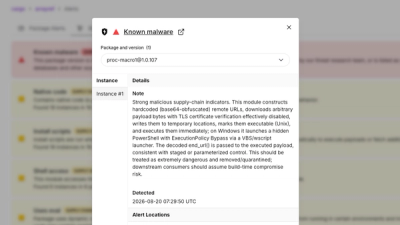
Three compromised Rust crates pulled in a malicious dependency that downloaded and executed cross-platform malware during Cargo builds.