
Product
PHP and Composer Support Is Now in Beta
Socket’s PHP and Composer support is now in Beta for all customers, with PHP reachability analysis generally available.
By Trevor Norris, Benjamin Barslev - Aug 21, 2026
@ramp-kit/react
Advanced tools
React onramp widget and hooks for LATAM ramps on Stellar: 3-step embeddable flow with live quote countdown, PIX/SPEI deposit instructions and order tracking to settlement, over any @ramp-kit/core provider
Drop-in React UI for LATAM fiat on/off-ramps on Stellar. Embeds a complete onramp flow — live quote with countdown, PIX/SPEI deposit instructions, order tracking to settlement — on top of any @ramp-kit/core provider (Etherfuse, Manteca, or the built-in mock).
npm install @ramp-kit/core @ramp-kit/react
React ≥ 18 is a peer dependency.
<RampWidget />import { EtherfuseProvider } from "@ramp-kit/core";
import { RampWidget } from "@ramp-kit/react";
const provider = new EtherfuseProvider({ apiKey, environment: "sandbox" });
<RampWidget
provider={provider}
customerId={orgId}
fiatCurrency="BRL"
network="stellar"
walletAddress={userWallet}
assets={await provider.listAssets("stellar", { currency: "brl" })}
onOrderCreated={(id) => console.log("order", id)}
onSettled={(id) => console.log("funds delivered", id)}
/>;
The widget walks the user through a 3-step flow:
| Prop | Type | Description |
|---|---|---|
provider | RampProvider | Any @ramp-kit/core provider instance |
customerId | string | Provider-side customer id (org UUID for Etherfuse, userAnyId for Manteca) |
fiatCurrency | "BRL" | "MXN" | … | Fiat leg of the ramp |
direction | "onramp" | "offramp" | Buy (default) or sell flow |
network | Network | Settlement network (default "stellar") |
walletAddress | string? | Destination wallet (onramp) / source wallet (offramp) |
payoutDestination | { address: string }? | Offramp fiat payout account (CBU/CLABE/IBAN/PIX key). Required for Manteca offramps |
assets | RampAsset[] | Assets to offer (from provider.listAssets()) |
signer | (xdr, passphrase) => Promise<string> | Wallet signing callback for offramps (Freighter, hardware, local key) |
environment | "testnet" | "mainnet" | "sandbox" | "production" | Network the flow runs on. Derives stellarConfig, picks the explorer, and warns on a provider mismatch |
stellarConfig | StellarConfig | Explicit signing network — overrides environment. Use stellarConfigFor(...) |
theme | "light" | "dark" | RampTheme | Color/radius/font tokens (default "light") |
size | "sm" | "md" | Compact or default spacing (default "md") |
showStepper | boolean | Show the numbered step header (default true) |
className | string? | Extra class on the root, alongside rk-widget |
style | CSSProperties? | Inline styles merged onto the root (wins over the theme) |
labels | Partial<RampLabels> | Override any visible copy (steps, statuses, buttons) — e.g. for i18n |
locale | string | BCP-47 locale for amount formatting (default "en-US") |
onOrderCreated | (orderId) => void | Fired when the order is accepted |
onSettled | (orderId) => void | Fired when funds are delivered |
onQuote | (quote) => void | Fired whenever a fresh quote arrives |
onStepChange | (step) => void | Fired when the flow advances between steps |
onError | (error, context) => void | Fired on any error, tagged "quote" | "order" | "sign" |
Every color, radius and font is a --rk-* CSS variable. Pass a theme preset
or a token set — set only what you want; the rest keep their defaults:
<RampWidget
  {...props}
  theme={{
    background: "#0b1e2d",
    surface: "#12293b",
    text: "#e6f1f7",
    primary: "#38bdf8",
    primaryText: "#04222f",
    accent: "#34d399",
    radius: 16,
  }}
/>;
theme="dark" ships a full dark palette. You can also override the
--rk-* variables (or the rk-widget / rk-quote / rk-deposit / rk-done
classes) from your own CSS. Translate the copy with labels:
<RampWidget
  {...props}
  locale="pt-BR"
  labels={{
    steps: { amount: "Valor", deposit: "Transferência", done: "Pronto" },
    youPay: "Você paga",
    youReceive: "Você recebe",
    continueButton: "Continuar",
  }}
/>;
import { signTransaction } from "@stellar/freighter-api";
import { stellarConfigFor } from "@ramp-kit/core";

<RampWidget
  provider={provider}
  customerId={orgId}
  direction="offramp"
  fiatCurrency="BRL"
  walletAddress={userAddress}
  assets={assets}
  signer={async (xdr, networkPassphrase) => {
    const res = await signTransaction(xdr, { networkPassphrase, address: userAddress });
    return res.signedTxXdr;
  }}
  stellarConfig={stellarConfigFor("sandbox")}
/>;
The widget renders an in-widget "Sign & send" step, recovers automatically
from expired provider transactions (tx_too_late → regenerate → re-sign),
and links the settlement transaction on Stellar Expert.
Styling: theme tokens via the theme prop or --rk-* CSS variables, plus
rk- class hooks (rk-widget, rk-quote, rk-deposit, rk-done).
Once you hold production credentials (see the checklist below), flipping to mainnet is a single value used in two places — the provider and the widget:
import { EtherfuseProvider } from "@ramp-kit/core";

// One flag drives everything. "production" and "mainnet" are equivalent here.
const environment = "production";

const provider = new EtherfuseProvider({
  apiKey: process.env.ETHERFUSE_API_KEY!, // production key
  environment,                            // flips the API base URL to mainnet
  baseUrl: "https://api.myapp.com/ramp/etherfuse", // your @ramp-kit/server
});

<RampWidget
  provider={provider}
  environment={environment}   // derives mainnet Horizon + passphrase + explorer
  customerId={realCustomerId}
  fiatCurrency="BRL"
  walletAddress={userWallet}
  assets={await provider.listAssets("stellar")}
/>;
Pass the same environment to the provider and the widget. If they differ,
the widget logs a console warning so a testnet UI never signs against mainnet
funds by accident. Omit environment and it stays on testnet (default).
The switch is code; it doesn't create the credentials. Working on mainnet also requires, per provider (one-time, outside the SDK):
api_prod_… key; real registered
bank accounts (real CLABE/RFC/PIX); real end-user KYC (no sandbox auto-approve).md-api-key, per-country
permissions, real onboarded users.Full operational checklist: skills/ramp-kit/references/production.md in the repo.
import { useQuote, useOrder } from "@ramp-kit/react";

// Live quote that refreshes itself when it expires
const { quote, loading, error, secondsLeft, refresh } = useQuote(provider, {
  direction: "onramp",
  fiatCurrency: "BRL",
  assetIdentifier: usdc.identifier,
  network: "stellar",
  sourceAmount: "100",
  customerId,
});

// Order polling that stops at settled/failed/cancelled
const { order, polling } = useOrder(provider, orderId);
import { MockProvider } from "@ramp-kit/core";

// Realistic lifecycle without credentials; auto-funds orders after 4s
const provider = new MockProvider({ autoFundMs: 4000 });
Two demo apps (a full sandbox demo on Stellar Testnet and a second minimal integration) live in the latam-ramp-kit repository.
Building this integration with an AI coding agent? Install the kit's agent
skill (npx skills add https://github.com/armandocodecr/latam-ramp-kit/tree/main/skills/ramp-kit)
and the @ramp-kit/mcp MCP
server — the agent gets integration knowledge, verified troubleshooting,
and live tools to quote and test orders against the sandbox.
MIT © Armando Cruz
FAQs
React onramp widget and hooks for LATAM ramps on Stellar: 3-step embeddable flow with live quote countdown, PIX/SPEI deposit instructions and order tracking to settlement, over any @ramp-kit/core provider
The npm package @ramp-kit/react receives a total of 128 weekly downloads. As such, @ramp-kit/react popularity was classified as not popular.
We found that @ramp-kit/react demonstrated a healthy version release cadence and project activity because the last version was released less than a year ago. It has 1 open source maintainer collaborating on the project.
Product
Socket’s PHP and Composer support is now in Beta for all customers, with PHP reachability analysis generally available.
Product
Socket is bringing experimental protection to Firefox, scanning 97,000+ extensions in Mozilla's official directory for malware and risky updates.
Research
/Security News
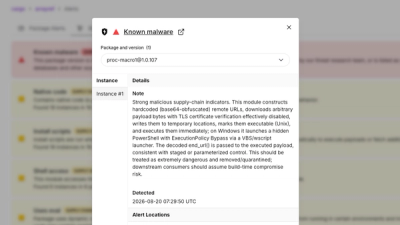
Three compromised Rust crates pulled in a malicious dependency that downloaded and executed cross-platform malware during Cargo builds.