
Research
/Security News
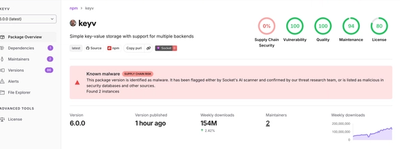
Popular npm Packages in the keyv and Cacheable Namespaces Compromised in Active Supply Chain Attack
Popular npm packages keyv and cacheable compromised.
By Socket Research Team - Aug 04, 2026
@retentioncheck/mcp-server
Advanced tools
MCP server for AI-powered churn analysis. Analyze cancellation feedback to identify churn patterns and get actionable recommendations.
MCP server for AI-powered churn analysis. Analyze customer cancellation feedback to identify churn patterns, severity ratings, and actionable recommendations.
Analyze cancellation feedback to identify why customers are leaving.
Input:
feedback (string, required) — cancellation responses, one per linefocus (string, optional) — narrow analysis to a specific area (e.g., "pricing")Output: Structured JSON with executive summary, priority action, and categorized insights (reason, count, percentage, severity, confidence, examples, recommendation).
Pull canceled subscriptions directly from Stripe and analyze them — no middleware, no DB hookup. Each cancellation is enriched with plan, MRR, sub age, and voluntary vs. involuntary context before being fed to Claude.
Input:
lookback_days (number, optional) — how many days back to analyze. Defaults to 90. Min 7, max 365.focus (string, optional) — narrow analysis to a specific area (e.g., "pricing")Requires: STRIPE_SECRET_KEY env var. Use a restricted (read-only) key, not your live secret key. Create one at dashboard.stripe.com/apikeys/create with these permissions:
Output: Same shape as analyze_churn, plus a stripeContext block with totalCanceled, activeSubs, voluntaryCount, involuntaryCount, totalMrrLost, truncated, lowSample, nonUsdSkipped, and noFeedbackRate. When there's not enough data, the Churn Health Score is null rather than fabricated.
Pull canceled subscriptions directly from Postgres or MySQL and analyze them — zero middleware, zero backend. You describe your schema in plain arguments (table name, column names) and the tool generates a safe parameterized SELECT query internally.
Input:
dialect ("postgres" | "mysql", required) — which SQL database you're using.schema (object, required):
table (string, required) — table containing subscription/cancellation records.cancelled_at_column (string, required) — column storing cancellation timestamp.reason_column (string, optional) — column storing cancellation reason.comment_column (string, optional) — column storing free-text comments.mrr_column (string, optional) — column storing monthly revenue.mrr_unit ("dollars" | "cents", optional) — defaults to "dollars". Use "cents" for Stripe-style integer storage.customer_tenure_days_column (string, optional) — column for sub age in days.status_filter (object, optional) — { column, value } filter for canceled-only rows.lookback_days (number, optional) — defaults to 90. Min 7, max 365.focus (string, optional) — narrow analysis to a specific area.Requires: POSTGRES_URL or MYSQL_URL env var (matching the dialect). Use a read-only database user, not your app DB user. Example Postgres setup:
CREATE USER retentioncheck_readonly WITH PASSWORD 'use-a-strong-password';
GRANT CONNECT ON DATABASE your_db TO retentioncheck_readonly;
GRANT USAGE ON SCHEMA public TO retentioncheck_readonly;
GRANT SELECT ON subscriptions TO retentioncheck_readonly;
Example MySQL setup:
CREATE USER 'retentioncheck_readonly'@'%' IDENTIFIED BY 'use-a-strong-password';
GRANT SELECT ON your_db.subscriptions TO 'retentioncheck_readonly'@'%';
FLUSH PRIVILEGES;
Safety: 500-row hard cap, 15-second statement timeout, identifier allowlist validation (rejects any table/column name outside [a-zA-Z_][a-zA-Z0-9_]*), all literal values parameterized, three schema-mismatch probes before the main query to give actionable errors instead of silent empty output, SSL warning when the connection isn't encrypted. Read-only user is the single most important safety layer. Full design notes in docs/2026-04-08-analyze-sql-churn-design.md.
Output: Same shape as analyze_churn, plus a sqlContext block with dialect, dateRange, totalCanceled, totalMrr, truncated, lowSample, noFeedbackRate, and sslEnabled.
See a pre-computed example analysis. No API key required.
Input:
scenario (string, optional) — "b2b-saas" (default), "consumer-app", or "pricing"Add to your MCP config (claude_desktop_config.json or .claude.json):
{
  "mcpServers": {
    "retentioncheck": {
      "command": "npx",
      "args": ["-y", "@retentioncheck/mcp-server"],
      "env": {
        "ANTHROPIC_API_KEY": "your-anthropic-key",
        "STRIPE_SECRET_KEY": "rk_live_...",
        "POSTGRES_URL": "postgres://ro_user:pass@host:5432/db?sslmode=require",
        "MYSQL_URL": "mysql://ro_user:pass@host:3306/db?ssl=true"
      }
    }
  }
}
Only ANTHROPIC_API_KEY is required. STRIPE_SECRET_KEY is needed for analyze_stripe_churn. POSTGRES_URL or MYSQL_URL is needed for analyze_sql_churn (depending on which dialect you use). Omit any you don't need.
Add to Cursor MCP settings with the same configuration.
analyze_churn, analyze_stripe_churn, and analyze_sql_churn)analyze_stripe_churn)analyze_sql_churn)Ask your AI assistant:
For history, trend tracking, PDF exports, team sharing, and more: retentioncheck.com
Starting in 0.2.0, this package sends anonymous usage events to help us understand which tools are used and how. We track:
~/.retentioncheck-mcp/install-id.json)analyze_churn, analyze_stripe_churn, analyze_sql_churn, or get_example_analysis)analyze_sql_churn: dialect (postgres or mysql) and whether SSL was enabledanalyze_stripe_churn: mode (live or test)We do NOT track:
To opt out, set RETENTIONCHECK_TELEMETRY=0 in your MCP server's env config:
{
  "mcpServers": {
    "retentioncheck": {
      "command": "npx",
      "args": ["-y", "@retentioncheck/mcp-server"],
      "env": {
        "ANTHROPIC_API_KEY": "your-api-key-here",
        "RETENTIONCHECK_TELEMETRY": "0"
      }
    }
  }
}
You can also delete ~/.retentioncheck-mcp/install-id.json at any time to reset your anonymous install ID.
MIT
FAQs
MCP server for AI-powered churn analysis. Analyze cancellation feedback to identify churn patterns and get actionable recommendations.
The npm package @retentioncheck/mcp-server receives a total of 51 weekly downloads. As such, @retentioncheck/mcp-server popularity was classified as not popular.
We found that @retentioncheck/mcp-server demonstrated a healthy version release cadence and project activity because the last version was released less than a year ago. It has 1 open source maintainer collaborating on the project.
Did you know?

Socket for GitHub automatically highlights issues in each pull request and monitors the health of all your open source dependencies. Discover the contents of your packages and block harmful activity before you install or update your dependencies.
Research
/Security News
Popular npm packages keyv and cacheable compromised.

Security News
A misconfiguration gave three Anthropic models internet access, and one, believing it was in a simulation, shipped a credential-stealing package to PyPI.

Security News
/Company News
Socket has joined the new Composer and Packagist sponsorship program as a launch sponsor, supporting the team that keeps PHP's package ecosystem secure.