
Product
PHP and Composer Support Is Now in Beta
Socket’s PHP and Composer support is now in Beta for all customers, with PHP reachability analysis generally available.
By Trevor Norris, Benjamin Barslev - Aug 21, 2026
@rubric-protocol/sdk
Advanced tools
Rubric Protocol SDK - post-quantum AI attestation for EU AI Act compliance. Patent Pending.
Post-quantum AI attestation for Node.js. Every AI decision your system makes — signed locally in microseconds, anchored to Hedera's public ledger in the background.
Built for EU AI Act Article 12 compliance and beyond.
| Endpoint | Tier Required | Behavior | Cost |
|---|---|---|---|
/v1/attest | Enterprise only | Writes directly to Hedera Consensus Service | HBAR per call |
/v1/tiered-attest | Developer+ | Merkle batching (1,000,000:1 compression) | Minimal |
Use /v1/tiered-attest for all development and high-volume workloads.
Hard rate limit: 60 req/min. If you are unsure which to use: use /v1/tiered-attest.
The SDK signs AI decisions locally using ML-DSA-65 (NIST FIPS 204, post-quantum) before any network call is made. Attestations are queued and flushed to Rubric's global federation in the background. Your AI pipeline sees zero added latency.
AI decision ‒ local sign (<1ms) → proof returned immediately
                                 ↓ background
                          Rubric anchor (5-10s) → HCS confirmed (~30s)
Each proof upgrades automatically as anchoring completes. You can fire-and-forget, or await full HCS confirmation for high-stakes decisions.
npm install @rubric-protocol/sdk
Peer dependencies (install only what you use):
npm install openai              # for OpenAI plugin
npm install @langchain/core     # for LangChain plugin
import { createRubricClient } from '@rubric-protocol/sdk';

const rubric = createRubricClient({
  apiKey: process.env.RUBRIC_API_KEY!,
  localSigning: true,       // sign locally before network
  backgroundQueue: true,    // non-blocking flush
  node: 'auto',             // route to nearest healthy node
});

const proof = await rubric.attest({
  agentId: 'my-agent-v1',
  output: 'Loan application approved. Score: 742, DTI: 28%.',
  leafType: 'AGENT_OUTPUT',
  metadata: { model: 'gpt-4o', pipeline: 'credit-decisioning' },
});

console.log(proof.attestationId);  // immediate
console.log(proof.stage);          // 'local'

// Optional: wait for full HCS confirmation
proof.onUpgrade('confirmed', (confirmed) => {
  console.log(confirmed.hashScanUrl); // publicly verifiable on HashScan
});
Add one handler and every LLM call, agent action, chain, and tool invocation is automatically attested.
import { ChatOpenAI } from '@langchain/openai';
import { AgentExecutor } from 'langchain/agents';
import { RubricLangChainHandler } from '@rubric-protocol/sdk';

const rubric = new RubricLangChainHandler({
  apiKey: process.env.RUBRIC_API_KEY!,
  localSigning: true,
  backgroundQueue: true,
  events: ['llm', 'agent', 'tool'],  // choose what to attest
  pipelineId: 'my-pipeline',
});

const executor = await AgentExecutor.fromAgentAndTools({
  agent,
  tools,
  callbacks: [rubric],  // that's it
});

await executor.invoke({ input: 'Analyze this transaction for fraud.' });
await rubric.shutdown(); // flush remaining queue on exit
Drop-in wrapper — your existing code is unchanged.
import OpenAI from 'openai';
import { withRubric } from '@rubric-protocol/sdk';

const openai = withRubric(new OpenAI(), {
  apiKey: process.env.RUBRIC_API_KEY!,
  agentId: 'my-openai-agent',
  localSigning: true,
  backgroundQueue: true,
});

// Use exactly as before — attestation happens automatically
const completion = await openai.chat.completions.create({
  model: 'gpt-4o',
  messages: [{ role: 'user', content: 'Should we approve this claim?' }],
});
For decisions requiring immediate confirmation (medical triage, credit denial, hiring rejection), await full HCS anchoring:
const confirmed = await rubric.attestAndConfirm({
  agentId: 'triage-agent',
  output: 'Patient flagged for immediate review.',
  leafType: 'AGENT_OUTPUT',
  risk: 'high',
}, 90_000); // timeout ms

console.log(confirmed.hcsSequenceNumber);
console.log(confirmed.hashScanUrl); // immutable public record
Every attestation returns a LiveProof that upgrades automatically:
| Stage | When | What you have |
|---|---|---|
local | <1ms | ML-DSA-65 signature + timestamp |
anchored | 5–10s | Merkle root committed to Rubric |
confirmed | ~30s | HCS sequence number, HashScan URL |
proof.onUpgrade('anchored', (p) => console.log(p.merkleRoot));
proof.onUpgrade('confirmed', (p) => console.log(p.hashScanUrl));
proof.onUpgrade('any', (p) => console.log(p.stage)); // fires on each upgrade
createRubricClient({
  apiKey: string,               // required — get one at rubric-protocol.com
  node?: 'us'|'sg'|'jp'|'ca'|'eu'|'auto',  // default: 'us'
  localSigning?: boolean,       // default: false
  keystorePath?: string,        // default: ~/.rubric/sdk-keypair.json
  keystorePassphrase?: string,  // AES-256-GCM encrypts the keystore
  backgroundQueue?: boolean,    // default: false
  enterprise?: boolean,         // uses /v1/tiered-attest (Merkle batching)
  proofUpgrade?: boolean,       // auto-poll for stage upgrades
  timeout?: number,             // HTTP timeout ms, default: 15000
})
The SDK routes to Rubric's global federation automatically when node: 'auto'.
| Region | Endpoint |
|---|---|
| US East | https://rubric-protocol.com/verify |
| Singapore | https://sg.rubric-protocol.com/verify |
| Japan | https://jp.rubric-protocol.com/verify |
| Canada | https://ca.rubric-protocol.com/verify |
| EU Central | https://eu.rubric-protocol.com/verify |
~/.rubric/sdk-keypair.json with optional AES-256-GCM encryption via passphraseMIT — Echelon Intelligence Systems LLC
Patent Pending
FAQs
Rubric Protocol SDK - post-quantum AI attestation for EU AI Act compliance. Patent Pending.
The npm package @rubric-protocol/sdk receives a total of 51 weekly downloads. As such, @rubric-protocol/sdk popularity was classified as not popular.
We found that @rubric-protocol/sdk demonstrated a healthy version release cadence and project activity because the last version was released less than a year ago. It has 1 open source maintainer collaborating on the project.
Product
Socket’s PHP and Composer support is now in Beta for all customers, with PHP reachability analysis generally available.
Product
Socket is bringing experimental protection to Firefox, scanning 97,000+ extensions in Mozilla's official directory for malware and risky updates.
Research
/Security News
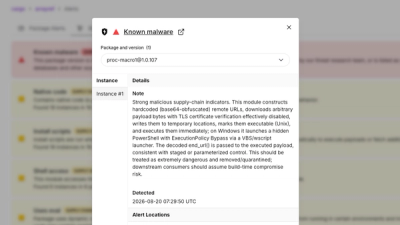
Three compromised Rust crates pulled in a malicious dependency that downloaded and executed cross-platform malware during Cargo builds.