

Product
PHP and Composer Support Is Now in Beta
Socket’s PHP and Composer support is now in Beta for all customers, with PHP reachability analysis generally available.
By Trevor Norris, Benjamin Barslev - Aug 21, 2026
@rubric-protocol/verify
Advanced tools
Reference TypeScript implementation of the Rubric Attestation Verification Specification v1.0.0
Independent, offline-capable verification of Rubric Protocol attestations — including Session Attestations (provable records of agent behavior) — against the public Hedera ledger. No API key, no trust in Rubric's servers.
2.x is the chain-conformant line. Its Merkle construction is proven byte-for-byte against the deployed production sealer and pinned by normative vectors that run as a ship-gate; if verifier and chain ever drift, the build fails. (The 1.x line implemented an earlier spec reading that does not reproduce mainnet anchors — see 1.x notice below.)
npm install @rubric-protocol/verify
Node ≥ 18.
Every sealed session exposes public, keyless endpoints:
GET /v1/session/:ses/manifest
GET /v1/session/:ses/proof/:seq
GET /v1/session/:ses/statement.html   (self-verifying, human-readable)
import { verifySessionProof, verifySessionSignature, verifyAnchorPayload } from "@rubric-protocol/verify";

const proof = await (await fetch(`${base}/v1/session/${ses}/proof/0`)).json();
const r = verifySessionProof(proof);          // leaf -> epoch -> session_root, pure SHA3 arithmetic
console.log(r.ok, r.checks);

const manifest = await (await fetch(`${base}/v1/session/${ses}/manifest`)).json();
verifySessionSignature(manifest.session_root, manifest.signature);  // ML-DSA-65 over ROOT BYTES

// bind to the public ledger: fetch the HCS mirror message your manifest's
// hcs_ref points at, base64-decode it, and check it commits to the same root
verifyAnchorPayload(manifest.session_root, decodedMirrorMessage, ses);
Everything below the ledger anchor is recomputable hashing; the anchor and the post-quantum signature bind the arithmetic to the world. The operator's honesty is never an input.
chain-merkle — the canonical on-chain construction (SHA3-256, RFC-6962
domain tags, promote-odd, forest wrap) with inclusion proofs.session-verify / session-signature — Session Attestation verification
per Verify Spec v2.0 §9: proof folding, event chain-rule, seal signature,
anchor binding.test/chain-conformance.standalone.ts — the normative vectors (Appendix A
of the spec), including a live production proof. Run it yourself:npx tsx test/chain-conformance.standalone.ts
| Direct / threshold | Tiered / session | |
|---|---|---|
| Hash | SHA-256 | SHA3-256 |
| Signs | canonical message bytes | Merkle root bytes |
| Tree | none | §4.7 construction |
A verifier MUST select the hash by family (Verify Spec v2.0 §4.1).
The first production session attestations are sealed on HCS topic
0.0.10800940 (mainnet). Sequence 2's message commits payload_hash equal to
the session root of ses_9D4FC4A64CB540F2B5006E1A51 — fetch it from any
mirror node and check it against the vectors in the conformance suite.
@rubric-protocol/verify 1.0.x was built from spec-side golden vectors that
predate the chain reconciliation; its attestation path is SHA-256 and cannot
reproduce mainnet tiered/session roots. It is deprecated. Its source is
retained in src/legacy-1x/ with notes. Full disclosure: spec
VERIFY-SPEC-v2.0-CHANGES.md, Appendix B.3.
VERIFY-SPEC-v2.0-CHANGES.md in this repo: two-family §4.1, the exact §4.7
construction, Session Attestation §9, normative vectors, disclosures.
Apache-2.0 (see LICENSE).
FAQs
Reference TypeScript implementation of the Rubric Attestation Verification Specification v1.0.0
The npm package @rubric-protocol/verify receives a total of 71 weekly downloads. As such, @rubric-protocol/verify popularity was classified as not popular.
We found that @rubric-protocol/verify demonstrated a healthy version release cadence and project activity because the last version was released less than a year ago. It has 1 open source maintainer collaborating on the project.
Product
Socket’s PHP and Composer support is now in Beta for all customers, with PHP reachability analysis generally available.
Product
Socket is bringing experimental protection to Firefox, scanning 97,000+ extensions in Mozilla's official directory for malware and risky updates.
Research
/Security News
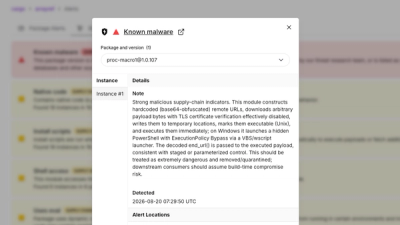
Three compromised Rust crates pulled in a malicious dependency that downloaded and executed cross-platform malware during Cargo builds.