@samuraizer/cli
Local-first CLI that turns meeting recordings into transcripts, summaries, action items, and decisions — entirely on your machine. No cloud, no subscriptions, no data leaving your network.

Reference implementation of the memnex specification. All outputs conform to memnex v0.2, including a full provenance chain.
💻 System Requirements
| 8 GB | qwen2.5:3b |
| 16 GB | qwen2.5:7b |
| 32 GB+ | qwen2.5:14b (default) |
Apple Silicon (M1/M2/M3/M4) and recent x86 CPUs with AVX2 are recommended.
Whisper transcription is CPU/Metal-accelerated; LLM inference uses Ollama's defaults.
⚙️ Prerequisites
Install the required tools:
Start Ollama and pull a model:
ollama serve
ollama pull qwen2.5:14b
Whisper transcription needs a downloaded whisper.cpp ggml model file too — grab one (e.g. ggml-large-v3.bin) from the whisper.cpp repo; you'll point whisperModelPath at it below.
📦 Installation
npm install -g @samuraizer/cli
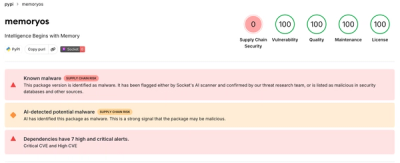
Migrating from the legacy samuraizer package? Versions ≤ 0.2.0 of the unscoped samuraizer package on npm are deprecated. Run npm uninstall -g samuraizer && npm install -g @samuraizer/cli to migrate. The CLI binary on your PATH is still called samuraizer.
🚀 Quick Start
samuraizer doctor
samuraizer init
samuraizer doctor
samuraizer process meeting.m4a
samuraizer doctor before init only checks system dependencies (Node/ffmpeg/ffprobe/whisper-cli/Ollama); it can't check whisperModelPath or meetingsDir until the config file exists, so run it again after editing the config to confirm those are set correctly.
On success, process prints where the results landed:
Done.
All files saved to: /home/you/.samuraizer/meetings/meeting/2026-08-19T...
On a 30-minute recording this typically takes 3–5 minutes on Apple Silicon and 8–15 minutes on x86 CPUs, depending on the model.
🧪 Commands
Process an audio file
samuraizer process meeting.m4a
samuraizer process meeting.m4a --verbose
samuraizer process meeting.m4a --force
samuraizer process meeting.m4a --verbose --force
Run individual steps
samuraizer normalize input.m4a output.wav
samuraizer summarize transcript.txt
samuraizer actions transcript.txt
samuraizer decisions transcript.txt
Configuration
samuraizer doctor
samuraizer init
samuraizer config path
samuraizer config get
Other
samuraizer --help
samuraizer --version
⚙️ Configuration
Samuraizer uses a global JSON config file.
Config location
- macOS:
~/Library/Application Support/samuraizer/config.json
- Linux:
~/.config/samuraizer/config.json
- Windows:
%AppData%/samuraizer/config.json
Example config
{
  "model": "qwen2.5:14b",
  "ollamaBaseUrl": "http://127.0.0.1:11434",
  "whisperCommand": "whisper-cli",
  "whisperModelPath": "/absolute/path/to/ggml-model.bin",
  "language": "en",
  "ffmpegCommand": "ffmpeg",
  "ffprobeCommand": "ffprobe"
}
Config fields
- model — LLM model used for analysis (summary, action items, decisions)
- ollamaBaseUrl — URL where Ollama is running
- whisperCommand — Command used to run Whisper
- whisperDevice (optional) — GPU/device whisper-cli runs on. Accepts a device index (
0, 1), a comma-separated list ("0,1"), or a GPU UUID; value semantics match CUDA_VISIBLE_DEVICES. Omit to use the default device.
- whisperPrompt (optional) — Initial prompt / hotwords passed to whisper-cli (
--prompt). Bias decoding toward domain terms, participant names, or acronyms you know will appear. Keep under ~200 characters. Example: "Patient ID, CR, Change Request, Spider, Grant".
- whisperCarryInitialPrompt (optional, default
false) — Re-apply whisperPrompt to every decoding window (--carry-initial-prompt). By default whisper.cpp uses the initial prompt for the first window only, so on a long recording the hotword bias fades after the opening minutes. Enable this to keep it active throughout; the trade-off is that the prompt occupies context in every window and, if it is long or unnatural, can leak into the transcript.
- ffmpegCommand — Command used for audio processing
- ffprobeCommand — Command used for audio inspection
- llmConcurrency (optional, default
1, range 1-3) — How many of the three LLM stages (summary, action items, decisions) may run at the same time. Parallel execution is opt-in; see LLM concurrency and VRAM.
Every config field can also be overridden with an environment variable, e.g. SAMURAIZER_WHISPER_DEVICE=1 samuraizer process meeting.m4a. Booleans accept 1/0, true/false, yes/no, or on/off.
Selecting a GPU
If your machine has multiple GPUs, pin whisper transcription to a specific one:
{
  "whisperDevice": 1
}
Or per-run, without editing the config:
SAMURAIZER_WHISPER_DEVICE=1 samuraizer process meeting.m4a
LLM concurrency and VRAM
Summary, action items, and decisions are independent, but Samuraizer runs them sequentially by default (llmConcurrency: 1). This is the safe setting for laptops, integrated graphics, CPU-only systems, and GPUs where the model already consumes most of the available VRAM.
On hardware with enough spare VRAM, you can explicitly allow two or three stages at once:
{
  "llmConcurrency": 3
}
SAMURAIZER_LLM_CONCURRENCY=3 samuraizer process meeting.m4a
Whether that actually runs in parallel is Ollama's decision, not Samuraizer's. The server processes OLLAMA_NUM_PARALLEL requests per model at a time; anything beyond that queues. If it resolves to 1, requests are served one after another and there is no speedup.
To check what your server actually allocated, run a stage and inspect the loaded runner:
curl -s http://127.0.0.1:11434/api/ps | grep context_length
Samuraizer requests num_ctx: 16384. A context_length of 16384 means one slot; 49152 means three slots. To get three genuine slots, start Ollama with OLLAMA_NUM_PARALLEL=3 — and budget for it: each slot adds another full KV cache, so three slots need roughly three times the context memory of one. If they do not fit, Ollama may spill layers to CPU or run out of memory.
Measured on a 24 GB GPU with qwen3.8:27b (18.6 GB resident, OLLAMA_NUM_PARALLEL at its default): 24.0s with llmConcurrency: 3 versus 24.2s with llmConcurrency: 1 — no gain because the server serialized the requests. Smaller models that leave room for several slots are where the measured ~2.3× speedup appeared.
Leave the setting at 1 unless you have verified both spare VRAM and multiple Ollama runner slots. Values 2 and 3 are performance opt-ins, not recommended defaults.
📂 Example output
After processing, you'll find structured files in output/<recording-name>/:
output/meeting/
  transcript.txt
  summary.txt
  action-items.json
  decisions.json
  report.txt
  meeting.json
The meeting.json file is a memnex v0.2-conforming document combining all outputs with a full provenance chain.
summary.txt
Team standup focused on Q2 roadmap and infrastructure migration.
The frontend team will start the Next.js upgrade next week...
action-items.json
[
  {
    "owner": "Alice",
    "task": "Set up staging environment for migration testing",
    "deadline": "by end of week"
  },
  {
    "owner": "Bob",
    "task": "Review the auth refactor PR",
    "deadline": null
  }
]
decisions.json
[
  {
    "decision": "Adopt Next.js 15 for the new dashboard",
    "rationale": "Better SSR and built-in App Router support"
  }
]
🔁 Resume behavior
Samuraizer skips steps whose output files already exist. If processing crashes or you stop it mid-pipeline, just re-run the same command — completed steps are reused.
Use --force to recompute everything from scratch.
⚠️ Troubleshooting
Ollama not running
ollama serve
Ollama on a non-default port
Update ollamaBaseUrl in your config:
{
  "ollamaBaseUrl": "http://127.0.0.1:11500"
}
Out of memory during analysis
Switch to a smaller model:
ollama pull qwen2.5:7b
Then update model in your config to qwen2.5:7b (or qwen2.5:3b on machines with 8 GB RAM).
Model not found
Make sure the model in your config is actually pulled:
ollama list
ollama pull <model-name>
whisper-cli not in PATH
Build whisper.cpp and ensure the binary is on your PATH, or set the absolute path in whisperCommand in your config.
ffmpeg not found
macOS:
brew install ffmpeg
Linux:
sudo apt install ffmpeg
sudo pacman -S ffmpeg
sudo dnf install ffmpeg
Windows:
winget install Gyan.FFmpeg
🤖 AI agent access (MCP)
Samuraizer also ships with a companion MCP server, @samuraizer/mcp-server, that lets AI agents (Claude Desktop, Claude Code, MCP Inspector) query your processed meetings and run the pipeline on demand.
📝 Changelog
See CHANGELOG.md for release history.
📄 License
MIT — see LICENSE.
🔗 Source code
Part of the Samuraizer monorepo: github.com/UladzKha/samuraizer-cli.