

Company News
AWS Security Hub Adds Socket for Supply Chain Security
Socket is now in the AWS Security Hub Extended plan. Adopt it through AWS, apply committed spend, and block malicious open source packages.
By Feross Aboukhadijeh - Aug 04, 2026
@sapiom/mcp
Advanced tools
Local Sapiom developer MCP server (sapiom-dev) — the unmetered surface for building and operating on Sapiom; today it scaffolds, tests, deploys, and inspects orchestrations. Not the remote Sapiom capability MCP.
The local developer MCP server for Sapiom. It runs on your machine over
stdio under the server name sapiom-dev — the unmetered sapiom_dev_* surface
for building and operating on Sapiom. Today it gives a coding agent the tools to
scaffold, test, deploy, and inspect Sapiom orchestrations; the namespace leaves
room for other non-capability developer tooling later.
Not the capability surface. This is not the remote "Sapiom" MCP (the hosted connector with
sapiom_sandbox_*, scrape, search, … capability tools).sapiom-devis the local developer surface; it makes no paid capability calls and exposes no capability tools. See the two Sapiom MCP servers for which to use when.
No global install — run it on demand with npx:
{
  "mcpServers": {
    "sapiom-dev": {
      "command": "npx",
      "args": ["-y", "@sapiom/mcp"]
    }
  }
}
In Claude Code:
claude mcp add sapiom-dev -- npx -y @sapiom/mcp
The server targets the production environment by default. Override it with the
SAPIOM_ENVIRONMENT environment variable:
{
  "mcpServers": {
    "sapiom-dev": {
      "command": "npx",
      "args": ["-y", "@sapiom/mcp"],
      "env": { "SAPIOM_ENVIRONMENT": "staging" }
    }
  }
}
production (alias prod) → app.sapiom.ai / api.sapiom.ai — the default.staging (alias dev) → app.sapiom.dev / api.sapiom.dev.Both resolve from built-in presets, so no config file is required. A custom
target can be defined in ~/.sapiom/credentials.json (the server prints the
expected shape if it encounters an unknown environment name).
The first networked call (link, deploy, run, inspect, signal) needs a
Sapiom API key. Run sapiom_authenticate and the server opens a browser
login flow, then caches the resulting key per environment in
~/.sapiom/credentials.json. After that, tools work without re-authenticating.
sapiom_status reports who you're authenticated as; sapiom_logout clears the
cached credentials.
The local authoring tools (scaffold, check, run_local) need no
authentication — they run entirely offline.
| Tool | Network | What it does |
|---|---|---|
sapiom_authenticate | browser | Log in and cache an API key for the current environment |
sapiom_status | — | Report authentication status |
sapiom_logout | — | Clear cached credentials |
sapiom_send_feedback | ✓ | Relay the user's product feedback to the Sapiom team |
sapiom_dev_agents_scaffold | — | Create a new orchestration project |
sapiom_dev_agents_check | — | Bundle + validate the step graph offline |
sapiom_dev_agents_run_local | — | Run the workflow locally, resolving capability calls from stubs (no cost) |
sapiom_dev_agents_link | ✓ | Resolve/create the hosted orchestration and cache its id |
sapiom_dev_agents_clone | ✓ | Fork a gallery template (or re-clone a fork) into a local project |
sapiom_dev_agents_deploy | ✓ | Push the current commit, build, and wait for it |
sapiom_dev_agents_run | ✓ | Start a real cloud execution |
sapiom_dev_agents_inspect | ✓ | Inspect an execution or build (optionally waiting for it) |
sapiom_dev_agents_signal | ✓ | Resume a paused execution by delivering a signal |
sapiom_dev_agents_schedule | ✓ | Create a recurring (cron) or one-off schedule for a deployed agent |
sapiom_dev_agents_schedule_inspect | ✓ | Inspect one schedule (with fire history) or list an agent's schedules |
sapiom_dev_agents_schedule_cancel | ✓ | Cancel a schedule (stops all future fires) |
sapiom_dev_agents_cron_preview | ✓ | Validate a cron expression and preview its next occurrences |
A typical loop: scaffold → write step code → run_local until green → link
→ deploy → run → inspect.
Workflows authored here call Sapiom capabilities — sandboxes, repositories,
coding agents, search, storage, content generation — through
@sapiom/tools (ctx.sapiom.*). run_local resolves those calls
from stubs; a real run/deploy executes them in the cloud (metered). This MCP
never grows a per-capability tool of its own — capabilities live in
@sapiom/tools and the remote sapiom MCP. See
the positioning doc for the full policy.
sapiom_send_feedback relays a user's product feedback (a bug, a rough edge, a
feature request) to the Sapiom team. The agent sends only what the user said;
the server attaches package version, platform, arch, node version, environment
and a timestamp itself, so the model never has to read those off the machine.
A host embedding this server can advertise its own version with
SAPIOM_HARNESS_VERSION — it rides along as clientMeta.harnessVersion,
which is what makes "which build is this user on" answerable during triage. The
field is omitted entirely when the variable is unset, never filled with a
placeholder. @sapiom/harness sets it automatically.
The server emits anonymous usage analytics (one tool.call event per tool
invocation: tool name, arguments, duration, ok/error class) via
@sapiom/analytics-core to the hosted Sapiom collector
by default. Opt out at any time with SAPIOM_TELEMETRY_DISABLED=1 or
DO_NOT_TRACK=1 — either makes the emitter a complete no-op (nothing is sent,
nothing is written to disk). SAPIOM_ANALYTICS_ENDPOINT overrides the
destination. Telemetry is a synchronous in-memory enqueue that never throws,
never blocks a tool call, and can never change a tool result.
MIT
FAQs
Local Sapiom developer MCP server (sapiom-dev) — the unmetered surface for building and operating on Sapiom; today it scaffolds, tests, deploys, and inspects orchestrations. Not the remote Sapiom capability MCP.
The npm package @sapiom/mcp receives a total of 200 weekly downloads. As such, @sapiom/mcp popularity was classified as not popular.
We found that @sapiom/mcp demonstrated a healthy version release cadence and project activity because the last version was released less than a year ago. It has 4 open source maintainers collaborating on the project.
Did you know?

Socket for GitHub automatically highlights issues in each pull request and monitors the health of all your open source dependencies. Discover the contents of your packages and block harmful activity before you install or update your dependencies.
Company News
Socket is now in the AWS Security Hub Extended plan. Adopt it through AWS, apply committed spend, and block malicious open source packages.
Research
/Security News
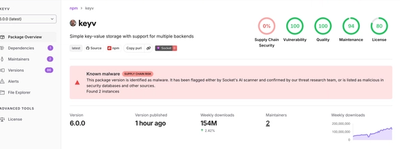
Popular npm packages keyv and cacheable compromised.

Security News
A misconfiguration gave three Anthropic models internet access, and one, believing it was in a simulation, shipped a credential-stealing package to PyPI.