


Company News
Socket Has Acquired Secure Annex
Socket has acquired Secure Annex to expand extension security across browsers, IDEs, and AI tools.
By Feross Aboukhadijeh - Apr 28, 2026
@scalar/api-client
Advanced tools



The Scalar API Client is a powerful tool designed to simplify API testing and integration. This versatile package offers multiple usage options:
We have removed the old version of the clients so you must update your imports as seen below. We will keep the v2 exports for a while then remove them.
npm install @scalar/api-client
You can mount the full-blown API Client to your DOM like this:
<!-- index.html -->
<!doctype html>
<html lang="en">
  <head>
    <meta charset="UTF-8" />
    <meta
      name="viewport"
      content="width=device-width, initial-scale=1.0" />
    <title>Scalar API Client App</title>
  </head>
  <body>
    <div
      id="scalar-client"
      class="scalar-app scalar-client"></div>
    <script
      type="module"
      src="./main.js"></script>
  </body>
</html>
// main.js
import '@/style.css'

import { createApiClientApp } from '@scalar/api-client/app'

const el = document.getElementById('scalar-client')

createApiClientApp(el, { layout: 'web' })
Or you can mount a more compact version, which is rendered in a modal. You must initialize the workspace store and add at least one document.
// main.js
import { createWorkspaceStore } from '@scalar/workspace-store/client'
import { createApiClientModal } from '@scalar/api-client/modal'

import '@/style.css'

const workspaceStore = createWorkspaceStore()
await workspaceStore.addDocument({
  name: 'default',
  url: 'https://cdn.jsdelivr.net/npm/@scalar/galaxy/dist/latest.json',
})

const modal = createApiClientModal({
  el: document.getElementById('app'),
  workspaceStore,
  options: {
    proxyUrl: 'https://proxy.scalar.com',
  },
})

// Open the API client right-away
modal.open()

document.getElementById('button')?.addEventListener('click', () =>
  modal.open({
    path: '/user/signup',
    method: 'post',
  }),
)

// Navigate while the modal is already open
modal.route({
  path: '/me',
  method: 'get',
})

// Merge options at runtime
modal.updateOptions({
  hideClientButton: true,
})
createApiClientModal accepts these top-level properties:
| Option | Description |
|---|---|
el | [Required] The HTML element to mount the modal app to. |
workspaceStore | [Required] An initialized workspace store with documents loaded. |
mountOnInitialize | Mount immediately (default: true). Set to false to mount manually later. |
eventBus | Pass an existing workspace event bus, or let the modal create one. |
plugins | Client plugins to include in the modal. |
options | Partial API client configuration for modal behavior (see below). |
options supports these keys:
| Option | Description |
|---|---|
options.proxyUrl | Use a proxy URL to send requests when CORS blocks direct browser requests. |
options.authentication | Prefill authentication credentials and default security scheme behavior. |
options.baseServerURL | Prefix all relative servers with a base URL. |
options.hideClientButton | Hide the client button in modal-based integrations. |
options.hiddenClients | Control which HTTP code-example clients are shown; pass [] to show all clients. |
options.oauth2RedirectUri | Set the default OAuth 2.0 redirect URI for auth code and implicit flows. |
options.servers | Override the servers from your OpenAPI document. |
The createApiClientModal call returns:
open(payload?): Opens the modal and optionally navigates to a route.route(payload): Navigates to a route without toggling modal visibility.updateOptions(nextOptions, overwrite?): Merges options by default, or replaces them when overwrite is true.mount(mountingEl?): Mounts the modal app to a specific element.modalState: Reactive open/close state object.app: Underlying Vue app instance.open and route use this payload shape:
{
  path: string
  method: HttpMethod
  example?: string
  documentSlug?: string // For multiple documents
}
The plugins option accepts an array of ClientPlugin objects that extend the API Client with custom behavior. Plugins can add lifecycle hooks, custom UI components, and custom response body handlers for content types that the client does not natively support.
When your API returns a non-standard content type (for example, MessagePack), you can register a plugin with a responseBody handler to decode and display it:
import type { ClientPlugin } from '@scalar/oas-utils/helpers'

const msgpackPlugin: ClientPlugin = {
  responseBody: [
    {
      mimeTypes: ['application/msgpack', 'application/x-msgpack'],
      decode: async (buffer) => {
        const { decode } = await import('@msgpack/msgpack')
        const decoded = decode(new Uint8Array(buffer))
        return JSON.stringify(decoded, null, 2)
      },
      language: 'json',
    },
  ],
}

createApiClientApp(el, {
  layout: 'web',
  plugins: [msgpackPlugin],
})
Each handler in responseBody supports:
| Property | Description |
|---|---|
mimeTypes | MIME type patterns to match (exact or wildcard like application/vnd.*+json). |
decode | Transforms the raw ArrayBuffer into a string or Blob for display. |
language | CodeMirror language hint for the built-in raw renderer (for example, json). |
rawComponent | A custom Vue component for the raw view (mutually exclusive with language). |
previewComponent | A custom Vue component for the preview view. |
We are API nerds. You too? Let's chat on Discord: https://discord.gg/scalar
The source code in this repository is licensed under MIT.
FAQs
the open source API testing client
The npm package @scalar/api-client receives a total of 208,744 weekly downloads. As such, @scalar/api-client popularity was classified as popular.
We found that @scalar/api-client demonstrated a healthy version release cadence and project activity because the last version was released less than a year ago. It has 8 open source maintainers collaborating on the project.
Did you know?

Socket for GitHub automatically highlights issues in each pull request and monitors the health of all your open source dependencies. Discover the contents of your packages and block harmful activity before you install or update your dependencies.
Company News
Socket has acquired Secure Annex to expand extension security across browsers, IDEs, and AI tools.

Research
/Security News
Socket is tracking cloned Open VSX extensions tied to GlassWorm, with several updated from benign-looking sleepers into malware delivery vehicles.
Product
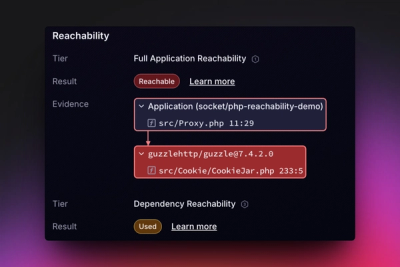
Reachability analysis for PHP is now available in experimental, helping teams identify which vulnerabilities are actually exploitable.