
Research
/Security News
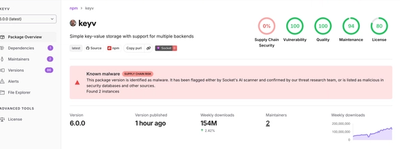
Popular npm Packages in the keyv and Cacheable Namespaces Compromised in Active Supply Chain Attack
Popular npm packages keyv and cacheable compromised.
By Socket Research Team - Aug 04, 2026
@scriptmasterlabs/scriptdocs-mcp-server
Advanced tools
ScriptMaster Labs docs/context MCP server. Fetches real, verifiable package documentation (npm + PyPI registries) and OSV.dev vulnerability data for AI coding agents. No demo/simulated data.
A Model Context Protocol (MCP) server that gives AI coding agents real,
live, source-cited documentation for npm and PyPI packages — pulled
directly from registry.npmjs.org and pypi.org at call time.
Built by ScriptMaster Labs.
Every tool call makes a real HTTP request to the actual registry. There is
no cached demo data, no fabricated example output, and no guessing. If a
package or its docs can't be found, the tool returns an explicit error —
never a plausible-looking made-up answer. Every successful response
includes source_url and fetched_at so the caller can verify exactly
where the data came from and how fresh it is.
Not yet built (honest status, not hype):
| Tool | What it does |
|---|---|
docs_get_package_info | Live metadata: latest version, description, homepage, repo — npm, PyPI, or Cargo (crates.io), right now. |
docs_get_readme | The verbatim README (npm), long description (PyPI), or README-derived text (Cargo — see note below) for a package/version. |
docs_search_docs | Keyword search inside a package's real docs (any of the 3 ecosystems, optionally a specific version), returns verbatim matching snippets with context — not a summary. |
docs_check_vulnerabilities | Checks a specific package+version against OSV.dev. When a fix exists, automatically fetches that fixed version's README in the same call — "here's what's wrong" and "here's what upgrading looks like," one round trip. |
docs_resolve_library | Fuzzy name → real candidates, via npm's and crates.io's actual search APIs. PyPI has no official search API (confirmed: XML-RPC search was killed in 2022, never replaced) — calling this for PyPI returns an honest explanation, not a scraped or fabricated result. |
Note on Cargo READMEs: crates.io stores READMEs pre-rendered as HTML, not the original markdown source — there's no raw-source endpoint. docs_get_readme/docs_search_docs return that HTML converted to plain text (tags stripped, entities decoded) — a mechanical transformation, not a summary; no content is invented or dropped.
scriptdocs-mcp-server/
├── package.json
├── tsconfig.json
├── Dockerfile
├── src/
│   ├── index.ts          # server entry point, transport selection
│   ├── constants.ts
│   ├── types.ts
│   ├── services/
│   │   ├── npm.ts        # real npm registry client
│   │   ├── npmSearch.ts  # real npm search API (fuzzy resolution)
│   │   ├── pypi.ts       # real PyPI registry client (supports version pinning)
│   │   ├── cargo.ts      # real crates.io client (metadata, readme, search)
│   │   ├── osv.ts        # real OSV.dev vulnerability database client
│   │   ├── versionCompare.ts  # best-effort numeric version comparator
│   │   ├── access.ts     # founder always-free guarantee
│   │   └── docSearch.ts  # keyword/snippet extraction over fetched text
│   └── tools/
│       ├── getPackageInfo.ts
│       ├── getReadme.ts
│       ├── searchDocs.ts
│       ├── checkVulnerabilities.ts
│       └── resolveLibrary.ts
└── dist/                 # build output (git-ignored)
npm install
npm run build
node dist/index.js
To wire it into Claude Desktop or Cursor, point their MCP config at:
{
  "mcpServers": {
    "scriptdocs": {
      "command": "node",
      "args": ["/absolute/path/to/scriptdocs-mcp-server/dist/index.js"]
    }
  }
}
npm install
npm run build
TRANSPORT=http PORT=3000 node dist/index.js
GET /healthPOST /mcpThe included Dockerfile builds and runs the HTTP transport. Point a
Render Web Service at this repo with:
/healthThis mirrors how mcp-x402 and squeezeos-api are already deployed.
docs_get_package_info → express (npm), serde (cargo) returned real
current metadata straight from their respective registries.docs_get_readme → zod (npm, jsDelivr fallback), requests (PyPI,
latest + version-pinned), and serde (cargo) all returned real README
content. The cargo path hit a real bug during testing — crates.io's
README endpoint varies its response by Accept header and was
returning a JSON pointer instead of HTML — caught and fixed, verified
again after the fix.docs_search_docs → keyword search over real docs verified across
npm and cargo.docs_check_vulnerabilities → express@4.17.1 correctly returned 2
real advisories (incl. CVE-2024-43796) and automatically fetched the
real README for 4.20.0 (the fixed version) in the same call — the
vuln-to-fix bridge, verified working end-to-end.docs_resolve_library → real fuzzy search verified for npm ("react"
→ react, react-is, ...) and cargo ("http client" → real candidates).
PyPI correctly returns an honest limitation message instead of a
fabricated result (verified: PyPI has had no official search API
since 2022).isError: true response instead of fabricating a plausible answer.stdio and TRANSPORT=http modes verified against the actual
MCP JSON-RPC protocol (initialize, tools/list, tools/call).ScriptMaster Labs (you) always gets full, unmetered, free access to every tool this server exposes — no matter what paid tiers get built later. This is baked into the architecture now, before any billing exists, not retrofitted after the fact:
src/services/access.ts exports isOwnerRequest(), checked against a
secret in the SCRIPTDOCS_OWNER_KEY environment variable (never
hardcoded — this repo is public, so a hardcoded bypass would give
everyone free access, not just you).x-scriptdocs-access-tier response header (owner-unlimited or
standard) — verified working, not just written.isOwnerRequest() first and skip all limits/charges when it returns
true.To use it once deployed: set SCRIPTDOCS_OWNER_KEY as an environment
variable on your Render service, then send requests with header
x-scriptdocs-owner-key: <that value>. Keep the value secret — it's
not in this repo, and shouldn't be.
There's no "beat Context7's ranking" button. There's one source-of-truth
feed and a handful of directories that read from it. This is the real,
current (as of July 2026) process, verified against the official docs at
modelcontextprotocol.io/registry:
registry.modelcontextprotocol.io) is
what a growing number of AI clients read to discover servers. There's
no review queue — you publish a server.json record under a namespace
you prove you own, and it's live.package.json has "mcpName": "io.github.Timwal78/scriptdocs-mcp-server"
and is renamed to the scoped package @scriptmasterlabs/scriptdocs-mcp-server
(under the existing @scriptmasterlabs org scope — same one publishing
mcp-x402 and mcp-x402-sdk — rather than a personal scope, since this
sits alongside your other MCP infrastructure)server.json is written and validated against the real, live official
schema (static.modelcontextprotocol.io/schemas/2025-12-11/server.schema.json)
— not guessed at..github/workflows/publish-mcp.yml auto-publishes to npm and the MCP
Registry every time you push a v* tag, using the official OIDC flow
(no registry secret needed — just an NPM_TOKEN).UNLICENSED to MIT — a package meant for
strangers to install needs a license that actually lets them use it.github.com/Timwal78/scriptdocs-mcp-server
(or wherever you want it — update repository in package.json and
server.json to match if the path differs).NPM_TOKEN secret to that repo (Settings → Secrets → Actions)
from an npm access token tied to your npm account.git tag v0.2.0 && git push origin v0.2.0 —
the workflow handles npm publish + MCP Registry publish automatically
from there.Context7 has real scale (tens of thousands of installs, broad ecosystem coverage) built over time. What actually makes a server "a viable alternative" in these registries isn't a claim in a README — it's real uptime, a working install, and accurate tool descriptions, which is what steps 1-4 above get you: correctly listed, discoverable, and functioning. Nothing here fabricates traction that doesn't exist yet.
proxy.golang.org has no search endpoint at all.server.json supports adding a remotes entry once this
is deployed to Render with a public URL.FAQs
ScriptMaster Labs docs/context MCP server. Fetches real, verifiable package documentation (npm + PyPI registries) and OSV.dev vulnerability data for AI coding agents. No demo/simulated data.
The npm package @scriptmasterlabs/scriptdocs-mcp-server receives a total of 67 weekly downloads. As such, @scriptmasterlabs/scriptdocs-mcp-server popularity was classified as not popular.
We found that @scriptmasterlabs/scriptdocs-mcp-server demonstrated a healthy version release cadence and project activity because the last version was released less than a year ago. It has 1 open source maintainer collaborating on the project.
Did you know?

Socket for GitHub automatically highlights issues in each pull request and monitors the health of all your open source dependencies. Discover the contents of your packages and block harmful activity before you install or update your dependencies.
Research
/Security News
Popular npm packages keyv and cacheable compromised.

Security News
A misconfiguration gave three Anthropic models internet access, and one, believing it was in a simulation, shipped a credential-stealing package to PyPI.

Security News
/Company News
Socket has joined the new Composer and Packagist sponsorship program as a launch sponsor, supporting the team that keeps PHP's package ecosystem secure.