
Product
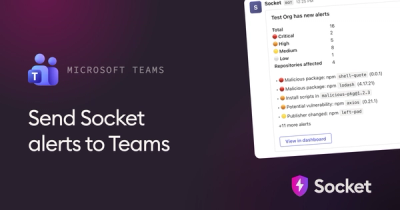
Microsoft Teams Notifications Are Now Available in Socket
Socket can now send alerts and supply chain attack notifications to Microsoft Teams, with filters that route the right updates to each channel.
By Jeppe Hasseriis - Sep 01, 2026
@sentry/node
Advanced tools




npm install @sentry/node
# Or yarn
yarn add @sentry/node
Sentry should be initialized as early in your app as possible. It is essential that you call Sentry.init before you
require any other modules in your application, otherwise auto-instrumentation of these modules will not work.
You need to create a file named instrument.js that imports and initializes Sentry:
// CJS Syntax
const Sentry = require('@sentry/node');
// ESM Syntax
import * as Sentry from '@sentry/node';

Sentry.init({
  dsn: '__DSN__',
  // ...
});
You need to require or import the instrument.js file before importing any other modules in your application. This is
necessary to ensure that Sentry can automatically instrument all modules in your application:
// Import this first!
import './instrument';

// Now import other modules
import http from 'http';

// Your application code goes here
When running your application in ESM mode, you should use the Node.js
--import command line option to ensure that Sentry is loaded before
the application code is evaluated.
Adjust the Node.js call for your application to use the --import parameter and point it at instrument.js, which
contains your Sentry.init() code:
# Note: This is only available for Node v18.19.0 onwards.
node --import ./instrument.mjs app.mjs
If it is not possible for you to pass the --import flag to the Node.js binary, you can alternatively use the
NODE_OPTIONS environment variable as follows:
NODE_OPTIONS="--import ./instrument.mjs" npm run start
@sentry/node installs its automatic (diagnostics-channel) instrumentation through a runtime module
hook that ships in @sentry/server-runtime-injection and is designed to run from node_modules. There are two
supported ways to keep auto-instrumentation working when you bundle your server:
@sentry/server-runtime-injection external (do not inline it into the bundle) so the runtime hook
loads from node_modules. Most bundlers externalize node_modules for a Node target by default;
if yours inlines everything, mark @sentry/server-runtime-injection as external explicitly.@sentry/node/esbuild,
@sentry/node/webpack, @sentry/node/vite, @sentry/node/rollup), which inject the
instrumentation into your bundled dependencies during the build. In this mode the runtime hook is
not needed.If you bundle @sentry/server-runtime-injection and don't use the build-time plugin, its internal code
transformer is stripped and runtime auto-instrumentation is disabled. @sentry/node warns the
first time an instrumented dependency loads uninstrumented, so a build-time-instrumented app never
sees the warning.
Bugsnag provides error monitoring for web, mobile, and server applications. Similar to @sentry/node, it offers real-time error reporting and allows for detailed error diagnostics and performance monitoring. Bugsnag differentiates itself with features tailored to mobile app monitoring.
Rollbar offers real-time error tracking and debugging tools for developers. Like @sentry/node, it supports multiple programming languages and frameworks, including Node.js. Rollbar emphasizes its ability to help teams with workflow integrations and automated error grouping for efficient management.
Raygun provides crash reporting, real-user monitoring, and deployment tracking. It's similar to @sentry/node in its core functionalities of error tracking and performance monitoring but also offers unique features like user journey tracking and version comparisons to understand the impact of deployments.
FAQs
Sentry Node SDK using OpenTelemetry for performance instrumentation
The npm package @sentry/node receives a total of 28,790,174 weekly downloads. As such, @sentry/node popularity was classified as popular.
We found that @sentry/node demonstrated a healthy version release cadence and project activity because the last version was released less than a year ago. It has 1 open source maintainer collaborating on the project.
Product
Socket can now send alerts and supply chain attack notifications to Microsoft Teams, with filters that route the right updates to each channel.

Security News
pnpm 12 rewrites the package manager in Rust, cutting install times by up to 90% while preserving pnpm 11 workflows and lockfiles.
Security News
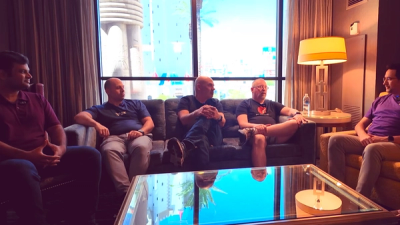
Socket CTO Ahmad Nassri joins AppSec leaders at Black Hat to discuss active malware, package manager risks, and software supply chain defense.