
Product
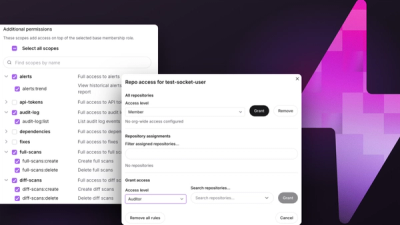
Introducing Repository Access Permissions and Custom Roles
Socket now supports Custom Roles and Repository Access Permissions so organizations can control who can access specific repositories and actions.
By Joe Werle - Jun 19, 2026
@shadowob/connector
Advanced tools
Shadow connector helpers for OpenClaw, Hermes Agent, and cc-connect
Connection helpers for attaching Shadow Buddies to local OpenClaw and CLI runtimes.
The package exports pure plan builders for legacy app UIs and a shadowob-connector CLI for terminal setup.
Run the daemon flow used by the Buddy creation panel:
npx @shadowob/connector@latest --daemon \
  --server-url https://shadowob.com \
  --api-key sk_machine_...
The daemon connects this computer once, scans supported runtimes, sends heartbeats to Shadow, claims Buddy setup jobs, and configures the selected runtime. Supported runtime detection currently includes OpenClaw, Hermes Agent, Claude Code, Codex CLI, OpenCode, Cursor CLI, Kimi CLI, Copilot CLI, and Antigravity CLI.
Research and design notes for runtime session scanning, monitoring, and direct
message push are in docs/agent-runtime-session-monitoring.md.
Desktop builds run the connector through Electron's Node runtime. If the user's
machine does not have Node/npm, the connector downloads a verified official
Node.js runtime under ~/.shadowob/connector/node/, installs Shadow CLI tools
under ~/.shadowob/connector/node-global/, and adds that toolchain plus nvm,
login-shell, and common user bin directories to the runtime PATH.
Use --once to run one heartbeat/job pass for debugging, and --poll-interval-ms to tune the loop interval.
Print a plan:
npx @shadowob/connector@latest plan \
  --target openclaw \
  --server-url https://shadowob.com \
  --token buddy-token
Apply a connector setup:
npx @shadowob/connector@latest connect \
  --target hermes \
  --server-url https://shadowob.com \
  --token buddy-token
--server-url defaults to https://shadowob.com. Use --dry-run to preview writes and commands. Use --json with plan, scan, status, or doctor when embedding output in another tool.
Operational commands:
npx @shadowob/connector@latest scan
npx @shadowob/connector@latest runtime-scan --sessions --json
npx @shadowob/connector@latest runtime-watch --runtime opencode
npx @shadowob/connector@latest runtime-watch --runtime claude-code --json
npx @shadowob/connector@latest session-list --runtime opencode --json
npx @shadowob/connector@latest session-send --runtime opencode --session <session-id> --message "continue"
npx @shadowob/connector@latest status --target cc-connect
npx @shadowob/connector@latest doctor --target hermes
npx @shadowob/connector@latest fix --target openclaw --server-url https://shadowob.com --token buddy-token
npx @shadowob/connector@latest update --target cc-connect --server-url https://shadowob.com --token buddy-token
scan probes local OpenClaw, Hermes Agent, and cc-connect installs/config files, then prints connection instructions for each target.runtime-scan --sessions adds a compact runtime session snapshot for supported
monitor adapters. Initial support covers OpenCode's loopback server and
Claude Code transcript inventory.runtime-watch shows a lightweight terminal monitor panel. With --json, it
emits newline-delimited event JSON for automation.session-list prints normalized runtime session inventory, and
session-send pushes a message to a supported runtime session. OpenCode uses
the documented server API; Claude Code uses a structured claude -p --resume
process adapter.status checks local connector health and exits successfully.doctor prints the same checks with fix guidance and exits non-zero when required config is broken.fix reinstalls common Shadow CLI/skill assets and repairs the target connector config.update refreshes the same assets/config and installs target runtime dependencies by default.connect, fix, and update merge existing configuration instead of replacing it:
shadowob is not
on PATH, the connector writes a ~/.local/bin/shadowob shim; it installs
the official Shadow skill files into common agent skill directories; and it
writes a Buddy profile to ~/.shadowob/shadowob.config.json.~/.openclaw/openclaw.json or --openclaw-config.~/.hermes/.env and merges ~/.hermes/config.yaml.~/.cc-connect/config.toml.Existing model providers, plugins, projects, platforms, and unrelated keys are preserved.
When Shadow's official model proxy is enabled on the server, daemon-created Buddy setup jobs also include an OpenAI-compatible provider. The connector writes it into OpenClaw/Hermes/cc-connect config so a newly installed desktop Buddy has a usable default LLM provider without asking the user for an API key. Manual runs can pass the same values explicitly:
npx @shadowob/connector@latest connect \
  --target cc-connect \
  --server-url https://shadowob.com \
  --token buddy-token \
  --model-provider-base-url https://shadowob.com/api/ai/v1 \
  --model-provider-api-key model-proxy-token \
  --model-provider-model deepseek-v4-flash
npx @shadowob/connector@latest connect \
  --target openclaw \
  --server-url https://shadowob.com \
  --token buddy-token
Equivalent manual steps:
openclaw plugins install @shadowob/openclaw-shadowob
openclaw config set channels.shadowob.token 'buddy-token'
openclaw config set channels.shadowob.serverUrl 'https://shadowob.com'
openclaw gateway restart
OpenClaw resolves the Buddy identity from the token and pulls channel policy dynamically from Shadow.
Reference: OpenClaw's plugin documentation covers openclaw plugins install,
managed plugin roots, and repair/update behavior:
https://docs.openclaw.ai/plugins
npx @shadowob/connector@latest connect \
  --target hermes \
  --server-url https://shadowob.com \
  --token buddy-token
The Hermes plugin is bundled in hermes-shadowob-plugin/. The connector copies it to ~/.hermes/plugins/shadowob, writes the Shadow token/base URL, and enables the plugin.
Hermes does not need agentId or channelId in the setup command. The plugin calls /api/auth/me to resolve the Buddy agent id, then /api/agents/:id/config to receive channel access policy dynamically, matching the OpenClaw plugin behavior. If no channel is available yet, Hermes stays online and waits for a DM, server join, channel membership, or policy update. By default it creates/uses the DM with the Buddy owner as the home channel.
Manual config shape:
plugins:
  enabled:
    - shadowob

platforms:
  shadowob:
    enabled: true
    token: "buddy-token"
    extra:
      base_url: "https://shadowob.com"
      mention_only: false
      rest_only: false
      catchup_minutes: 0
      download_media: true
      slash_commands: []
Optional environment variables:
export SHADOW_BASE_URL="https://shadowob.com"
export SHADOW_TOKEN="buddy-token"
export SHADOW_HEARTBEAT_INTERVAL_SECONDS=30
export SHADOW_SLASH_COMMANDS_JSON='[]'
For the official model proxy, Hermes receives model.provider: custom,
model.base_url, and model.default in ~/.hermes/config.yaml. This follows
Hermes' documented custom OpenAI-compatible endpoint shape:
https://hermes-agent.nousresearch.com/docs/integrations/providers
The connector uses the ShadowOB-capable fork
buggyblues/cc-connect@8289423. It does not install the official npm
cc-connect package, because the npm package currently points to the upstream
chenhg5/cc-connect release line.
npx @shadowob/connector@latest connect \
  --target cc-connect \
  --server-url https://shadowob.com \
  --token buddy-token \
  --work-dir . \
  --project-name shadow-buddy \
  --agent-type codex \
  --install \
  --start
With --install, the CLI first tries the fork's GitHub release asset matching
the local OS/CPU and verifies its pinned SHA-256. If the fork release asset is
missing or does not match, it pulls the pinned source archive, builds a no_web
Go binary, caches it under
~/.shadowob/connector/cc-connect/8289423/bin/, and starts that binary when
--start is present.
The fork is published as GitHub release
https://github.com/buggyblues/cc-connect/releases/tag/v1.3.3-beta.11. It is
merged from upstream chenhg5/cc-connect and preserves the ShadowOB platform.
Upstream usage docs cover supported agents, providers, /model, /dir, voice,
attachments, cron, daemon mode, and web management:
https://github.com/chenhg5/cc-connect/blob/main/docs/usage.zh-CN.md
Equivalent TOML:
language = "zh"

[[projects]]
name = "shadow-buddy"

[projects.agent]
type = "codex"

[projects.agent.options]
work_dir = "."
provider = "shadow-official"
model = "deepseek-v4-flash"

[[projects.agent.providers]]
name = "shadow-official"
api_key = "model-proxy-token"
base_url = "https://shadowob.com/api/ai/v1"
model = "deepseek-v4-flash"

[[projects.agent.providers.models]]
model = "deepseek-v4-flash"

[[projects.platforms]]
type = "shadowob"

[projects.platforms.options]
token = "buddy-token"
server_url = "https://shadowob.com"
allow_from = "*"
listen_dms = true
share_session_in_channel = false
progress_style = "compact"
import { createConnectorPlan, createConnectorPlans } from '@shadowob/connector'

const hermes = createConnectorPlan({
  target: 'hermes',
  serverUrl: 'https://shadowob.com',
  token: 'buddy-token',
})

const allPlans = createConnectorPlans({
  serverUrl: 'https://shadowob.com',
  token: 'buddy-token',
})
pnpm --filter @shadowob/connector test
pnpm -C packages/connector typecheck
pnpm -C packages/connector build
uv run --project .tmp/hermes-agent --with pytest python -m pytest packages/connector/hermes-shadowob-plugin/tests
The tests cover plan generation, config merging for OpenClaw/Hermes/cc-connect, and Hermes dynamic channel behavior without static agentId or channelId arguments.
FAQs
Shadow connector helpers for OpenClaw, Hermes Agent, and cc-connect
We found that @shadowob/connector demonstrated a healthy version release cadence and project activity because the last version was released less than a year ago. It has 1 open source maintainer collaborating on the project.
Did you know?

Socket for GitHub automatically highlights issues in each pull request and monitors the health of all your open source dependencies. Discover the contents of your packages and block harmful activity before you install or update your dependencies.
Product
Socket now supports Custom Roles and Repository Access Permissions so organizations can control who can access specific repositories and actions.
Product
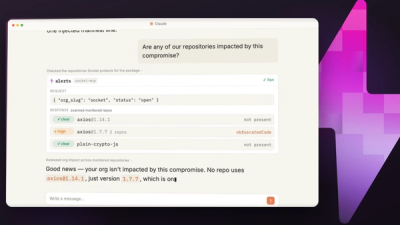
Socket MCP now lets AI assistants review org alerts, investigate threats using the Socket threat feed, and inspect package files in addition to dependency scoring.
Product
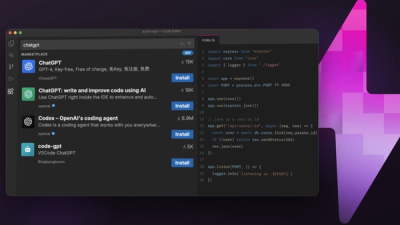
Socket Firewall blocks malicious VS Code and Open VSX extensions before install, protecting developers from compromised editor marketplaces.