

Security News
/Company News
Securing the Financial Frontier: How Capital One Uses Socket for Open Source Security
Capital One is partnering with Socket to proactively secure its open source supply chain.
By Sarah Gooding - Oct 01, 2026
@ship-safe/mcp
Advanced tools
ShipSafe MCP server — let your AI coding agent scan the code it writes for security vulnerabilities, in-loop
A Model Context Protocol server that lets your AI coding agent (Cursor, Claude Code, Claude Desktop, Windsurf, …) scan the code it writes for security vulnerabilities — in-loop, without leaving the editor.
It runs ShipSafe's fast local pattern scan for free (secrets, injection, broken auth/IDOR, misconfig) plus a dependency CVE scan of your lockfiles (package-lock.json, pnpm-lock.yaml, yarn.lock, requirements.txt, go.sum, Gemfile.lock) via the OSV database. With a Growth or Shield login it also runs AI deep analysis and can generate a one‑paste fix prompt. Your code is never stored.
| Tool | What it does | Auth |
|---|---|---|
shipsafe_scan | Scan a directory; returns plain‑English findings with the exact fix for each, plus structured output (see below). | Free (local). AI analysis needs Growth/Shield. |
shipsafe_fix_prompt | Scan, then return one paste‑ready prompt that fixes everything, tailored to the detected AI builder. | Growth / Shield |
shipsafe_status | Show login state, plan, and remaining AI scan quota. | — |
shipsafe_login | Log in from the editor: call once for a browser URL + code, then again with the returned device_code to finish. | — |
Secrets that show up in findings are masked ([REDACTED]) before anything is echoed back to the agent, so a model can't quote a real credential into its transcript.
shipsafe_scan inputs| Input | Type | Purpose |
|---|---|---|
path | string | Directory to scan (defaults to cwd). |
severity | critical|high|medium|low | Only return findings at or above this severity. |
ai | boolean | Run AI deep analysis (needs Growth/Shield). On by default for paid users. |
paths | string[] | Scan only these files/dirs (inside the project) — e.g. the files you just edited. Fast inner loop. |
changedOnly | boolean | Scan only files changed vs git HEAD + new untracked files. Falls back to a full scan if not a git repo. |
upload | boolean | Save the scan to your ShipSafe dashboard (needs login) and return a shareable dashboardUrl. Off by default. |
Alongside the human‑readable report, shipsafe_scan returns machine‑readable structuredContent an agent can branch on:
clean (boolean) and counts (by severity) — a greppable pass/fail, so you never have to parse prose.findings[] — each with key, severity, file, line, cwe, plainEnglish, fixDescription, fixSuggestion.scanned — { mode: "full" | "targeted", sourceFiles, dependencyFiles }.diff (full‑project scans only) — { resolved, stillOpen, introduced } vs your previous scan of the same directory, so a scan → fix → re-scan loop can confirm a fix actually worked. The diff state is kept locally under ~/.shipsafe/mcp-history and never leaves your machine.Failures (no source files, generation errors, not logged in) are returned with isError: true, so "couldn't run" is never mistaken for "ran clean".
Published, including the misses — the numbers below come from a public benchmark of 1,147 labelled cases (569 vulnerable, 578 clean twins), scored with a per-category confusion matrix.
| Layer | Precision | Recall |
|---|---|---|
| Pattern scan (free) | 93.2% | 43.4% |
| With AI analysis | 72.7% | 84.5% |
| With AI, held-out slice | — | 82.0% |
The free pattern layer is deliberately high-precision and low-recall: it is tuned to almost never cry wolf, which means it misses more than half of what a deep scan finds. The AI pass roughly doubles recall and gives up some precision to do it. Neither layer certifies that an app is secure, and no scanner can.
Full method, per-category breakdown and every miss: https://ship-safe.co/benchmark
The free local + dependency scan works with no login. To unlock AI deep analysis and fix prompts, log in either way:
shipsafe_login tool, which gives you a browser URL + code and finishes once you authorize.npx @ship-safe/cli login.Both write ~/.shipsafe/token.json, which this MCP server reads, so a single login covers the CLI and the MCP.
.cursor/mcp.json (project) or ~/.cursor/mcp.json (global){
"mcpServers": {
"shipsafe": { "command": "npx", "args": ["-y", "@ship-safe/mcp"] }
}
}
claude mcp add shipsafe -- npx -y @ship-safe/mcp
claude_desktop_config.json{
"mcpServers": {
"shipsafe": { "command": "npx", "args": ["-y", "@ship-safe/mcp"] }
}
}
Then ask the agent: "scan this project with ShipSafe and fix what it finds."
| Env var | Default | Purpose |
|---|---|---|
SHIPSAFE_API_URL | https://ship-safe.co | Point at a local/staging backend (e.g. http://localhost:3000). |
pnpm install
pnpm --filter @shipsafe/shared --filter @shipsafe/scanner build
pnpm --filter @ship-safe/mcp build
# run the built server directly (stdio):
node apps/mcp/dist/index.js
FAQs
ShipSafe MCP server — the independent verifier for AI-built apps: your AI coding agent checks the code it writes, in-loop
The npm package @ship-safe/mcp receives a total of 631 weekly downloads. As such, @ship-safe/mcp popularity was classified as not popular.
We found that @ship-safe/mcp demonstrated a healthy version release cadence and project activity because the last version was released less than a year ago. It has 1 open source maintainer collaborating on the project.
Security News
/Company News
Capital One is partnering with Socket to proactively secure its open source supply chain.
Security News
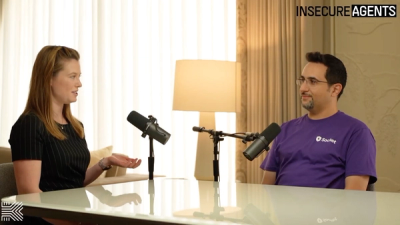
Socket CTO Ahmad Nassri discusses how to keep AI agents from bypassing package blocks, limit credential access, and monitor their actions.

Security News
GPT-6 Astra tried to plant malicious code in simulated open source projects using fake GitHub accounts and deceptive PRs during an assigned CTF challenge.