

Product
PHP and Composer Support Is Now in Beta
Socket’s PHP and Composer support is now in Beta for all customers, with PHP reachability analysis generally available.
By Trevor Norris, Benjamin Barslev - Aug 21, 2026
@shipeasy/cli
Advanced tools
The command-line companion for Shipeasy — feature flags, A/B experiments, dynamic configs, kill switches, i18n, and in-app feedback + production-error tracking.
One command does the whole onboarding — log in, bind a project, detect your coding agents, register the Shipeasy MCP server + skills, and hand the in-repo SDK wiring to your agent:
npx @shipeasy/cli setup
setup walks through:
.shipeasy file so the CLI, MCP
server, and CI all agree on the project.@shipeasy/mcp) in
the right config for each agent and drops a universal AGENTS.md plus
per-agent rules (.cursor/rules/shipeasy.mdc,
.github/copilot-instructions.md). For Claude Code it installs the
marketplace plugin (commands + skills + MCP)./shipeasy:setup) to install
@shipeasy/sdk, wire your entry points, and persist keys.| Flag | Description |
|---|---|
--yes | Non-interactive: bind the current session's project and wire all detected agents. |
--agents <list> | Comma list to wire explicitly: claude,cursor,codex,copilot,jules. |
--domain <domain> | Production domain, passed to the Claude /shipeasy:setup step. |
--scope user|project | MCP config scope (default project). |
--no-claude-run | Don't launch Claude Code for the in-repo wiring step. |
--dry-run | Show what would change without writing files or launching anything. |
setup is idempotent — safe to re-run. In CI (or any non-TTY) it runs
non-interactively; provide credentials via SHIPEASY_CLI_TOKEN +
SHIPEASY_PROJECT_ID.
| Agent | MCP registration | Instructions |
|---|---|---|
| Claude Code | marketplace plugin (claude plugin install shipeasy@shipeasy) → else .mcp.json | plugin skills + AGENTS.md |
| Cursor | .cursor/mcp.json | .cursor/rules/shipeasy.mdc + AGENTS.md |
| OpenAI Codex | codex mcp add → else ~/.codex/config.toml snippet | AGENTS.md |
| GitHub Copilot | .vscode/mcp.json (servers) | .github/copilot-instructions.md + AGENTS.md |
| Google Jules | connect @shipeasy/mcp in Jules settings (cloud) | AGENTS.md |
Run shipeasy --help for the full list. Common ones:
shipeasy login            # PKCE device-flow auth (no-op if already logged in)
shipeasy whoami           # show auth state + active project
shipeasy bind [id]        # bind the current directory to a project
shipeasy mcp install      # (re)register the MCP server only
shipeasy scan             # detect language, framework, and SDK state
shipeasy flags list       # gates, configs, killswitches, experiments, metrics …
Every command, argument, flag, and usage example is documented at:
📖 https://docs.shipeasy.ai/get-started/cli-reference
That page is generated directly from this CLI's command definitions (the same
source that powers --help), so it never drifts from the installed binary. Add
--help to any command for the same details in your terminal, e.g.
shipeasy experiments create --help.
MIT
FAQs
CLI for the Shipeasy platform (flags, experiments, translations, bugs)
The npm package @shipeasy/cli receives a total of 69 weekly downloads. As such, @shipeasy/cli popularity was classified as not popular.
We found that @shipeasy/cli demonstrated a healthy version release cadence and project activity because the last version was released less than a year ago. It has 1 open source maintainer collaborating on the project.
Product
Socket’s PHP and Composer support is now in Beta for all customers, with PHP reachability analysis generally available.
Product
Socket is bringing experimental protection to Firefox, scanning 97,000+ extensions in Mozilla's official directory for malware and risky updates.
Research
/Security News
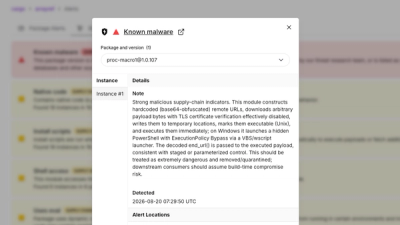
Three compromised Rust crates pulled in a malicious dependency that downloaded and executed cross-platform malware during Cargo builds.