

Company News
AWS Security Hub Adds Socket for Supply Chain Security
Socket is now in the AWS Security Hub Extended plan. Adopt it through AWS, apply committed spend, and block malicious open source packages.
By Feross Aboukhadijeh - Aug 04, 2026
@sisense/mcp-server
Advanced tools
MCP server leveraging Sisense Intelligence for actionable insights and analytics.
A Model Context Protocol (MCP) server that provides integration with Sisense analytics platform. This server enables LLMs to interact with Sisense data models and create charts programmatically.
streamable-http) for HTTP-based MCP clients (for example Claude Desktop, Cursor)getDataSources: Retrieve Sisense data sources (or data models)getDataSourceFields: List all available fields for a specific data sourcebuildChart: Build charts from natural language promptsbuildQuery (optional): Run analytics queries when TOOL_BUILD_QUERY_ENABLED / toolBuildQueryEnabled is enabledbuildChart exposes an interactive View that renders the chart in an iframe within the app..env, run, MCP client setupnpm)dev, build, start, tests): the bun package is a devDependency, so after npm install or bun install the Bun binary is available under node_modules/.bin—a global Bun install is not required. A global Bun install is optional.bun install / npm install via postinstall)bun install
# or
npm install
Start the server:
# Development mode (hot reload)
bun run dev
# or
npm run dev

# Production mode
bun run build && bun run start
# or
npm run build && npm run start
Sessions are in-memory — chart state is lost if the server restarts.
The server prints something like the following (port defaults to 3001, or PORT if set):
Sisense MCP Server running on http://localhost:3001

Connect with:
  http://localhost:3001/mcp?sisenseUrl=<SISENSE_URL>&sisenseToken=<SISENSE_TOKEN>
  Or set SISENSE_URL and SISENSE_TOKEN in the environment and use http://localhost:3001/mcp

Optional feature-flag query params (override env vars per connection):
  mcpAppEnabled=true|false, toolBuildQueryEnabled=true|false, toolBuildChartNarrativeEnabled=true|false

Endpoints:
  Health: http://localhost:3001/health
  Screenshots: http://localhost:3001/screenshots/
Use an MCP streamable HTTP URL. For Cursor, Claude Desktop, and similar clients, add a server entry with the MCP path (not a shell command such as bun run dev or npm run dev).
If SISENSE_URL and SISENSE_TOKEN are set in the server environment (for example in .env loaded by the process that runs bun run dev or npm run dev), the client URL does not need to include credentials:
{
  "mcpServers": {
    "sisense-analytics": {
      "url": "http://localhost:3001/mcp"
    }
  }
}
Note: Depending on your network or client environment, the localhost HTTP setup may not connect. In those cases, you will need to expose your local server publicly via HTTPS using a proxy service such as ngrok. Point the client at your HTTPS tunnel URL with the same /mcp path (and query parameters if you are not using server env credentials).
Credentials: If you do not use server env vars, put sisenseUrl and sisenseToken on the MCP URL as query parameters (URL params take precedence over env when both are present). Always percent-encode each value — see Configuration: URL encoding for details and examples.
Alternative connection patterns (placeholders only; use encoded values for real credentials):
http://localhost:3001/mcp?sisenseUrl=https://your-instance.sisense.com&sisenseToken=your-api-token
With SISENSE_URL and SISENSE_TOKEN in the server environment only:
http://localhost:3001/mcp
Behind a public HTTPS tunnel (example):
https://your-ngrok-url.ngrok-free.app/mcp?sisenseUrl=https://your-instance.sisense.com&sisenseToken=your-api-token
| Parameter | Description |
|---|---|
sisenseUrl | Full URL to your Sisense instance (e.g., https://instance.sisense.com). In the query string, pass the value percent-encoded. |
sisenseToken | Sisense API authentication token. In the query string, pass the value percent-encoded (required if the token contains &, =, +, etc.). |
PORT | (Optional) Server port, defaults to 3001 |
The server automatically derives its public base URL from request headers, so it works correctly behind proxies like ngrok. For how to build encoded MCP URLs, see URL encoding for query parameters.
Defaults suit most setups; change flags when you need a specific client behavior. For when to use each flag, copy-paste URL patterns, and env vs query string, see docs/guides/configuration.md.
These query params override the corresponding env vars on a per-connection basis. Accepted values: true, false, 1, 0 (case-insensitive).
| Query parameter | Env var equivalent | Default | Description |
|---|---|---|---|
mcpAppEnabled | MCP_APP_ENABLED | true | Renders the chart in an interactive app UI (supported in Claude); set to false for tool mode (image/screenshot output) |
toolBuildQueryEnabled | TOOL_BUILD_QUERY_ENABLED | false | Enable the buildQuery tool for executing analytics queries |
toolBuildChartNarrativeEnabled | TOOL_BUILD_CHART_NARRATIVE_ENABLED | true | Include NLG narrative/insights in the build chart tool response |
Example URL with all three overrides (encode sisenseUrl and sisenseToken values when they are not simple alphanumeric placeholders):
http://localhost:3001/mcp?sisenseUrl=https://your-instance.sisense.com&sisenseToken=your-api-token&mcpAppEnabled=false&toolBuildQueryEnabled=true&toolBuildChartNarrativeEnabled=false
# Run server in development mode with hot reload
bun run dev
# or npm run dev

# Build the project (View + server)
bun run build
# or npm run build

# Build only the analytics View (dist/view.html)
bun run build:view
# or npm run build:view

# Run tests
bun test
# or npm test (same as npm run test)

# Type checking
bun run type-check
# or npm run type-check

# Lint
bun run lint
# or npm run lint
⚠️ NEVER commit credentials to version control
⚠️ Use secret managers or vaults - NOT environment variables in production
⚠️ NEVER bind to 0.0.0.0 in production - use 127.0.0.1 or Unix socket
⚠️ Recommended: Use dev or staging Sisense when you have them. Autonomous AI clients can issue many API calls, and prompts can be ambiguous. Non-production reduces the impact of mistakes and surprises.
⚠️ Enable authentication - never run without auth
⚠️ Approve EVERY tool call - review all parameters before execution
⚠️ Create dedicated Sisense service account with minimum required permissions
⚠️ Rotate credentials regularly (every 90 days recommended)
FAQs
MCP server leveraging Sisense Intelligence for actionable insights and analytics.
The npm package @sisense/mcp-server receives a total of 20 weekly downloads. As such, @sisense/mcp-server popularity was classified as not popular.
We found that @sisense/mcp-server demonstrated a healthy version release cadence and project activity because the last version was released less than a year ago. It has 3 open source maintainers collaborating on the project.
Did you know?

Socket for GitHub automatically highlights issues in each pull request and monitors the health of all your open source dependencies. Discover the contents of your packages and block harmful activity before you install or update your dependencies.
Company News
Socket is now in the AWS Security Hub Extended plan. Adopt it through AWS, apply committed spend, and block malicious open source packages.
Research
/Security News
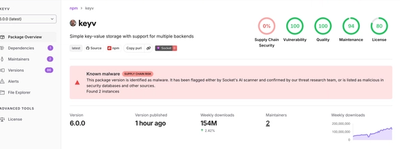
Popular npm packages keyv and cacheable compromised.

Security News
A misconfiguration gave three Anthropic models internet access, and one, believing it was in a simulation, shipped a credential-stealing package to PyPI.