

Product
PHP and Composer Support Is Now in Beta
Socket’s PHP and Composer support is now in Beta for all customers, with PHP reachability analysis generally available.
By Trevor Norris, Benjamin Barslev - Aug 21, 2026
@sonenta/cli
Advanced tools
Command-line interface for Sonenta translation management. Sits next to the API and the React SDK; calls into the public HTTP surface using a Sonenta API key.
npm install -g @sonenta/cli
# or
npx @sonenta/cli --help
# 1. Authenticate (the key must carry the `mcp:*` scope — see Auth below)
sonenta login --host https://api.sonenta.com --token vrb_live_<prefix>.<secret>

# 2. Bind the current directory to a project
sonenta init --project 069fc15d-…  --version main

# 3. Import an i18next file in one shot
sonenta import locales/fr/common.json
Two files are involved:
sonenta.config.json — per-project, committed to the repo.
Contains the host + project_uuid + version_slug. Any command resolves
it by walking up from the current directory.sonenta init also writes an idempotent, marker-delimited Sonenta managed
block into CLAUDE.md and AGENTS.md at the repo root, so any coding agent
that reads those files knows the project id, source language, namespaces, CDN
host, how to edit/publish translations, and how to add the @sonenta/mcp MCP
server. Re-running sonenta init --force refreshes the block in place (your own
content outside the markers is never touched); when you are logged in it is
populated live from GET /v1/me + project info. Pass --no-repo-doc to skip it.
~/.sonenta/credentials — per-user, never committed.
JSON file with mode 0600 keyed by host so the same user can hold
credentials for multiple Sonenta deployments simultaneously
(e.g. cloud + local dev + self-hosted prod). The currently active
host is recorded as default.The credentials file shape:
{
  "default": "https://api.sonenta.com",
  "hosts": {
    "https://api.sonenta.com":     { "api_key": "vrb_live_…", "user_email": "…" },
    "https://api.dev.sonenta.ca": { "api_key": "vrb_live_…" }
  }
}
All project commands talk to the metered MCP surface
(/v1/mcp/projects/{id}/…) and require an API key carrying the mcp:*
scope (see Auth).
| Command | Purpose |
|---|---|
login / logout | Store / remove an API key for a host |
whoami | Show the active host + masked key |
init | Scaffold sonenta.config.json + write a managed Sonenta block into CLAUDE.md / AGENTS.md |
projects list | List projects the key can reach |
keys list | List keys (namespace_slug/key_name) |
import <files…> | One-shot import of i18next JSON (nested or flat) — creates keys + upserts translations |
push | Push the whole local locales/ tree in one import call |
pull | Pull translations into locales/<lang>/<namespace>.json |
export | Export translations as i18next JSON (flat, or --nested) |
status | Diff local locales/ against the remote project |
releases publish | Trigger a CDN release (publish bundles) |
snapshot | Emit a build-time initialBundles module for @sonenta/react-i18next |
missing | List runtime-detected missing keys |
agents list | List the bundled Claude agents available to install |
agents add <name> | Write a bundled agent into .claude/agents/<name>.md |
Mutating commands accept --dry-run and print a created / updated / unchanged
summary.
agents add drops a ready-made Claude agent into the project's
.claude/agents/ directory — usable interactively in Claude Code or headless in
CI. The bundled agents are local-first and CRUD-based: they do the work
themselves and write it back via plain CRUD tools (0 Sonenta AI credits;
changes land as drafts or soft/restorable for review); any server-side AI is an
explicit, estimated, opt-in fallback.
sonenta-a11y — accessibility auditor. Drives the Sonenta a11y MCP tools
(a11y_report, list_a11y_gaps, set_a11y_variant, plus the
generate_a11y_variant / translate_a11y_variants fallback) to find WCAG gaps
— missing aria-labels, images without alt text, hard-to-read copy, missing or
untranslated a11y variants — and fix them. Also scores plain-language difficulty
locally (list_cognitive_candidates → set_cognitive_score, 0 credits) and
suggests clearer rewrites.sonenta-i18n — i18n automation. Audits coverage (coverage_report,
list_missing_keys), creates missing keys (create_keys_bulk), translates the
untranslated itself honoring the glossary + project context
(list_untranslated_keys → propose_translations_bulk), and publishes
(publish_cdn).sonenta-source-health — duplicate-source repairer. Finds keys that share
the same source string and fixes them, strictly step by step and only on your
acceptance. When the Sonenta dashboard has prepared a merge plan (surfaced via
list_source_duplicates → merge_plan), it applies it verbatim: repoints
t('redundant') → t('canonical') in your code and trashes the redundant keys
(delete_keys_bulk, value-safe & restorable — never edits a source value),
then per survivor_outcome marks the residue allowed (set_duplicate_status)
or differentiates the survivors (update_key). With no plan it falls back to
its own consolidate / disambiguate / allow judgment.sonenta-knowledge — knowledge manager. Builds and maintains the project's
glossary (glossary_list / glossary_create / glossary_update;
translation rules, do-not-translate, forbidden) and context document
(project_context_get / project_context_set; domain, audience, tone, product
name) from the real source strings (list_keys) + repo docs. Three modes:
INIT (bootstrap from scratch), AUDIT (report current state + gaps,
read-only), MAINTAIN (detect new terms, inconsistent usage, and context
drift, then propose updates). Non-destructive — proposes and confirms before
overwriting (the context set replaces the whole doc, so it always merges
first).# see what's available (and what's already installed)
sonenta agents list
# install an agent into .claude/agents/
sonenta agents add sonenta-a11y
sonenta agents add sonenta-i18n
sonenta agents add sonenta-source-health
sonenta agents add sonenta-knowledge
The agents reach these tools through the
@sonenta/mcp server, so configure
that server with an mcp:* key first. --dir <path> targets another project
directory; --force overwrites an existing definition.
# import an i18next file (language + namespace inferred from the path)
sonenta import locales/fr/common.json
# …or a bare file with an explicit namespace
sonenta import --namespace common fr.json

# preview, then push the whole locales/ tree in ONE call
sonenta push --dry-run
sonenta push

# pull remote translations back to disk; diff before committing
sonenta pull --language fr
sonenta status

# publish to the CDN; generate a build-time SDK fallback bundle
sonenta releases publish
sonenta snapshot --out src/sonenta-bundles.ts
Every call emits Authorization: ApiKey <prefix>.<secret> (capital A, lowercase
k) against the MCP surface, so the API key must carry the mcp:* scope.
Generate one in the dashboard at Org Settings → API Keys. The key is supplied
by you — via sonenta login, the SONENTA_TOKEN env var (handy for CI), or
~/.sonenta/credentials — and is never hard-coded.
sonenta login validates before storing. It checks the key against
GET /v1/me and only stores it when the key is valid and the account is
active — an invalid key or an inactive account is rejected with a clear message
and nothing is written.
Value commands require an active login. agents add, import, push,
pull, export, status, releases publish, snapshot, missing,
keys list, and projects list verify you're logged in with an active account
(via /v1/me) before they act — otherwise you get
Not logged in. Run \sonenta login`orAccount inactive …. The local commands login, logout, whoami, init, and agents list` are not gated.
Credentials live in ~/.sonenta/credentials (mode 0600); the legacy
~/.verbumia/credentials is still read as a fallback, and the next write
migrates you to ~/.sonenta.
0.2.0 migration (breaking): the whole CLI moved from the project REST surface (
/v1/projects/…, project-scoped keys) to the MCP surface (/v1/mcp/projects/…). Re-issue your CLI key with themcp:*scope — project-scoped keys now return403.
MIT
FAQs
Command-line interface for Sonenta translation management.
The npm package @sonenta/cli receives a total of 3,633 weekly downloads. As such, @sonenta/cli popularity was classified as popular.
We found that @sonenta/cli demonstrated a healthy version release cadence and project activity because the last version was released less than a year ago. It has 1 open source maintainer collaborating on the project.
Product
Socket’s PHP and Composer support is now in Beta for all customers, with PHP reachability analysis generally available.
Product
Socket is bringing experimental protection to Firefox, scanning 97,000+ extensions in Mozilla's official directory for malware and risky updates.
Research
/Security News
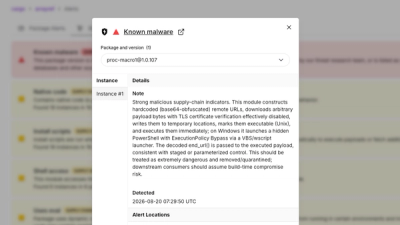
Three compromised Rust crates pulled in a malicious dependency that downloaded and executed cross-platform malware during Cargo builds.