

Company News
AWS Security Hub Adds Socket for Supply Chain Security
Socket is now in the AWS Security Hub Extended plan. Adopt it through AWS, apply committed spend, and block malicious open source packages.
By Feross Aboukhadijeh - Aug 04, 2026
@standardserver/peer
Advanced tools





@standardserver/peer adapts message-based transports to the transport-agnostic request and response model defined by Standard Server.
Standard Server provides a unified interface for client-server communication across HTTP and message-based transports. It lets you write handlers and clients against the same request, response, body, and streaming primitives whether the underlying transport is Fetch, Node.js HTTP, WebSocket, MessagePort, or another peer-style channel.
This package is the peer adapter for that model. It converts between Standard Server requests and responses and a structured peer message protocol that can be sent through any transport capable of carrying strings or binary data.
The package exports a single entry point:
| Export | Purpose |
|---|---|
@standardserver/peer | Peer adapter helpers for requests, responses, codecs, streams, and validators |
The main entry point exposes four groups of helpers:
| Group | Exports | Purpose |
|---|---|---|
| Peer runtime | ClientPeer, ServerPeer | Send Standard Server requests and responses over a peer transport |
| Message codec | encodePeerMessage(), decodePeerMessage() | Encode peer messages as strings or bytes for transport |
| Stream utilities | toAsyncIteratorObject(), EventStreamTransmitter, HibernationAsyncIteratorClass | Bridge peer messages with Standard Server event-stream semantics |
| Types and validators | PeerMessage, PeerRequestMessage, PeerResponseMessage, PeerCancelMessage, PeerEventStreamMessage, PeerOctetStreamMessage, PeerStreamCancelMessage, ClientPeerSendMessage, ServerPeerSendMessage, isPeerMessage(), isPeerRequestMessage(), isPeerResponseMessage(), isPeerCancelMessage(), isPeerEventStreamMessage(), isPeerOctetStreamMessage(), isPeerStreamCancelMessage(), isClientPeerSendMessage(), isServerPeerSendMessage() | Describe and validate the peer protocol payloads |
Use these helpers when you want Standard Server handlers or clients to run over message-based transports such as MessagePort, WebSocket, Electron IPC, or a custom channel.
ClientPeer starts a request and waits for a StandardLazyResponse. ServerPeer receives peer messages, reconstructs a StandardLazyRequest, calls your handler, and sends the resulting StandardResponse back over the same transport.
import type { StandardLazyRequest, StandardResponse } from '@standardserver/core'
import {
  ClientPeer,
  decodePeerMessage,
  encodePeerMessage,
  isClientPeerSendMessage,
  isServerPeerSendMessage,
  ServerPeer,
} from '@standardserver/peer'

async function handle(request: StandardLazyRequest): Promise<StandardResponse> {
  const body = await request.resolveBody()

  return {
    status: 200,
    headers: { 'content-type': 'application/json' },
    body: {
      ok: true,
      method: request.method,
      url: request.url,
      received: body,
    },
  }
}

const { port1, port2 } = new MessageChannel()

const clientPeer = new ClientPeer(async (message) => {
  port1.postMessage(await encodePeerMessage(message, { /** options */ }))
})

const serverPeer = new ServerPeer(async (message) => {
  port2.postMessage(await encodePeerMessage(message, { /** options */ }))
})

port1.addEventListener('message', async (event) => {
  const decoded = decodePeerMessage(event.data, { /** options */ })

  if (decoded.matched && isServerPeerSendMessage(decoded.message)) {
    await clientPeer.message(decoded.message)
  }
})

port2.addEventListener('message', async (event) => {
  const decoded = decodePeerMessage(event.data, { /** options */ })

  if (decoded.matched && isClientPeerSendMessage(decoded.message)) {
    await serverPeer.message(decoded.message, handle)
  }
})

port1.start()
port2.start()

const response = await clientPeer.request({
  method: 'POST',
  url: '/echo',
  headers: { 'content-type': 'application/json' },
  body: { message: 'hello' },
})

const payload = await response.resolveBody()
[!TIP] When encoding or decoding peer messages, you can pass additional options, such as
prefix, to prevent collisions when the same peer is used for multiple purposes.
Use encodePeerMessage() and decodePeerMessage() to bridge between the peer protocol and your underlying transport.
import { decodePeerMessage, encodePeerMessage } from '@standardserver/peer'

const encoded = await encodePeerMessage(
  {
    id: '1',
    kind: 'request',
    json: { method: 'GET', url: '/health', headers: {}, body: undefined },
  },
  { prefix: 'rpc:' },
)

const decoded = decodePeerMessage(encoded, { prefix: 'rpc:' })

if (decoded.matched) {
  console.log(decoded.message.kind)
}
Encoding rules:
Uint8Array values containing JSON, a delimiter byte, and the raw binary bytes.prefix lets you share the same transport between multiple protocols without collisions.For the higher-level project overview, see the root Standard Server README.
Like what we build over at middleapi? You can help keep it going here: GitHub Sponsors. Every bit helps! 🚀
 ScreenshotOne.com |
 村上さん |
 LN Markets |
 Reece McDonald |  nk |  supastarter |  Dexter Miguel |  herrfugbaum |  Ryota Murakami |
 David Cramer |  Valerii Petryniak |  Valerii Strilets |  Kyle Mistele |  christ12938 |  Ryan Soderberg |
 shota |  Ellis Driscoll |
 David Walsh |  Robbe Vaes |  Aidan Sunbury |  soonoo |  Kevin Porten |  Denis |  Christopher Kapic |
 Tom Ballinger |  Sam |  Titoine |  Igor Makowski |  hanayashiki |  Lev Dubinets |  Kelly Peilin Chan |
 Guy Ariely |  Alex |  Andrey Gubanov |


FAQs
Unknown package
The npm package @standardserver/peer receives a total of 16,094 weekly downloads. As such, @standardserver/peer popularity was classified as popular.
We found that @standardserver/peer demonstrated a healthy version release cadence and project activity because the last version was released less than a year ago. It has 1 open source maintainer collaborating on the project.
Did you know?

Socket for GitHub automatically highlights issues in each pull request and monitors the health of all your open source dependencies. Discover the contents of your packages and block harmful activity before you install or update your dependencies.
Company News
Socket is now in the AWS Security Hub Extended plan. Adopt it through AWS, apply committed spend, and block malicious open source packages.
Research
/Security News
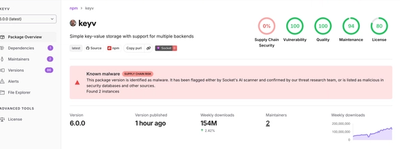
Popular npm packages keyv and cacheable compromised.

Security News
A misconfiguration gave three Anthropic models internet access, and one, believing it was in a simulation, shipped a credential-stealing package to PyPI.