

Company News
AWS Security Hub Adds Socket for Supply Chain Security
Socket is now in the AWS Security Hub Extended plan. Adopt it through AWS, apply committed spend, and block malicious open source packages.
By Feross Aboukhadijeh - Aug 04, 2026
@suparse/mcp
Advanced tools
MCP stdio server for the Suparse Document Processing API.
Use this package to connect Suparse document extraction to local MCP clients such as Claude Code and Codex.
The MCP server reads credentials from:
SUPARSE_API_KEY~/.config/suparse/config.jsonYou can optionally override the API base URL with SUPARSE_API_URL, or pass api_url to individual MCP tools.
claude mcp add suparse -e SUPARSE_API_KEY=your_api_key -- npx -y @suparse/mcp
Open your config file at ~/Library/Application Support/Claude/claude_desktop_config.json
on Mac or %APPDATA%\Claude\claude_desktop_config.json on Windows. Add Suparse to
the mcpServers section:
{
  "mcpServers": {
    "suparse": {
      "command": "npx",
      "args": ["-y", "@suparse/mcp"],
      "env": {
        "SUPARSE_API_KEY": "your_api_key"
      }
    }
  }
}
Add this to ~/.codex/config.toml or a project-scoped .codex/config.toml:
[mcp_servers.suparse]
command = "npx"
args = ["-y", "@suparse/mcp"]

[mcp_servers.suparse.env]
SUPARSE_API_KEY = "your_api_key"
extract_file: Process one local document. Defaults to result_mode: "defer", returning compact task_id/document_ids metadata for later download_results. Use result_mode: "return_json" only when the full JSON extraction is needed in the MCP response.extract_folder: Process supported files in one local folder. Defaults to result_mode: "defer", returning compact task_id/document_ids metadata for later download_results. Use result_mode: "return_json" only when full JSON extractions are needed in the MCP response.list_templates: List summary metadata for templates available to the authenticated account.fetch_json_results: Fetch JSON extraction results by document ID directly in the MCP response. Use only when full JSON is needed in context.download_results: Fetch an export by document ID and write it directly to local disk. Use this for json, csv, xlsx, and google_sheets.delete_documents: Delete documents by ID.fetch_json_results accepts:
| Input | Values | Default |
|---|---|---|
export_type | original, unified | unified |
JSON exports are returned as structured results.
download_results accepts json, csv, xlsx, and google_sheets, plus an optional output_path local file path or existing directory. It writes the export directly to disk and returns the saved output_path. MCP clients should use download_results for CSV, XLSX, Google Sheets, and saved JSON files; they should not fetch base64 data and decode it with shell or Python.
result_mode controls whether extraction results in JSON format are returned directly. Use return_json only when you need the full JSON extraction in the MCP response. In all other cases you can retrieve the results in the format of your choice using download_results.
Important: cleanup on extract_file and extract_folder is only valid with result_mode: "return_json". It fetches JSON and then deletes the processed Suparse documents, so later exports cannot be fetched from those document IDs. For CSV/XLSX/Google Sheets or saved JSON files, run extract_file or extract_folder with result_mode: "defer", call download_results, then call delete_documents.
Build the package:
pnpm --filter @suparse/mcp build
Test with MCP Inspector:
npx @modelcontextprotocol/inspector node packages/mcp/dist/index.mjs
The MCP server uses stdout for JSON-RPC protocol messages. Do not add console.log output to the server path; use stderr or MCP tool responses.
FAQs
MCP server for the Suparse Document Processing API
The npm package @suparse/mcp receives a total of 19 weekly downloads. As such, @suparse/mcp popularity was classified as not popular.
We found that @suparse/mcp demonstrated a healthy version release cadence and project activity because the last version was released less than a year ago. It has 1 open source maintainer collaborating on the project.
Did you know?

Socket for GitHub automatically highlights issues in each pull request and monitors the health of all your open source dependencies. Discover the contents of your packages and block harmful activity before you install or update your dependencies.
Company News
Socket is now in the AWS Security Hub Extended plan. Adopt it through AWS, apply committed spend, and block malicious open source packages.
Research
/Security News
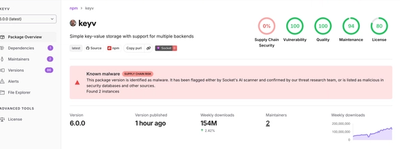
Popular npm packages keyv and cacheable compromised.

Security News
A misconfiguration gave three Anthropic models internet access, and one, believing it was in a simulation, shipped a credential-stealing package to PyPI.