

Security News
/Company News
Securing the Financial Frontier: How Capital One Uses Socket for Open Source Security
Capital One is partnering with Socket to proactively secure its open source supply chain.
By Sarah Gooding - Oct 01, 2026
@sylphx/anymd
Advanced tools
Any file → clean Markdown for AI agents: PDF, Word, PowerPoint, Excel, EPUB, HTML and web pages, images (OCR), audio and video (metadata, subtitles, transcripts). A fast Rust MCP server and CLI that runs on your machine. No API key.

PDF, Word, PowerPoint, Excel, EPUB, HTML and web pages, images (OCR), audio and video (metadata, subtitles, transcripts). A fast Rust MCP server and CLI that runs on your machine. No API key.

Install · Benchmarks · Tools · CLI · Formats · Docs
Formerly pdf-reader-mcp. Migrating from pdf-reader-mcp

A real, unedited terminal recording (asciinema + agg, script). The last command is Claude Code answering from the PDF through the anymd MCP server.
<!-- page 3 --> citation anchors, a small front-matter header, and compact tables. A token budget and a cursor keep large documents within your agent's context.search looks across all of them.Add anymd to every MCP client on your machine (Claude Code, Codex, Cursor, VS Code, Claude Desktop, Windsurf, Gemini CLI) with one command:
npx -y @sylphx/anymd setup # --dry-run to preview, --remove to undo
Or add it by hand: every MCP client runs the same command, npx -y @sylphx/anymd. Node 18+ is the only requirement; npm installs the native binary for your platform.
claude mcp add anymd -- npx -y @sylphx/anymd
Or as a plugin, with the anymd skill: /plugin marketplace add SylphxAI/anymd, then /plugin install anymd@anymd.
codex mcp add anymd -- npx -y @sylphx/anymd
or in ~/.codex/config.toml:
[mcp_servers.anymd]
command = "npx"
args = ["-y", "@sylphx/anymd"]

or in .cursor/mcp.json:
{ "mcpServers": { "anymd": { "command": "npx", "args": ["-y", "@sylphx/anymd"] } } }
Install in VS Code with one click, or from a terminal:
code --add-mcp '{"name":"anymd","command":"npx","args":["-y","@sylphx/anymd"]}'
or in .vscode/mcp.json:
{ "servers": { "anymd": { "type": "stdio", "command": "npx", "args": ["-y", "@sylphx/anymd"] } } }
One click: download anymd-<version>.mcpb from the latest release and open it. Or, by hand:
Add to claude_desktop_config.json (Settings → Developer → Edit Config):
{ "mcpServers": { "anymd": { "command": "npx", "args": ["-y", "@sylphx/anymd"] } } }
Any client that speaks MCP over stdio: command npx, args ["-y", "@sylphx/anymd"]. To keep the server inside one folder, add --allow-dir=/path/to/docs.
npm install -g @sylphx/anymd # or run it once with: npx -y @sylphx/anymd <file>
Python: uvx anymd report.pdf > report.md runs it once, pip install anymd installs it, and uvx anymd mcp starts the MCP server. The wheels carry the same prebuilt binary.
Docker (amd64 and arm64):
docker run --rm -v "$PWD:/data" ghcr.io/sylphxai/anymd report.pdf > report.md
docker run -i --rm ghcr.io/sylphxai/anymd        # MCP server on stdio
Or build it from crates.io (needs a Rust 1.92+ toolchain; OCR and transcripts still use tesseract/ffmpeg when installed):
cargo install anymd
npm, pip and Docker ship a prebuilt binary, while cargo install compiles one on your machine.
AgentDocBench is an open benchmark for document → Markdown conversion for agents: license-clean documents in 12 categories (math papers, two-column papers, financial tables, forms, scans, CJK, slides, spreadsheets, Word, EPUB, HTML), scored on verbatim sentences, text F1, reading order, and table cells, with time and output tokens. Every tool runs on the same kind of GitHub-hosted runner (4 CPUs):
| anymd | docling | kreuzberg | unstructured | markitdown | marker | pdftotext | |
|---|---|---|---|---|---|---|---|
| Overall score | 96.3 | 93.0 | 81.7 | 81.2 | 76.8 | 71.0 | 42.2 |
| Table cells F1 | 92.2 | 89.9 | 38.4 | 38.4 | 57.2 | 60.9 | 0.0 |
| Reading order | 98.8 | 94.4 | 96.8 | 93.9 | 85.5 | 76.8 | 52.0 |
| Docs converted | 38/38 | 38/38 | 38/38 | 38/38 | 38/38 | 30/38 | 23/38 |
| Time, all docs | 22.9 s | 2,432.4 s | 16.0 s | 346.5 s | 75.6 s | 7,104.5 s | 0.90 s |
The generated leaderboard, per-category scores (including where anymd loses), and method are in the benchmark guide. The corpus, ground truth, adapters, and raw results are in bench/, and the Benchmark workflow reruns everything; new tools can join with a single adapter file.
anymd exposes three tools.
| Tool | Use it to | Key arguments |
|---|---|---|
read | Turn a file, URL, or folder into Markdown | source, pages ("1-5,8"), max_tokens (default 20000), cursor, ocr, images (refs · none), revisions (markup · accept · reject), transcript, download_whisper_model |
search | Find text across files, folders, and URLs | query, sources, mode (auto · literal · ranked), glob, max_results |
inspect | Go deeper on a PDF | operation: render_page, extract_regions, ocr_pages, structure (JSON with geometry), compare, inspect |
A read answer looks like this:
---
source: papers/attention.pdf
title: Attention Is All You Need
pages: 15
showing: pages 1-9
---

<!-- page 1 -->

# Attention Is All You Need
…

<!-- page 8 -->

|Model|BLEU EN-DE|BLEU EN-FR|
|-|-|-|
|Transformer (big)|28.4|41.8|
…

<!-- Stopped at the 20000-token budget. Continue with cursor: "10", or pick pages, or raise max_tokens. -->
search answers with one line per hit:
5 matches for "masked language model" (2 files, 31 sections searched)

### papers/bert.pdf (5)
- p.1: …by using a “**masked language model**” (MLM) pre-training objective, inspired by the Cloze task…
- p.2: …In addition to the **masked language model**, we also use a “next sentence prediction” task…
If nothing matches exactly, search falls back to BM25-ranked passages, so a question like "how does bidirectional pretraining work" still finds the right page.
The same binary is a command-line converter, like MarkItDown but much faster:
anymd report.pdf > report.md                 # a file
anymd deck.pptx notes.docx budget.xlsx        # several files, each with a header
anymd https://example.com/article            # a web page (main content only)
cat scan.png | anymd - --ocr                 # stdin, with OCR
anymd paper.pdf --pages 1-3 --max-tokens 4000
anymd search "indemnification" contracts/ --glob '*.pdf'
anymd doctor                                 # lists the optional tools anymd found
Run with no arguments from an MCP client (piped stdin), or as anymd mcp, and it serves MCP over stdio.
| Input | What you get |
|---|---|
Reading-order Markdown: headings, paragraphs, lists, tables, sub/superscripts, <!-- page N --> markers, bookmarks as an outline. Running headers and page numbers are removed. Image-only pages are OCR'd when tesseract is installed. Embedded figures are saved to the anymd cache and marked in place with their caption (images: "refs", the default). | |
Word .docx | Headings, bold/italic, links, nested lists, tables with merged cells, footnotes, equations as LaTeX, embedded pictures as image files, tracked changes and comments as CriticMarkup |
PowerPoint .pptx | One section per slide in deck order, titles, bullets, tables, chart data, speaker notes, pictures as image files |
Excel .xlsx .xls .ods · CSV/TSV | One table per sheet, dates as ISO strings, capped at 2,000 rows per sheet |
| EPUB | One section per chapter in spine order, plus title and author; pictures as image files |
| HTML and URLs | The main article only: navigation, cookie banners, and sidebars are dropped. Relative links are resolved, and code keeps its language. |
| Markdown, text, JSON | Returned unchanged, with pagination |
| Images | Dimensions and EXIF (camera, date, GPS), plus OCR text when tesseract is installed |
| Audio / video | Duration, streams, chapters, embedded and sidecar subtitles (via ffprobe/ffmpeg). Local whisper.cpp transcript with transcript: true; download_whisper_model: true fetches a verified model on first use. |
For PDFs, anymd reads glyph positions rather than text runs. Glyphs are grouped into lines by baseline, which tolerates super- and subscripts. Word spaces come from the gaps between glyphs, measured against the font size and adjusted for letter tracking. A column-aware XY cut finds gutters between running text. Tables come from drawn lines where a table has them (a missing line between two cells makes a merged cell) and from aligned columns of whitespace where it does not. Wrapped cell text stays in its cell, stacked header lines become one header, and a header over several columns is kept with each of them. Text a reader cannot see (invisible text, or text in the colour of the box behind it) is left out. Pages are processed in parallel and isolated from each other, so one malformed page never fails the whole document. The other formats are parsed natively in Rust (zip/XML, calamine, html5ever); no Python, LibreOffice, or cloud service is involved.
--allow-dir=<path> (repeatable) or MCP_PDF_ALLOWED_DIRS confines the server to the directories you list.ANYMD_CACHE_DIR, else the platform cache), never next to the source document, and refused over 50 megapixels.See SECURITY.md to report a vulnerability.
More from Sylphx: https://sylphx.com/open-source
MIT © Sylphx
FAQs
Any file → clean Markdown for AI agents: PDF, Word, PowerPoint, Excel, EPUB, HTML and web pages, images (OCR), audio and video (metadata, subtitles, transcripts). A fast Rust MCP server and CLI that runs on your machine. No API key.
The npm package @sylphx/anymd receives a total of 6,709 weekly downloads. As such, @sylphx/anymd popularity was classified as popular.
We found that @sylphx/anymd demonstrated a healthy version release cadence and project activity because the last version was released less than a year ago. It has 2 open source maintainers collaborating on the project.
Security News
/Company News
Capital One is partnering with Socket to proactively secure its open source supply chain.
Security News
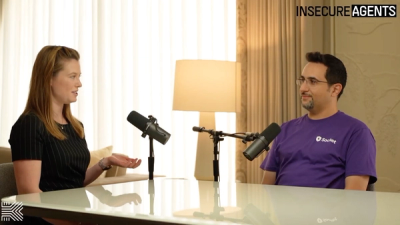
Socket CTO Ahmad Nassri discusses how to keep AI agents from bypassing package blocks, limit credential access, and monitor their actions.

Security News
GPT-6 Astra tried to plant malicious code in simulated open source projects using fake GitHub accounts and deceptive PRs during an assigned CTF challenge.