
Product
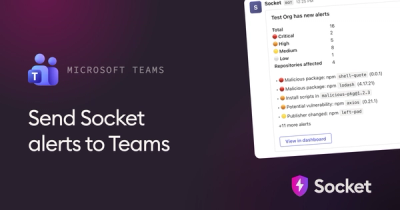
Microsoft Teams Notifications Are Now Available in Socket
Socket can now send alerts and supply chain attack notifications to Microsoft Teams, with filters that route the right updates to each channel.
By Jeppe Hasseriis - Sep 01, 2026
@synap-core/auth
Advanced tools
Synap auth client — sign in to Synap pods + Control Plane. Powers Hub, Studio, Eve, and any Synap-compatible app.
Centralized authentication client for all Synap apps. Platform-agnostic core with pluggable transport and storage adapters.
AuthClient
├── AuthTransport (how HTTP requests are made)
│ ├── FetchTransport — default, uses fetch API
│ ├── ElectronTransport — routes through Electron main process IPC
│ └── ProxyTransport — routes through server-side proxy (Telegram, iframes)
│
└── TokenStorage (where session tokens are stored)
├── MemoryStorage — in-memory only (Telegram)
├── SessionStorage — browser sessionStorage (web app)
└── ElectronStorage — OS keychain via Electron safeStorage
*.synap.live or self-hosted, Ory Kratos. It owns local
users, access, workspace membership, and its trusted-issuer registry.The bridge: a trusted issuer signs a short-lived federated assertion → the Pod verifies a locally approved issuer and its own local membership before creating a Kratos session. The Pod never needs the issuer's product-specific account or Pod IDs, and raw Pod session tokens never transit the issuer service.
import {
  createAuthClient,
  createFetchTransport,
  createMemoryStorage,
} from "@synap-core/auth";

const auth = createAuthClient({
  cpUrl: "https://api.synap.live",
  transport: createFetchTransport(),
  storage: createMemoryStorage(),
  events: {
    onPodSessionExpired: (podUrl) => console.log("Session expired:", podUrl),
  },
});

// Sign in to CP
await auth.signInToCP("user@example.com", "password");

// Discover pods
const pods = await auth.fetchPods();

// Connect to a pod through a trusted-issuer federation exchange
const session = await auth.connectViaCPHandshake(pods[0].podUrl);

// Get auth headers for pod API calls
const headers = await auth.getPodAuthHeaders(pods[0].podUrl);
// → { "X-Session-Token": "kratos-session-token-value" }

// Direct login (self-hosted)
const session2 = await auth.connectDirectLogin(
  "https://my-pod.example.com",
  "user@example.com",
  "password"
);
import {
  createAuthClient,
  createElectronTransport,
  createElectronStorage,
} from "@synap-core/auth";

const auth = createAuthClient({
  cpUrl: "https://api.synap.live",
  transport: createElectronTransport(window.synap.connection),
  storage: createElectronStorage(window.synap.security),
});
import {
  createAuthClient,
  createProxyTransport,
  createMemoryStorage,
} from "@synap-core/auth";

const auth = createAuthClient({
  cpUrl: "https://api.synap.live",
  transport: createProxyTransport({
    cpProxyBase: "/api/cp",
    podProxyBase: "/api/pod",
    getExtraHeaders: () => ({ "X-Pod-Url": connectionStore.podUrl }),
  }),
  storage: createMemoryStorage(), // tokens live in memory only
});
import { createAuthClient, createFetchTransport } from "@synap-core/auth";
import * as SecureStore from "expo-secure-store";

const auth = createAuthClient({
  cpUrl: "https://api.synap.live",
  transport: createFetchTransport(),
  storage: {
    get: (key) => SecureStore.getItemAsync(key),
    set: (key, value) => SecureStore.setItemAsync(key, value),
    delete: (key) => SecureStore.deleteItemAsync(key),
  },
});
| Concern | Approach |
|---|---|
| Pod session tokens | Stored via TokenStorage (OS keychain on Electron, SecureStore on RN, memory on Telegram) |
| CP session | Cookie-based where possible, token-based via proxy where not |
| Federated assertion | 5-minute expiry, ES256 asymmetric, audience-scoped; no CP ledger metadata |
| Transport | All requests go through AuthTransport — Electron uses main process (no cross-origin cookie issues) |
| No localStorage | Session tokens never touch localStorage. Period. |
FAQs
Synap auth client — sign in to Synap pods + Control Plane. Powers Hub, Studio, Eve, and any Synap-compatible app.
The npm package @synap-core/auth receives a total of 10 weekly downloads. As such, @synap-core/auth popularity was classified as not popular.
We found that @synap-core/auth demonstrated a healthy version release cadence and project activity because the last version was released less than a year ago. It has 1 open source maintainer collaborating on the project.
Product
Socket can now send alerts and supply chain attack notifications to Microsoft Teams, with filters that route the right updates to each channel.

Security News
pnpm 12 rewrites the package manager in Rust, cutting install times by up to 90% while preserving pnpm 11 workflows and lockfiles.

Security News
Socket CTO Ahmad Nassri joins AppSec leaders at Black Hat to discuss active malware, package manager risks, and software supply chain defense.