Security News
Feross on TBPN: Socket's Series C and the State of Software Supply Chain Security
Feross Aboukhadijeh joins TBPN to discuss Socket's $60M Series C, 500%+ ARR growth, AI's impact on open source, and the rise in supply chain attacks.
@syncano/socket-user-auth
Advanced tools
Syncano Socket for basic user authentication and registration
Originally derived from es5-ext package.
Defining properties with descriptors is very verbose:
var Account = function () {};
Object.defineProperties(Account.prototype, {
deposit: { value: function () {
/* ... */
}, configurable: true, enumerable: false, writable: true },
withdraw: { value: function () {
/* ... */
}, configurable: true, enumerable: false, writable: true },
balance: { get: function () {
/* ... */
}, configurable: true, enumerable: false }
});
D cuts that to:
var d = require('d');
var Account = function () {};
Object.defineProperties(Account.prototype, {
deposit: d(function () {
/* ... */
}),
withdraw: d(function () {
/* ... */
}),
balance: d.gs(function () {
/* ... */
})
});
By default, created descriptor follow characteristics of native ES5 properties, and defines values as:
{ configurable: true, enumerable: false, writable: true }
You can overwrite it by preceding value argument with instruction:
d('c', value); // { configurable: true, enumerable: false, writable: false }
d('ce', value); // { configurable: true, enumerable: true, writable: false }
d('e', value); // { configurable: false, enumerable: true, writable: false }
// Same way for get/set:
d.gs('e', value); // { configurable: false, enumerable: true }
$ npm install d
To port it to Browser or any other (non CJS) environment, use your favorite CJS bundler. No favorite yet? Try: Browserify, Webmake or Webpack
Define methods which will be automatically bound to its instances
var d = require('d');
var autoBind = require('d/auto-bind');
var Foo = function () { this._count = 0; };
Object.defineProperties(Foo.prototype, autoBind({
increment: d(function () { ++this._count; });
}));
var foo = new Foo();
// Increment foo counter on each domEl click
domEl.addEventListener('click', foo.increment, false);
Define lazy properties, which will be resolved on first access
var d = require('d');
var lazy = require('d/lazy');
var Foo = function () {};
Object.defineProperties(Foo.prototype, lazy({
items: d(function () { return []; })
}));
var foo = new Foo();
foo.items.push(1, 2); // foo.items array created and defined directly on foo

$ npm test
FAQs
Syncano Socket for basic user authentication and registration
The npm package @syncano/socket-user-auth receives a total of 4 weekly downloads. As such, @syncano/socket-user-auth popularity was classified as not popular.
We found that @syncano/socket-user-auth demonstrated a not healthy version release cadence and project activity because the last version was released a year ago. It has 3 open source maintainers collaborating on the project.
Did you know?

Socket for GitHub automatically highlights issues in each pull request and monitors the health of all your open source dependencies. Discover the contents of your packages and block harmful activity before you install or update your dependencies.

Security News
Feross Aboukhadijeh joins TBPN to discuss Socket's $60M Series C, 500%+ ARR growth, AI's impact on open source, and the rise in supply chain attacks.

Security News
OSV withdrew 157 OSV malware reports after automated false positives incorrectly flagged trusted npm and PyPI packages, sending bad records into tools that rely on OSV data.

Research
/Security News
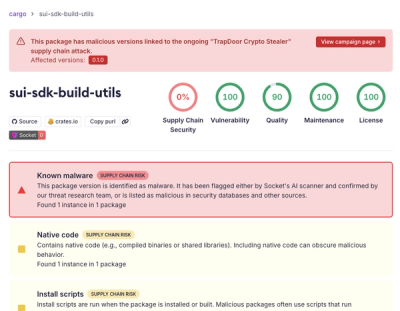
TrapDoor crypto stealer hits 36 malicious packages across npm, PyPI, and Crates.io, targeting crypto, DeFi, AI, and security developers.