

Company News
AWS Security Hub Adds Socket for Supply Chain Security
Socket is now in the AWS Security Hub Extended plan. Adopt it through AWS, apply committed spend, and block malicious open source packages.
By Feross Aboukhadijeh - Aug 04, 2026
@themelt/mcp-server
Advanced tools
Melt MCP server — exposes value-leak discovery (melt_analyze_value_vectors, melt_estimate_annual_leak) and a lead-capture handoff (melt_request_scan) to Claude, Cursor, GitHub Copilot, and any MCP-compatible agent.
MCP server that puts Melt's value-leak discovery logic directly into Claude, Cursor, GitHub Copilot, or any other MCP-compatible agent — so when a tech leader asks their assistant "where is value leaking out of my org," the assistant can call a Melt tool and answer with a real, structured estimate instead of a generic list of vendors.
This is the engineering half of Melt's LLMO (LLM Optimization) distribution
strategy. See /llms.txt at the repo root and LLMO_PLAYBOOK.md for the full
content + distribution + evaluation plan this server plugs into. Positioning
reconciled 2026-07-18 against the live site and current decks — see
/CLAUDE.md for the full current product context.
| Tool | What it does |
|---|---|
melt_analyze_value_vectors | Free Stage-1 Sandbox estimator. Estimates where value is leaking in one department from headcount, labor cost, and dominant unstructured-input type. No integration required — synthetic/self-reported inputs only. |
melt_estimate_annual_leak | Quantifies an already-identified leak pattern in dollars/yr — totalVolume x (leakRatePct/100) x valuePerEvent, generalizing Melt's real "Anatomy of a Scan" methodology (a 29% Gong bypass rate, a 62% Clari override rate, etc., combined into a real $77,235/yr finding). |
melt_request_scan | Lead-capture handoff — the move from a directional estimate to a real, log-verified scan (Frictionless POC Playbook Stage 1 → 2). Routes to HubSpot if HUBSPOT_PORTAL_ID/HUBSPOT_FORM_ID are set, otherwise appends to a local leads.jsonl. |
melt_estimate_annual_leak replaced four formula-named calculators
(melt_calculate_feature_waste, _dso_cash_flow_impact,
_contract_cycle_revenue_unlock, _win_rate_pipeline_impact) that
implemented financial formulas from a retired product framing (Thermal Scan /
Feature Waste Dollar Amount™ / Delta Engine) — none of which appear in any
current Melt material. See CLAUDE.md's "What's Explicitly Retired" section.
cd mcp-server
npm install
npm run build
npm start          # runs dist/index.js on stdio
To poke at it interactively before wiring it into a client:
npm run inspect # launches the MCP Inspector against the built server
Published on npm — one-line config, no local clone needed:
{
  "mcpServers": {
    "melt": {
      "command": "npx",
      "args": ["-y", "@themelt/mcp-server"]
    }
  }
}
Or from a local clone:
{
  "mcpServers": {
    "melt": {
      "command": "node",
      "args": ["/absolute/path/to/mcp-server/dist/index.js"]
    }
  }
}
For Claude Desktop specifically, themelt-mcp-server.mcpb (Anthropic's MCP
Bundle format) installs with a
double-click — no terminal, no config file editing. Download the .mcpb from
the latest GitHub Release
and either double-click it or drag it into Claude Desktop's Settings window.
To rebuild it from source:
npm run build:mcpb # produces themelt-mcp-server.mcpb
The manifest (mcpb-build/manifest.json) is hand-maintained, not
auto-generated from the TypeScript source — if a tool's name, parameters, or
description change, update the manifest's tools array to match.
dist/index.js (stdio) is what gets configured into a local Claude Desktop/
Cursor install. dist/httpServer.js is an alternate entrypoint implementing
the MCP Streamable HTTP transport — what a future "Launch Hosted MCP" web
button (LLMO_PLAYBOOK.md, Task 3.2) would point at, so someone can try the
tools without installing anything locally.
npm run build
PORT=3000 npm run start:http   # POST MCP JSON-RPC to http://localhost:3000/mcp
Stateless by design — no session ID, a fresh server instance per request.
Auth is opt-in via MCP_HTTP_API_KEY (unset by default): with it unset, the
endpoint stays fully open — the appropriate trust boundary for what this
exposes today (read-only calculators plus a lead-capture form, the same
boundary as a public website contact form). Set it before putting anything
more sensitive behind this transport:
MCP_HTTP_API_KEY=some-long-random-value PORT=3000 npm run start:http
Every /mcp request then needs Authorization: Bearer some-long-random-value
— missing or wrong key gets a 401. Compared with crypto.timingSafeEqual, not
a plain string ===, so response timing can't be used to guess the key one
byte at a time. Not deployed anywhere yet; this is the code, not a live URL —
deploying it (Vercel/Fly/Render/etc.) is a separate, later decision.
Every tool call (success or error) appends one line to mcp-server/analytics.jsonl
(gitignored) and logs a one-line summary to stderr — tool name, ok/error, and
the error code if applicable. Deliberately excludes dollar figures, contact
info, and free-text notes; kept separate from leads.jsonl's PII. This is
what answers "is anyone actually using this" and "which tool description is
confusing models," independent of llmo-eval's citation-only audit.
| Variable | Required | Purpose |
|---|---|---|
HUBSPOT_PORTAL_ID | No | Overrides the default HubSpot Portal ID for melt_request_scan (e.g. to test against a sandbox form). |
HUBSPOT_FORM_ID | No | Paired with HUBSPOT_PORTAL_ID. |
PORT | No | Port for start:http (default 3000). |
MCP_HTTP_API_KEY | No | If set, requires Authorization: Bearer <key> on every hosted-HTTP /mcp request. Unset by default — stdio transport is unaffected either way (no HTTP surface to gate). |
Real Portal ID / Form ID defaults are already baked into the code (they
aren't secrets — the same values are exposed in any public HubSpot embed
snippet), so melt_request_scan reaches the real Melt pipeline with zero
configuration. If HubSpot submission fails for any reason, requests fall back
to mcp-server/leads.jsonl (gitignored) instead of being lost.
Published under the @themelt npm org (created 2026-07-20, owner omer_melt)
under the MIT license. npm publish is effectively one-way — npm allows
unpublishing within 72 hours but strongly discourages it and blocks it
entirely once a package has dependents, so treat any published version as
permanent.
FAQs
Melt MCP server — exposes value-leak discovery (melt_analyze_value_vectors, melt_estimate_annual_leak) and a lead-capture handoff (melt_request_scan) to Claude, Cursor, GitHub Copilot, and any MCP-compatible agent.
The npm package @themelt/mcp-server receives a total of 194 weekly downloads. As such, @themelt/mcp-server popularity was classified as not popular.
We found that @themelt/mcp-server demonstrated a healthy version release cadence and project activity because the last version was released less than a year ago. It has 2 open source maintainers collaborating on the project.
Did you know?

Socket for GitHub automatically highlights issues in each pull request and monitors the health of all your open source dependencies. Discover the contents of your packages and block harmful activity before you install or update your dependencies.
Company News
Socket is now in the AWS Security Hub Extended plan. Adopt it through AWS, apply committed spend, and block malicious open source packages.
Research
/Security News
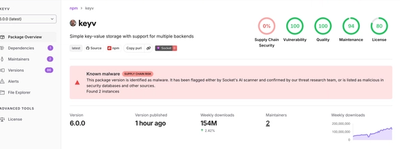
Popular npm packages keyv and cacheable compromised.

Security News
A misconfiguration gave three Anthropic models internet access, and one, believing it was in a simulation, shipped a credential-stealing package to PyPI.