

Company News
AWS Security Hub Adds Socket for Supply Chain Security
Socket is now in the AWS Security Hub Extended plan. Adopt it through AWS, apply committed spend, and block malicious open source packages.
By Feross Aboukhadijeh - Aug 04, 2026
@three-ws/agent-sniper
Advanced tools
Lightweight, embeddable pump.fun sniper engine for 3D AI agents — multi-agent, multi-user, with pluggable wallet/store/RPC adapters. Library + CLI + MCP server + x402 paid API.
A lightweight, embeddable pump.fun sniper engine for 3D AI agents. One trade
loop — feed a stream of new launches, score each against a per-agent strategy,
run the pre-trade guards, buy, then sweep open positions on an interval and exit
on stop-loss / take-profit / trailing-stop / timeout / sentiment-flip. It is
multi-agent and multi-user by construction (one wallet per agentId), and every
external dependency — wallet custody, persistence, RPC/venue, launch feed — is a
pluggable adapter, so the same engine runs locally with in-memory state or
hosted across thousands of tenants. The package ships with four faces over that
one engine: a library, a CLI, an MCP server, and an x402 paid HTTP
API.
The engine is pure orchestration. It owns the decision pipeline; it owns nothing
about where the money, the data, or the chain live. Five adapter interfaces
(src/types.js) are the seams, and a default implementation ships for each:
                            ┌──────────────────────────── engine ────────────────────────────┐
   Feed ──{mint|intel|claim}─▶  score  ──▶  guards  ──▶  executeBuy  ──▶  claimPosition         │
   (PumpPortal)               (scorer)   (concurrency,    (quote +        (atomic slot)          │
                                          budget, SOL      build + sign                          │
                                          headroom,        + broadcast)                          │
                                          price impact)                                          │
                                                                  position sweep (every pollMs)  │
                                                                  ──▶ decideExit ──▶ executeSell │
                            └────────────────────────────────────────────────────────────────────┘
        adapters:    Feed          Solana            Wallet           Executor          Store
                  (launch        (quote/build      (resolve a       (sign +          (strategies,
                   stream)        pump.fun ix)      Keypair per      broadcast)        positions,
                                                    agentId)                           spend ledger)
Swap any one without touching the loop: a custodial KMS wallet instead of local
keys, a Postgres store instead of memory, a different launch feed, a different
venue. Implement the shape, pass it to createSniper(), done.
| Adapter | Responsibility |
|---|---|
Feed | Push { kind: 'mint'|'intel'|'claim', data: Candidate } events into the engine. |
Solana | Quote + build pump.fun buy/sell instructions; expose a web3 Connection. |
Wallet | Resolve a signing Keypair for an agentId (or null if unprovisioned). |
Executor | The one place that signs and broadcasts; returns landing telemetry. |
Store | Persist strategies, positions, and the daily spend ledger; atomic claimPosition. |
Optional Hooks (firewall assessSafety, oracleGate, onScreen, onBuy,
onSell, recordDecision) are best-effort cross-cutting callbacks — a throw is
swallowed and never aborts a trade, except onTip, which is a deliberate veto.
npm i @three-ws/agent-sniper
Optional peers, installed only if you use the face that needs them:
npm i better-sqlite3   # durable Store (src/adapters/store/sqlite.js)
npm i express          # the x402 HTTP API face
Requires Node >= 20.
The presets.local wiring is the zero-to-running path: in-memory store +
self-custody wallet + pump.fun client + web3 executor + PumpPortal feed. Run it
in simulate mode on devnet first — the engine scores, guards, and logs
every decision but never broadcasts.
A strategy must carry a stop_loss_pct — the engine refuses to arm a
strategy without one. SOL amounts on a strategy are expressed in lamports
(1 SOL = 1,000,000,000 lamports), as a string, number, or bigint.
import { createSniper, createMemoryStore, presets } from '@three-ws/agent-sniper';

// 1 SOL = 1e9 lamports.
const SOL = 1_000_000_000n;

const strategy = {
  id: 'strat_scout_1',
  agent_id: 'scout',                  // one wallet per agentId
  enabled: true,
  trigger: 'new_mint',                // fire on the create event
  network: 'devnet',
  per_trade_lamports: (SOL / 100n).toString(),   // 0.01 SOL per snipe
  daily_budget_lamports: (SOL / 2n).toString(),  // 0.5 SOL/day ceiling
  max_concurrent_positions: 3,
  slippage_bps: 500,                  // 5%
  max_price_impact_pct: 10,           // entry circuit breaker
  stop_loss_pct: 30,                  // REQUIRED — exit when down 30%
  take_profit_pct: 80,                // exit when up 80%
  trailing_stop_pct: 20,              // exit when down 20% from peak (after profit)
  max_hold_seconds: 1800,             // hard time-stop
  require_socials: true,              // skip launches with no twitter/telegram/website
  max_creator_launches: 10,           // skip serial launchers
};

const sniper = await presets.local({
  network: 'devnet',
  mode: 'simulate',                   // no funds move
  strategies: [strategy],
  // secrets: { scout: '<base58 | [byte,array] | 0x-hex secret>' },  // for live mode
});

await sniper.start();

console.log(sniper.stats());          // { events, candidates, buys, sells, errors, strategies, queued, lastEventAt }
console.log(sniper.strategies());     // the live armed-strategy cache

// Fire a manual buy by hand (drives the same path as MCP snipe_now):
sniper.submitCandidate(
  { mint: 'THREEsynthetic1111111111111111111111111111111', entry_trigger: 'manual' },
  { force: true },
);

// later…
await sniper.stop();
createSniper(deps) is the lower-level constructor when you want to bring your
own adapters — pass { config, store, wallet, solana, executor, feed, hooks }.
presets.local is just one wiring of it.
The package installs an agent-sniper binary. Default mode is simulate — it
will not move funds until you pass --mode live (or set SNIPER_MODE=live),
which trades real funds.
# Run the engine. Mode defaults to simulate; live trades real funds.
npx agent-sniper run --network devnet --strategy ./strategy.json

# Serve the engine over MCP (stdio) for Claude / Cursor / any MCP client.
agent-sniper mcp

# Serve the x402-gated HTTP API + web console (open http://localhost:8787).
agent-sniper serve

# Help.
agent-sniper help
Safety.
run/serve/mcpall start in simulate mode unless you opt into live explicitly. In live mode every armed strategy can spend up to itsdaily_budget_lamportsper UTC day. Read Safety & guardrails below before you flip the switch.
--strategy ./strategy.json loads a strategy (or array of strategies) as JSON.
A minimal file mirrors the object in the Quickstart — note stop_loss_pct is
required.
agent-sniper mcp exposes the engine as an MCP stdio server. Every tool maps
1:1 onto a public engine/store method — no internals are reached around. The
server is unauthenticated and meant to run locally against your own wallet/RPC.
| Tool | Kind | Purpose |
|---|---|---|
arm_strategy | write | Register/update a strategy. SOL → lamports for you; stop_loss_pct mandatory. |
disarm_strategy | write | Disable a strategy (enabled=false); open positions still exit on their rules. |
list_strategies | read | List the armed strategy set the engine is evaluating. |
snipe_now | write | Force a manual buy of a mint across all armed agents (bypasses the scorer). |
list_positions | read | List positions, filter by agentId and/or status. |
close_position | write | Schedule an exit — flips the position's kill switch; the next sweep sells it. |
sniper_status | read | Engine health: event/candidate/buy/sell counts, armed count, queue depth, network/mode. |
Wire it into an MCP client (Claude Desktop, Cursor, etc.):
{
  "mcpServers": {
    "agent-sniper": {
      "command": "npx",
      "args": ["-y", "@three-ws/agent-sniper", "mcp"],
      "env": {
        "SNIPER_NETWORK": "devnet",
        "SNIPER_MODE": "simulate"
      }
    }
  }
}
createSniperMcpServer(deps) builds the fully-registered server without
connecting a transport, so you can construct it in a test and drive it over an
in-memory transport.
agent-sniper serve (or import { serve } from '@three-ws/agent-sniper/api')
mounts the engine over HTTP. Reads are free; the three mutating endpoints are
gated behind x402 USDC micropayments via @three-ws/x402-server — the
middleware verifies the X-PAYMENT header against the facilitator, runs the
work, settles on-chain, and emits the receipt.
| Method | Endpoint | Price | Notes |
|---|---|---|---|
| GET | /health | free | Liveness + network/mode/stats. |
| GET | /status | free | Full stats + immutable runtime config. |
| GET | /strategies | free | The armed strategy set. |
| GET | /positions?agentId=&status= | free | Positions from the store. |
| POST | /strategies | $0.01 USDC | Arm a strategy (SOL → lamports; stop-loss required). |
| POST | /snipe | $0.05 USDC | Force a snipe on { mint, symbol?, agentId? }. |
| POST | /strategies/:id/disarm | $0.005 USDC | Disable a strategy. |
Prices are the defaults (USDC atomic units, 6 decimals); override via
deps.prices = { arm, snipe, disarm }.
Gating turns on when a merchant wallet is configured — deps.payTo.solana or the
X402_PAY_TO_SOLANA env (a Base lane is available via X402_PAY_TO_BASE). When
no payTo is set, the mutating routes still mount but answer 503, so the
server boots cleanly for local/dev without payment config.
The Solana lane also needs a facilitator sponsor fee-payer — set
X402_FEE_PAYER_SOLANA (or deps.feePayer). Without it the Solana lane
self-disables (falling back to the Base lane, or the 503 guard if that's the
only lane) rather than failing requests, and logs a one-time warning at boot.
import { serve } from '@three-ws/agent-sniper/api';

await serve(
  { payTo: { solana: process.env.X402_PAY_TO_SOLANA } },
  { port: 8787 },
);
serve also ships a built-in operator dashboard — a single, dependency-free
HTML file served from the same origin as the API, at / and /console. Open
http://localhost:8787 and you get a live control room:
s snipe, n new strategy, r refresh, , settings, ? help), a
disconnected banner, and full mobile responsiveness.Reads are free. The mutating controls (arm, snipe, disarm, close) are x402-paid for external callers — so to drive them from your own console without paying yourself, set an operator token:
export SNIPER_ADMIN_TOKEN="$(openssl rand -hex 24)"
agent-sniper serve --port 8787
Open Settings (⚙ or ,) in the console and paste the same token. It is sent as
X-Admin-Token (or Authorization: Bearer …), stored only in your browser, and
bypasses the x402 gate — while unauthenticated external agents still pay. Pass it
programmatically as deps.adminToken. Without a token set, the console is a
full-featured read-only monitor and mutations return 503 with guidance.
The engine is multi-tenant by design. The unit of isolation is the agentId:
Wallet adapter resolves a signing Keypair
per agentId. Self-custody reads it (in order) from a secrets map,
SNIPER_WALLET_<AGENTID> env, a keystore directory of <agentId>.json files,
or a single default SOLANA_SECRET_KEY. If an agent has no provisioned
wallet, loadKeypair returns null and the engine fails the trade cleanly —
it never auto-provisions an unfunded wallet.createCustodialWallet({ resolve })
takes a single async resolve(agentId, ctx) that decrypts a key from your own
KMS/secret box on demand, with a short TTL cache so a long-lived process
doesn't re-decrypt every trade. The cache is keyed per agent; clearCache()
forces a re-resolve.daily_budget_lamports and
max_concurrent_positions. The guards enforce them per agent, independent of
the platform-wide buy throttle.getArmedStrategies filters out any strategy missing
stop_loss_pct, so an agent can never run uncapped downside.Store.claimPosition to atomically reserve the (agent_id, mint, network)
slot. A second event for the same slot returns null and is skipped.@three-ws/agent-sniper/agents is the presentation layer that lets a 3D AI
agent embody the sniper: avatar definitions, the canonical animation clip
library, and a desk-monitor visualization driven by the engine's onScreen
hook. Wire the hook to push live activity (Sniper online…, $SYM scored N — BUYING) onto the agent's monitor so the trading loop is something you can watch,
not just a log stream. The onScreen payload shape is { text, kind } with
kind in activity | trade.
Implement any of these (src/types.js has the full JSDoc contracts) and pass it
to createSniper. Defaults live under src/adapters/.
| Interface | Default implementation | Write your own when… |
|---|---|---|
Store | createMemoryStore · createSqliteStore (./adapters/store/sqlite) | you need durable or shared multi-process state (e.g. Postgres). |
Wallet | createSelfCustodyWallet · createCustodialWallet | keys live in a KMS/HSM or a hosted secret store. |
Solana | createPumpClient (./adapters/solana/pump-client) | you route quotes/builds through a different venue. |
Executor | createWeb3Executor (./adapters/solana/executor-web3) | you broadcast through a custom relay/bundler. |
Feed | createPumpPortalFeed (./adapters/feed/pumpportal) | you ingest launches from a different source. |
The Store contract is the load-bearing one: getArmedStrategies,
countOpenPositions, getDailySpendLamports, claimPosition (atomic),
updatePosition, getOpenPositions, and optional recordSpend. See the
in-memory reference at src/adapters/store/memory.js.
All SNIPER_* env vars (read by loadConfig, src/config.js). Explicit
overrides passed to createSniper/loadConfig always win. See .env.example.
| Variable | Default | Meaning |
|---|---|---|
SNIPER_NETWORK | mainnet | mainnet | devnet. |
SNIPER_MODE | simulate | simulate | live. Simulate never broadcasts. |
SOLANA_RPC_URL | — | RPC endpoint. Live mode requires this (or HELIUS_API_KEY). |
SNIPER_GLOBAL_KILL | false | Emergency switch — halts all buys when true. |
SNIPER_POLL_MS | 5000 | Position re-quote / exit cadence (floor 1000). |
SNIPER_STRATEGY_REFRESH_MS | 15000 | Strategy-cache refresh interval (floor 5000). |
SNIPER_MAX_GLOBAL_BUYS_PER_MIN | 10 | Platform-wide buy throttle; 0 disables. |
SNIPER_BUY_CONCURRENCY | 3 | Max concurrent in-flight snipes (floor 1). |
SNIPER_BUY_QUEUE_DEPTH | 50 | Queued-snipe cap before drops (floor 1). |
SNIPER_CONFIRM_TIMEOUT_MS | 60000 | Confirmation timeout per trade (floor 15000). |
SNIPER_FEED_WATCHDOG_MS | 180000 | Re-subscribe if the feed goes quiet (floor 30000). |
SNIPER_EXIT_ON_BEARISH | false | Enable the sentiment-flip exit. |
SNIPER_EXIT_BEARISH_MIN_CONFIDENCE | 0.7 | Min bearish confidence (0..1) to act. |
stop_loss_pct is never armed.daily_budget_lamports and
max_concurrent_positions are enforced before any transaction is built
(checkDailyBudgetLamports, checkConcurrency).checkSolHeadroom keeps ~0.012 SOL in the wallet so a
snipe can't drain the account below the cost of the very next sell's fee.max_price_impact_pct (default 10) skips a
buy whose quote impact is too high (checkPriceImpact; unset ⇒ no gate).assessSafety hook runs after the quote and
before broadcast; a block verdict cancels the trade.createMayhemFilter({ connection?, rpcUrl?, strictOnUnknown?, retries?, retryDelayMs? })
reads the bonding curve's isMayhemMode (cached per mint) and skips pump.fun
Mayhem-mode launches. As of 0.1.4 a pre-built web3 Connection (for example a
rotating multi-endpoint one) can be injected instead of a single rpcUrl, and
a null read retries with backoff (default 2 retries) before resolving
"unknown", so a throttled provider can't starve a strict gate. The pure
retryWhileNull(fn, { retries, delayMs }) helper is exported too.SNIPER_GLOBAL_KILL=true (or config.globalKill)
halts every buy across every agent immediately.claimPosition in the memory and sqlite stores is atomic within one
process — the memory store relies on JS being single-threaded; the sqlite
store on a single-writer transaction. Combined with the engine's bounded in-
process buy queue, that prevents double-buying the same (agent_id, mint, network) slot inside a single sniper instance.
Run two sniper processes against the same agent and that guarantee no longer
holds: nothing serializes the claim across processes. To scale horizontally,
back the Store with a database whose claimPosition is a genuinely atomic
insert-if-absent (e.g. a unique constraint on (agent_id, mint, network) with
INSERT … ON CONFLICT DO NOTHING RETURNING), so the reservation is decided by
the database, not by any one process. The Store contract documents exactly
this requirement.
Pure-logic and in-memory-adapter suites run with no network/RPC:
npm test # vitest run
All rights reserved. See LICENSE.
FAQs
Lightweight, embeddable pump.fun sniper engine for 3D AI agents — multi-agent, multi-user, with pluggable wallet/store/RPC adapters. Library + CLI + MCP server + x402 paid API.
The npm package @three-ws/agent-sniper receives a total of 22 weekly downloads. As such, @three-ws/agent-sniper popularity was classified as not popular.
We found that @three-ws/agent-sniper demonstrated a healthy version release cadence and project activity because the last version was released less than a year ago. It has 1 open source maintainer collaborating on the project.
Did you know?

Socket for GitHub automatically highlights issues in each pull request and monitors the health of all your open source dependencies. Discover the contents of your packages and block harmful activity before you install or update your dependencies.
Company News
Socket is now in the AWS Security Hub Extended plan. Adopt it through AWS, apply committed spend, and block malicious open source packages.
Research
/Security News
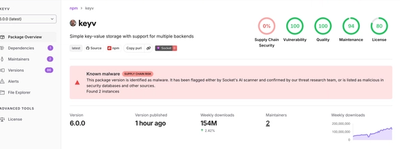
Popular npm packages keyv and cacheable compromised.

Security News
A misconfiguration gave three Anthropic models internet access, and one, believing it was in a simulation, shipped a credential-stealing package to PyPI.