

Company News
AWS Security Hub Adds Socket for Supply Chain Security
Socket is now in the AWS Security Hub Extended plan. Adopt it through AWS, apply committed spend, and block malicious open source packages.
By Feross Aboukhadijeh - Aug 04, 2026
@tmonier/argot
Advanced tools
argot — voice linter CLI. Single statically-linked binary replacing the TS/Bun CLI and Python engine.

Lint the rules you never wrote down.
AI writes the code. argot harnesses it with the one thing that can’t
hallucinate: your repo’s own history.
Statistics, not a second LLM. 100% local. It surfaces the divergence — you
decide what to accept.
argot.tmonier.com · Documentation · Evidence · Research log








|

🎬 Watch the 45-second launch film |
argot audit needs no prior Argot fit or configuration. It fits a historical
base in a temporary worktree, then evaluates the surviving base-to-HEAD net
diff. Your working tree is left untouched. It is a review prompt—not a census
of who wrote code, or proof that a finding is a defect.
# macOS / Linux
curl --proto '=https' --tlsv1.2 -LsSf https://github.com/get-tmonier/argot/releases/latest/download/argot-installer.sh | sh

cd your-repository
argot audit
Windows: powershell -c "irm https://github.com/get-tmonier/argot/releases/latest/download/argot-installer.ps1 | iex".
The npm package is also available as npm install -g @tmonier/argot.
Audit needs usable Git history and supported source. It has no fixed runtime promise. It runs fully offline — the code-embedding model behind the semantic findings ships inside the binary. See Getting started for install and fit details.
If the audit gives you a useful lead, fit the current repository and score the changes you intend to review:
argot init
argot check
Review and commit the generated argot.toml and .argot/ fit snapshot so
local tools and CI use the same learned baseline. CI only reads the base
branch snapshot; it never fits. argot status later recommends a local
fit-and-commit refresh only when accepted source, function, or layout surfaces
have materially changed. Commit count and age are not refresh triggers by
default; [fit] refresh-after is available only as an explicit team backstop.
The argot-refresh skill re-audits exclusions, structural paths, and mutes
before fitting, so a reorganized repository does not blindly relearn old scope.
flowchart LR
    A["argot init<br/>learn locally"] --> B["review + commit<br/>argot.toml · .argot/"]
    B --> C["local tools + CI<br/>read one baseline"]
    C --> D{"material accepted drift?"}
    D -- no --> C
    D -- yes --> E["argot-refresh<br/>review scope · fit locally"]
    E --> B
The embedding model itself ships inside the binary. Git stores only the repository-specific learned snapshot—typically a few MB to a few tens of MB—so every clone can reproduce the check without retraining or operating a service.
check reports configured findings on the selected changeset; a clean result
does not prove the change correct or fully idiomatic. Read the
Audit,
Init and Fit, and
Check guides for the exact contracts.
Type checkers ask if it compiles. argot asks if it’s yours. A clean, type-correct, well-reviewed pull request can still be foreign to the repository it lands in. These are the rules argot ships, every one of them learned from your own history rather than configured by hand:
| Rule | Group | What it flags |
|---|---|---|
foreign-import | voice | an import of a dependency the repo has never used |
unfamiliar-callee | voice | a call to a receiver or callee the repo's code never calls |
rare-tokens | voice | a token sequence statistically foreign to the repo's voice |
convention | voice | a construction that breaks a convention learned from the repo |
superseded | voice | a pattern this repo has been replacing, or declared migrated away |
redundant | semantic | a new function that duplicates one the repo already has |
misplaced | semantic | a function that looks like it belongs in another module area |
layering | architecture | an internal import that reverses the repo's layer direction |
test-deleted | integrity | a test removed while the code it exercised still exists |
test-disabled | integrity | a skip marker added, or a test gutted, as production changes |
test-weakened | integrity | assertions removed, tautologized, or loosened alongside a change |
rule-tampered | governance | a change that removes or weakens a locked rule |
Repositories add their own on top — a TOML manifest plus a sandboxed Rhai
script under .argot/rules/, with working ones to copy in
examples/rules/. No recompilation.
argot is a probabilistic review guardrail, not a correctness oracle. Each finding carries repository evidence. Treat it as a prompt to inspect and make the human decision explicit—never as proof that the code is wrong.
The CLI is the complete, explicit changeset check. Other routes have narrower triggers and coverage; none provides a universal acceptance-time check.
| Route | Execution class | Prerequisites and coverage | Evidence status |
|---|---|---|---|
| CLI | Invoked by a user or agent | Run audit, init, or the full check; fitting is required where the command needs it. | CLI/source inventory, 2026-07-22 |
| Skills | Invoked | Seven on-demand workflows for a compatible skill host; installation does not schedule commands, configure MCP, or add a hook. | Manifest/source inventory, 2026-07-30 |
| MCP | Passive | A configured client selects read-only context, hunk, or complete-changeset tools; a fitted repository is required for model-dependent tools. Fitting remains an explicit local CLI/skill workflow. | Focused test and source inspection, 2026-07-30 |
| Claude Code plugin | Automatic when configured, plus invoked/passive surfaces | Its opt-in pre-write hook, in a fitted repository, asks only when a Write, Edit, or MultiEdit introduces a foreign import. It never blocks and is not a full or end-of-turn check. | Manifest/source inspection, 2026-07-22 |
| pre-commit | Automatic when user-configured | Scores staged supported files in a fitted repository. The argot-check hook is advisory for findings; argot-check-gate is opt-in for error-severity exits. | Manifest inspection, 2026-07-22 |
| GitHub Action | Automatic when user-configured | Scores the configured ref/range in a workflow; it needs checkout history and release-download access. fail-on-hits defaults to false. | Action manifest inspection, 2026-07-22 |
Canonical setup and host details: Claude Code, other agents and MCP, and CI and pre-commit.
Current public measurements are detector-specific, not a product-wide accuracy or combined-brief claim. The approved claim manifest records:
A catch rate means little without the noise it costs, so both are published. On the same 36 corpora, the voice detectors flag 0.25% of ordinary accepted edits — and 0.00% of the hunks in newly added files, where a repository has the least to say about what belongs.
Each number has a distinct corpus, denominator, and qualifier. The combined briefing/noise result and ordinary-repository timing are not yet measured public claims. See the benchmark methodology and sources.
Argot ships adapters for 12 languages. The five tested release targets are macOS arm64/x64, Linux x64/arm64, and Windows x64. The local analysis path uses statistical, graph, scripted, and embedding evidence; no generative or opinion-forming model decides a finding.
Fit health matters. A repository with shallow, generated, vendored, or otherwise unsuitable history may not produce a useful model. Argot is also least reliable for an incorrect choice made entirely with familiar vocabulary, masked prose, and code outside the selected range. Read Limitations before relying on a specific detector.

This is an authored fixture, not a wild-case corpus. Its pinned command, version, receipts, checksums, regeneration procedure, and the visual’s non-byte-stable GIF qualification are documented in the proof receipt. The image is a reproducible companion to the auditable Markdown receipt.
Argot analyzes source, history, and findings locally. The individual local core
is free, MIT-licensed open source, and requires no account or cloud service.
Argot has no default telemetry and does not upload source code. No analysis it
performs needs a network at all — the code-embedding model behind the semantic
findings is compiled into the binary. It can still use network paths for
update/version checks, release downloads, or an explicitly configured
review/update/CI integration. Set ARGOT_OFFLINE=1 to prevent network use;
nothing analytical is lost.
Read the complete privacy and security boundary, security policy, and MIT license.
Contributions are welcome. Start with CONTRIBUTING.md, then see the product strategy for the maintained decision record and research log for evidence.
Every number argot publishes is measured against the real history of 36 open-source projects, across the twelve supported languages — fastapi, rich, faker, saleor, wagtail, scrapy, hono, ink, faker-js, excalidraw, outline, express, commander, eslint, gh-cli, hugo, ripgrep, bat, guava, junit5, powershell, jellyfin, redis, curl, rocksdb, fmt, homebrew, rubocop, laravel, composer, castle-engine, mORMot2, uos, ideU, MSEide/MSEgui, and dagster.
The benchmark would not exist without them, and we are grateful to their
maintainers and contributors. Argot vendors and redistributes none of their
code: the harness clones each repository at a pinned SHA, reads its history
locally, and ships nothing from it. Each project remains under its own license,
held by its own authors. Full list with links, and what argot does commit:
benchmarks/README.md.
argot does redistribute one thing. The model behind redundant and misplaced
is a 15.6M-parameter static table distilled from
jina-embeddings-v2-base-code
(Jina AI, Apache-2.0) using the
model2vec technique (MinishLab, MIT).
Its weights are compiled into the binary and redistributed under Apache-2.0;
full terms in NOTICE. argot is not affiliated with either project.
FAQs
argot — voice linter CLI. Single statically-linked binary replacing the TS/Bun CLI and Python engine.
The npm package @tmonier/argot receives a total of 2,071 weekly downloads. As such, @tmonier/argot popularity was classified as popular.
We found that @tmonier/argot demonstrated a healthy version release cadence and project activity because the last version was released less than a year ago. It has 1 open source maintainer collaborating on the project.
Did you know?

Socket for GitHub automatically highlights issues in each pull request and monitors the health of all your open source dependencies. Discover the contents of your packages and block harmful activity before you install or update your dependencies.
Company News
Socket is now in the AWS Security Hub Extended plan. Adopt it through AWS, apply committed spend, and block malicious open source packages.
Research
/Security News
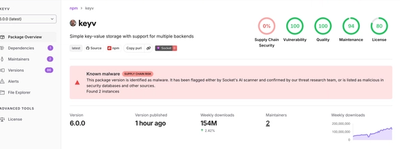
Popular npm packages keyv and cacheable compromised.

Security News
A misconfiguration gave three Anthropic models internet access, and one, believing it was in a simulation, shipped a credential-stealing package to PyPI.