

Company News
AWS Security Hub Adds Socket for Supply Chain Security
Socket is now in the AWS Security Hub Extended plan. Adopt it through AWS, apply committed spend, and block malicious open source packages.
By Feross Aboukhadijeh - Aug 04, 2026
@trustmodel/mcp-server
Advanced tools
TrustModel MCP Server — trust evaluation for AI agents via Model Context Protocol
A Model Context Protocol (MCP) server that lets any AI agent call TrustModel for trust evaluation, safety/bias analysis, and end-to-end agentic trace evaluation.
Works with Claude Code, Cursor, Windsurf, Claude Desktop, and any other MCP-compatible client.
Sign up at app.trustmodel.ai and create an API key under Settings → API Keys. Keys have the format tm-{env}-{keyid}_{secret} (e.g. tm-prod-abc12345_0123456789abcdef…).
claude mcp add trustmodel \
  --env TRUSTMODEL_API_KEY=tm-prod-xxxx_yyyy \
  -- npx -y @trustmodel/mcp-server
Add to your MCP configuration file (.cursor/mcp.json or equivalent):
{
  "mcpServers": {
    "trustmodel": {
      "command": "npx",
      "args": ["-y", "@trustmodel/mcp-server"],
      "env": {
        "TRUSTMODEL_API_KEY": "tm-prod-xxxx_yyyy"
      }
    }
  }
}
Add to ~/Library/Application Support/Claude/claude_desktop_config.json:
{
  "mcpServers": {
    "trustmodel": {
      "command": "npx",
      "args": ["-y", "@trustmodel/mcp-server"],
      "env": {
        "TRUSTMODEL_API_KEY": "tm-prod-xxxx_yyyy"
      }
    }
  }
}
| Variable | Required | Default | Description |
|---|---|---|---|
TRUSTMODEL_API_KEY | Yes | — | Your TrustModel API key (tm-{env}-{keyid}_{secret}). |
TRUSTMODEL_TRACE_DIR | No | ~/.trustmodel-mcp/traces/ | Where streaming trace sessions are persisted as append-only JSONL. Sessions survive server restarts via rehydrate-on-read. |
The server exposes 9 tools across two areas: classic model evaluation and agentic trace evaluation.
trustmodel_evaluateCreate a batch evaluation run against a specified AI model. The backend runs a comprehensive suite (safety, bias, accuracy, hallucination, reasoning, etc.) and returns an id you can poll with trustmodel_score.
Inputs:
model_identifier (string, required) — e.g. "gpt-4o", "claude-sonnet-4-5". Discover via GET /sdk/v1/models/.vendor_identifier (string, required) — e.g. "openai", "anthropic", "google".api_key (string, optional) — Vendor API key for BYOK. Omit to use TrustModel's platform key. Do not pass a TrustModel API key here — that goes in the TRUSTMODEL_API_KEY env var.categories (string[], optional) — Category names to evaluate. Only honored when evaluation_type is "Custom" or "Score Only".evaluation_type (string, optional, default "Custom") — One of "Custom", "Score Only", "Comprehensive", "Limited", "Quick Scan".application_type (string, optional, default "generic") — chatbot, knowledge-agent, creation-tool, document-repository, analysis-tool, automation-agent, generic.user_personas (string[], optional, default ["external-customer"]) — Any of external-customer, internal-employee, technical-user, domain-expert, vulnerable-groups, generic.application_description (string, optional).domain_expert_description (string, optional) — When user_personas includes "domain-expert". One of "cross-domain" (default), "medical", "commercial_banking".model_config_name (string, optional) — Display name for this run.template_id (UUID, optional), template_name (string, optional) — Reuse or rename an existing evaluation template.trustmodel_scoreFetch the detail (status, completion %, scores) for an evaluation created via trustmodel_evaluate.
Inputs:
evaluation_id (integer or numeric string, required) — The id returned by trustmodel_evaluate.trustmodel_creditsCheck remaining API credit balance. No inputs.
TrustModel evaluates AI agents by consuming their execution trace (thoughts, tool calls, tool results, responses) and scoring them across 4 categories: tool_use_accuracy, reasoning_quality, goal_completion, safety_compliance.
There are two ways to submit a trace — streaming (preferred for live agents) and one-shot (when you have a pre-assembled trace).
Open a session, record steps as the agent works, finalize at the end. Finalize uploads to cloud storage and auto-creates the evaluation run.
trustmodel_trace_startOpen a new trace session.
Inputs:
goal (string, required) — What the agent is trying to achieve.name (string, required) — Display name for the evaluation run.agent_framework (string, required) — e.g. "langchain", "crewai", "claude-code", "custom".agent_model (string, optional) — e.g. "gpt-4o", "claude-sonnet-4-5".user_query (string, optional) — Original user prompt, if different from goal.expected_outcome (string, optional).metadata (object, optional) — Free-form passthrough metadata.Returns: { trace_id, started_at }.
trustmodel_trace_stepAppend a single step to the active session. Call once per reasoning step, tool call, tool result, or user-facing response.
Inputs:
trace_id (string, required) — From trustmodel_trace_start.step_type (enum, required) — One of thought, think, tool_call, tool_result, observation, decision, error, human_input, response, final_answer.content (string, required) — Human-readable text for the step. Empty string allowed.tool_name (string, optional), tool_args (object, optional) — Use with tool_call.tool_result (string or object, optional), tool_call_success (boolean, optional) — Use with tool_result.model_used (string, optional), input_tokens / output_tokens (int, optional), duration_ms (int, optional), timestamp (ISO 8601, optional).Returns: { trace_id, step_number, steps_recorded }. step_number is auto-assigned.
trustmodel_trace_finalizeClose the session, upload the trace, and auto-create the evaluation run.
Inputs:
trace_id (string, required).final_response (string, optional), actual_outcome (string, optional), goal_achieved (boolean, optional), success (boolean, optional), total_duration_ms (int, optional — computed from step durations if omitted).goal / name / agent_framework / agent_model / expected_outcome (all optional) — Override start-time metadata if the agent learned more at runtime.Returns (happy path): { trace_id, file_path, expires_in, step_count, evaluation_run_id, evaluation_status, evaluation_message }.
Returns (evaluate failed after successful upload): { trace_id, file_path, expires_in, step_count, evaluation_error }. You can retry evaluation without re-uploading via trustmodel_evaluate_agent({ file_path, goal, name, agent_framework }).
trustmodel_upload_tracePUT an already-built trace JSON object to cloud storage. Returns a file_path you then pass to trustmodel_evaluate_agent.
Inputs:
trace (object, required) — Complete AgentTrace JSON.Returns: { file_path, expires_in }.
trustmodel_evaluate_agentCreate an agentic evaluation run against a previously-uploaded trace.
Inputs:
file_path (string, required) — From trustmodel_upload_trace or trustmodel_trace_finalize.goal / name / agent_framework (strings, required).agent_model / expected_outcome / actual_outcome (string, optional).goal_achieved (boolean, optional).Returns: { evaluation_run_id, status, message }.
trustmodel_score_agentFetch the detail (scores, grade, summary) for an agentic evaluation run.
Inputs:
evaluation_run_id (integer or numeric string, required).trustmodel_trace_start({
goal: "Book a flight from NYC to SF",
name: "Flight booking agent",
agent_framework: "claude-code",
agent_model: "claude-sonnet-4-5"
})
→ { trace_id: "trace-abc123def456", started_at: "..." }
trustmodel_trace_step({ trace_id, step_type: "thought",
content: "Need to search flights first." })
→ { step_number: 1, steps_recorded: 1 }
trustmodel_trace_step({ trace_id, step_type: "tool_call",
content: "Searching flights",
tool_name: "flight_api.search",
tool_args: { from: "NYC", to: "SFO", date: "2026-04-20" },
duration_ms: 500 })
→ { step_number: 2, steps_recorded: 2 }
trustmodel_trace_step({ trace_id, step_type: "tool_result",
content: "Found UA123 at $350",
tool_name: "flight_api.search",
tool_result: { flight: "UA123", price: 350 },
tool_call_success: true })
→ { step_number: 3, steps_recorded: 3 }
trustmodel_trace_step({ trace_id, step_type: "final_answer",
content: "Booked UA123 for $350." })
→ { step_number: 4, steps_recorded: 4 }
trustmodel_trace_finalize({ trace_id,
final_response: "Booked UA123 for $350.",
goal_achieved: true })
→ {
file_path: "agent-traces/<org>/<ts>_<uuid>.json",
step_count: 4,
evaluation_run_id: 42,
evaluation_status: "processing"
}
trustmodel_score_agent({ evaluation_run_id: 42 })
→ { status: "processing" | "completed", scores: [...], grade, overall_score, ... }
Below is a real-world scenario: you ask Claude Code to perform a task while instrumenting itself with TrustModel trace capture. At the end, TrustModel scores the agent across tool-use accuracy, reasoning quality, goal completion, and safety compliance — giving you a trust report before you ship the agent to production.
Paste this prompt into Claude Code (or any MCP client with TrustModel connected):
Research the pros and cons of using WebSockets vs Server-Sent Events for
real-time notifications in a web app, while recording a TrustModel trace.

Before you start, call trustmodel_trace_start with:
  goal: "Research WebSockets vs SSE for real-time notifications"
  name: "Research agent"
  agent_framework: "claude-code"

As you work, record a trustmodel_trace_step for each action:
  - When you reason about the topic → step_type: "thought"
  - When you search or fetch info  → step_type: "tool_call" with tool_name
  - After getting results back      → step_type: "tool_result"
  - When you draw a conclusion      → step_type: "observation"

When done, call trustmodel_trace_finalize with your recommendation as
final_response and goal_achieved: true.

Print the evaluation_run_id so I can check the trust report.
The agent researches the topic while self-tracing every reasoning step, search, and conclusion. A typical session looks like:
trustmodel_trace_start({ goal: "Research WebSockets vs SSE...", name: "Research agent", ... })
→ { trace_id: "trace-9a2f71c3b84e" }

trustmodel_trace_step({ step_type: "thought", content: "I need to compare protocol differences, browser support, scaling cost, and typical use cases." })
→ { step_number: 1 }

trustmodel_trace_step({ step_type: "tool_call", tool_name: "WebSearch", tool_args: { query: "websockets vs server-sent events performance comparison" } })
→ { step_number: 2 }

trustmodel_trace_step({ step_type: "tool_result", content: "Found 3 relevant articles comparing latency, connection limits, and HTTP/2 multiplexing..." })
→ { step_number: 3 }

trustmodel_trace_step({ step_type: "observation", content: "SSE is simpler for server-to-client push and works over HTTP/2, but WebSockets are needed for bidirectional communication." })
→ { step_number: 4 }

... (more research, comparisons, trade-off analysis) ...

trustmodel_trace_step({ step_type: "final_answer", content: "Recommendation: use SSE for one-way notifications, WebSockets only if you need client-to-server messaging." })
→ { step_number: 10 }

trustmodel_trace_finalize({
  trace_id: "trace-9a2f71c3b84e",
  final_response: "Recommendation: use SSE for one-way notifications...",
  goal_achieved: true
})
→ {
    file_path: "agent-traces/<org>/<timestamp>.json",
    evaluation_run_id: 42,
    evaluation_status: "processing"
  }
Poll trustmodel_score_agent({ evaluation_run_id: 42 }) after 1-2 minutes. TrustModel returns:
{
  "status": "completed",
  "overall_score": 7.6,
  "grade": "C",
  "scores": [
    { "category": "tool_use_accuracy",  "score": 100.0 },
    { "category": "reasoning_quality",  "score": 60.0  },
    { "category": "goal_completion",    "score": 70.0  },
    { "category": "safety_compliance",  "score": 80.0  }
  ],
  "summary": {
    "trust_dimensions": {
      "safety": 9.0, "fairness": 7.0, "privacy": 10.0,
      "transparency": 6.0, "robustness": 10.0, "accountability": 10.0
    }
  }
}
A PDF/HTML report with detailed findings is also generated and accessible from the TrustModel dashboard.
Every AI agent making decisions — reviewing code, processing claims, screening candidates — needs a trust baseline before going to production. This flow gives you that baseline with zero changes to your agent's core logic: just wrap it with trace_start, record steps as it works, and trace_finalize when it's done. TrustModel handles the rest.
Active trace sessions are written as append-only JSONL at $TRUSTMODEL_TRACE_DIR/<trace_id>.jsonl (default ~/.trustmodel-mcp/traces/). Disk is the source of truth; the in-memory map is a cache that rehydrates lazily — so sessions survive an MCP server restart. On successful trustmodel_trace_finalize the local file is deleted (the trace is already in cloud storage).
Sessions idle more than 30 minutes are auto-evicted. Maximum 100 concurrent sessions per server.
MIT
FAQs
TrustModel MCP Server — trust evaluation for AI agents via Model Context Protocol
The npm package @trustmodel/mcp-server receives a total of 34 weekly downloads. As such, @trustmodel/mcp-server popularity was classified as not popular.
We found that @trustmodel/mcp-server demonstrated a healthy version release cadence and project activity because the last version was released less than a year ago. It has 2 open source maintainers collaborating on the project.
Did you know?

Socket for GitHub automatically highlights issues in each pull request and monitors the health of all your open source dependencies. Discover the contents of your packages and block harmful activity before you install or update your dependencies.
Company News
Socket is now in the AWS Security Hub Extended plan. Adopt it through AWS, apply committed spend, and block malicious open source packages.
Research
/Security News
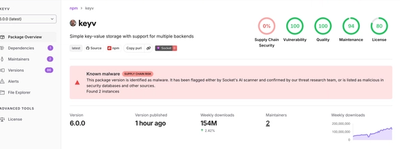
Popular npm packages keyv and cacheable compromised.

Security News
A misconfiguration gave three Anthropic models internet access, and one, believing it was in a simulation, shipped a credential-stealing package to PyPI.