

Company News
AWS Security Hub Adds Socket for Supply Chain Security
Socket is now in the AWS Security Hub Extended plan. Adopt it through AWS, apply committed spend, and block malicious open source packages.
By Feross Aboukhadijeh - Aug 04, 2026
@trusty-squire/mcp
Advanced tools
Trusty Squire signs up / in to websites for you so you don’t have to.



Trusty Squire signs up / in to websites for you so you don’t have to.
Trusty Squire is an MCP server that lets Claude Code, Codex, Cursor, OpenCode, Goose, and other coding agents create accounts on real websites and retrieve the API keys automatically — then saves each key in an encrypted, write-only vault instead of your chat, your code, or your .env. The raw provider secret never needs to enter the agent's context, so it can't be pasted into a commit or leaked in a log.
It is not a secrets manager for keys you already have, and not a browser-automation framework you script per site. Point your agent at a service — “set up Clerk and wire in the key” — and Trusty Squire opens a real browser, works through signup or sign-in one step at a time, clears the bot-detection and email-verification steps that make operator tools stall, and captures the generated key. When a real person is required for phone verification, a hard CAPTCHA, 3-D Secure, an unsupported payment, or another decision, it stops and says so rather than pretending the signup completed.
Built to be handed the keys. Provider secrets are write-only: the agent's credential tools return references and authenticated results, never stored plaintext. Backend access is a host-scoped, rate-limited, independently revocable grant, so a leaked token is killed without rotating the provider key — and you connect Google or GitHub yourself in a real browser, so the agent never types your password. Full threat model below.
Use Trusty Squire to create a Clerk account for this app, save the generated secret key, allow api.clerk.com for server-side requests, and wire it in without putting the raw key in chat, code, or .env.
Your coding agent plans the job. Trusty Squire operates the website, stores the generated key, and can issue your backend a scoped grant. The backend calls the provider through Trusty Squire, which injects the provider key on the server side.
Other useful asks:
For supported card checkouts, save a card in the Vault from a passkey-capable
device or let your first operate_pay approval link collect one just in time.
When no card is specified, Trusty Squire uses the only saved card, starts the
add-card ceremony if none exists, or asks you to choose when several exist. The
new card is encrypted in your browser with a passkey-derived key and bound to
that purchase before approval; if you add it but do not approve in time, it
remains saved for a faster retry.
Recognized Visa, Mastercard, Amex, Discover, Diners Club, and JCB cards show
their network mark in the Vault while keeping the full bank/network label. Open
a card row to see its masked number; reveal runs the passkey ceremony in your
browser before showing the number, name, expiry, and billing address. The CVV is
never shown, even after reveal. The Activity page also records card additions
and removals, payments, and app-grant changes without storing a PAN or CVV.
operate_pay reads the checkout total, sends you a short-lived approval link,
and submits only after you approve the exact purchase. The approval page shows
the venue, item, amount, requesting agent, and reason; one passkey prompt both
signs that approval and releases the card to the checkout operator. A first-time
payment is refused if the merchant, checkout origin, amount, or currency changes
between approval and submission. If the issuer requires 3-D Secure, Trusty
Squire notifies your linked Telegram chat and waits 180 seconds by default for
you to complete the challenge in the open checkout instead of automating it. It
reports a visible success or decline and hands an unresolved challenge back on
timeout. three_ds_wait_seconds accepts whole seconds from 0 to 600; set it to
0 on operate_pay to skip the notification and waiting and receive the
handoff immediately.
Connect Telegram under Vault Settings to receive secret-free alerts for credential, card, payment, and app-grant lifecycle changes. Routine credential retrieval and proxy access stay in Activity instead of sending a push for every request.
npx @trusty-squire/mcp connect
connect signs you in with Google or GitHub, detects your coding agent, and merges the squire MCP server into its existing configuration. Restart the agent and ask for the finished website outcome. Trusty Squire is free to start.
To choose a target explicitly:
npx @trusty-squire/mcp connect --target=codex
Supported targets: claude-code, cursor, codex, opencode, goose, cline, continue, and hermes.
If a site requires phone verification, a hard CAPTCHA, an unsupported payment, 3-D Secure, or another human decision, the run stops and tells you. It does not guess or pretend the signup completed.
Discovery pages are generated only for services with an active skill in the Trusty Squire registry. The first five detailed pages cover Braintrust, Cerebras, Clerk, DeepInfra, and Zilliz Cloud. Each sample has explicit signup evidence in its active registry record and a provider request checked against official API documentation. The service hub also lists every active registry entry; the remaining detail pages stay unpublished until their workflow and unique content pass review.
Browse the active service catalog. Maintainers can detect registry drift before merging with:
pnpm seo:verify-services
The registry controls which service pages exist. An external list is never used to claim support.
Ask the agent to create a scoped backend grant:
Grant this backend access to Clerk through Trusty Squire with a limit of 100 requests per hour.
Before minting the grant, make api.clerk.com the credential's primary allowed host in the Vault. The egress proxy refuses every other upstream host. This explicit policy step is required when the signup host and provider API host differ.
The agent calls the real MCP tool with the service and requested limit:
grant_app_access({
  service: "clerk",
  rate_limit_per_hour: 100
})
The result contains a host-scoped egress base_url and a token, not the Clerk secret key. The token is returned once through the MCP result and remains valid until revoked. That means the scoped grant token can enter agent context; it is not the provider key. Move it directly into backend-only deployment secret storage, never browser code, logs, or source control. If you need zero grant-token exposure to the model, use use_credential for agent-initiated requests instead. Trusty Squire removes the grant authorization at the boundary and injects the vaulted provider credential into the upstream request.
.env file.See the security model for the card and credential trust boundaries, and architecture for the system and data flows.
operate_start, operate_observe, and operate_act open a website, inspect
the current state, and perform one browser action at a time. If a visible
control has no observed ref, click and js_click can target its live
text=… or css=… locator; that one-off fallback is not replayable.operate_extract captures a generated credential into a sealed slot or the vault.operate_remember and operate_use save and replay eligible successful flows
built from observed refs.list_payment_cards returns saved-card labels and opaque references;
operate_pay can use a selected card, the only card on file, or a just-in-time
add-card approval, then fills the checkout and waits for the user to resolve
3-D Secure before handing back unresolved challenges.list_credentials and use_credential find saved credentials and make authenticated API calls without returning raw values.grant_app_access and revoke_app_access create and remove scoped backend access.audit_log reports credential activity without exposing credential values.This root file is the canonical README. The npm pack lifecycle copies it into @trusty-squire/mcp byte-for-byte, then removes the generated package-local copy after packing. GitHub and npm therefore publish the same product explanation.
git clone https://github.com/Trusty-Squire/trusty-squire.git
cd trusty-squire
./scripts/bootstrap.sh
After bootstrap, pnpm typecheck and pnpm test should pass. Stop local services with docker compose -f docker-compose.dev.yml down; add -v to reset their data.
Requirements: Node 20.11.0 (.nvmrc), pnpm 8.15+, Docker, and Docker Compose.
Repository map:
trusty-squire/
├── apps/
│   ├── api/        Accounts, OAuth, machine tokens, proxy, inbox, vault, and billing
│   ├── mcp/        MCP server, browser operation tools, and credential tools
│   ├── registry/   Signed website skills and verification service
│   └── web/        Marketing site and vault UI
└── packages/
    ├── vault/        Encrypted credential storage and audit log
    └── skill-schema/ Shared schema for replayable website skills
Product and public-web changes should follow PRODUCT.md and DESIGN.md.
MIT © Trusty Squire
FAQs
Trusty Squire signs up / in to websites for you so you don’t have to.
The npm package @trusty-squire/mcp receives a total of 3,124 weekly downloads. As such, @trusty-squire/mcp popularity was classified as popular.
We found that @trusty-squire/mcp demonstrated a healthy version release cadence and project activity because the last version was released less than a year ago. It has 1 open source maintainer collaborating on the project.
Did you know?

Socket for GitHub automatically highlights issues in each pull request and monitors the health of all your open source dependencies. Discover the contents of your packages and block harmful activity before you install or update your dependencies.
Company News
Socket is now in the AWS Security Hub Extended plan. Adopt it through AWS, apply committed spend, and block malicious open source packages.
Research
/Security News
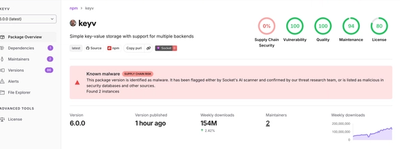
Popular npm packages keyv and cacheable compromised.

Security News
A misconfiguration gave three Anthropic models internet access, and one, believing it was in a simulation, shipped a credential-stealing package to PyPI.