
Product
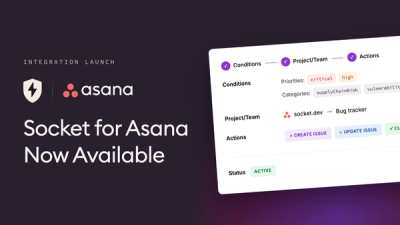
Socket for Asana Is Now Available
Create and manage Asana tasks directly from Socket alerts, with manual task creation, automated ticketing rules, and two-way sync.
By Jeppe Hasseriis - Aug 25, 2026
@txtcel/protocol
Advanced tools
TypeScript SDK for the Txtcel Solana program: instruction builders, account codecs and PDA derivation.
TypeScript SDK for the Txtcel Solana program — a thin, framework-agnostic wrapper around the on-chain protocol. It gives you:
build*Instruction(...) for every program instruction.buildSendMessageTransactions, createRootAlloc, …derive*Pda(...) helpers that mirror the program's seeds.load* helpers that fetch + decode in one call.No React, no wallet adapter — just @solana/web3.js primitives, so it works in
the browser, in Node scripts and in tests.
Note: This README is LLM-generated from the source and reviewed by hand. The code is the source of truth. A condensed, agent-oriented overview lives in
llms.txt.
npm install @txtcel/protocol @solana/web3.js
@solana/web3.js (v1) is a peer dependency — install it in your app.
import { Connection, Keypair, PublicKey } from '@solana/web3.js'
import {
  createRootAlloc,
  buildSendMessageTransactions,
  loadThreadNode,
} from '@txtcel/protocol'

const connection = new Connection('https://api.mainnet-beta.solana.com')
const programId = '<YOUR_PROGRAM_ID>'
const payer = Keypair.generate()

// 1. Create a channel (thread). `seed` is the thread's 32-byte identity.
const { seed, threadPda } = await createRootAlloc(connection, programId, payer)

// 2. Post a message (auto-chunks if it exceeds one transaction).
const txs = await buildSendMessageTransactions(
  connection, new PublicKey(programId), payer.publicKey, seed, 'gm world',
)

// 3. Read the thread back.
const thread = await loadThreadNode(connection, new PublicKey(programId), new PublicKey(threadPda))
All builders take the programId explicitly — the SDK has no hard-coded address,
so the same package works across clusters and deployments.
seed— most functions take aseed: Uint8Array. This is the thread's 32-byte identity (the thread account's pubkey bytes).createRootAllocreturns it; for an existing thread it'snew PublicKey(threadPda).toBytes(). Child PDAs (alloc/content/access/likes/author-fee) all derive from it.
Everything is re-exported from the package root (src/index.ts).
createRootAlloc(connection, programId, payer, messageFee?, title?, onSent?)Creates a new thread (channel) + root alloc and confirms it with a local
Keypair payer. Generates a fresh thread keypair internally (it co-signs).
programId: string, payer: KeypairmessageFee: bigint = 0n — per-message author fee in lamports.title: string = '' — channel title (≤ MAX_TITLE_LEN bytes).onSent?: () => void — called right after the tx is submitted.{ signature, seed, threadPda, allocPda }.createRootAllocWithWallet(connection, programId, wallet, messageFee?, title?, onSent?)Same as above but for a wallet-adapter style signer
(WalletSigner = { publicKey, signTransaction }). The wallet is fee payer; the
generated thread keypair is an extra signer.
buildSendMessageTransactions(connection, programId, payerKey, seed, text, replyTo?)The recommended way to post a message. Returns an array of POST-ONLY
Transactions: the first is a FillSlot, followed by AppendContent txs when
text is larger than one transaction. It never co-bundles prepare_alloc
(growing the chain is the separate buildExtendAllocTransaction). It:
N = thread.lastAllocSeq),N-1 (when it exists) plus the tail page N — in one
getMultipleAccountsInfo,DESIRED_CANDIDATES = 3 to reduce write
contention,maxFee slippage cap (≈ 2× base fee + message fee),Liveness fallback: if the whole 2-page window is full (rare burst), a separate
prepare_alloc(N) transaction (carrying the occupancy witness set for
non-authors) is prepended before the fill_slot targeting page N+1, so a
post is always possible — sign the returned array as one batch. replyTo?: { allocSeq: number; slot: number } | null threads the message as a reply.
Throws 'Text must not be empty' / 'Body is too long'.
buildExtendAllocTransaction(connection, programId, payerKey, seed)Returns a best-effort prepare_alloc(N) transaction that grows the alloc
chain when the tail page N = thread.lastAllocSeq has filled >= EXTEND_THRESHOLD slots, else null. Extension is occupancy-gated on-chain:
for non-authors the transaction carries EXTEND_THRESHOLD witness accounts
(randomly sampled occupied tail slots) proving the tail is full enough; the
thread author extends by signature alone. Decoupled from posting: fire it
alongside a post and ignore its failure (e.g. InvalidAllocSeq when
another sender already extended, or WitnessSlotEmpty when a witnessed
message was deleted mid-flight).
sendMessageWithWallet(connection, programId, wallet, seed, text, replyTo?, onSent?)Posts a message with a wallet using a single approval: builds the post txs
plus the best-effort extend tx, signs them all in one signAllTransactions
call (falling back to per-tx signTransaction), then sends them as independent
transactions — fill_slot then append_content chunks (confirmed), and the
extend tx best-effort (its failure is swallowed). Returns
{ signatures, extendSignature }.
buildSendMessageTransaction(...) — deprecatedReturns only the first transaction. Use buildSendMessageTransactions for
chunked sending.
type WalletSigner{ publicKey: PublicKey; signTransaction: (tx) => Promise<Transaction>; signAllTransactions?: (txs) => Promise<Transaction[]> }
Each returns a TransactionInstruction you add to your own Transaction. They
mirror the on-chain instructions 1:1 (see the program README for account
semantics, fees and errors).
| Builder | On-chain instruction | Key args |
|---|---|---|
buildCreateRootAllocInstruction(programId, payer, seed, messageFee?, title?) | CreateRootAlloc | thread keypair pubkey as seed, picks a random treasury shard. |
buildFillSlotInstruction(opts) | FillSlot | see options below. |
buildPrepareAllocInstruction(programId, payer, seed, allocSeq, witnessSlots?) | PrepareAlloc | pre-creates allocSeq + 1; non-authors pass EXTEND_THRESHOLD occupied tail slot indexes as the witness proof. |
buildAppendContentInstruction(programId, payer, contentAccount, threadAccount, settingsAccount, treasuryShard, authorFeeShard, chunk, treasuryShardIdx, authorFeeShardIdx) | AppendContent | append bytes to your message. |
buildLikeContentInstruction(programId, payer, seed, allocSeq, slot, maxFee) | LikeContent | random shards chosen internally. |
buildCloseAccountInstruction(programId, payer, targetAccount, likesAccount?) | CloseAccount | optional likes account resets the slot counter. |
buildSweepTreasuryInstruction(programId, treasuryWallet, shardIndices) | SweepTreasury | [settings, treasury, ...shards]. |
buildSweepAuthorFeesInstruction(programId, seed, threadAccount, authorWallet, shardIndices) | SweepAuthorFees | author signs. |
buildInitSettingsInstruction(programId, authority, treasury) | InitSettings | derives ProgramData PDA; upgrade authority signs. |
buildSetTreasuryInstruction(programId, authority, treasury) | SetTreasury | admin only. |
buildSetAdminInstruction(programId, authority, newAdmin) | SetAdmin | admin only. |
buildSetFeeInstruction(programId, authority, kind, feeBps) | SetBaseFee/SetAuthorFeeCut/SetEntryCut/SetLikeCut | kind: FeeKind. |
buildSetBaseFeeInstruction(programId, authority, feeBps) | SetBaseFee | admin only. |
buildSetAuthorFeeCutInstruction(programId, authority, feeBps) | SetAuthorFeeCut | admin only. |
buildSetEntryCutInstruction(programId, authority, feeBps) | SetEntryCut | admin only. |
buildSetLikeCutInstruction(programId, authority, feeBps) | SetLikeCut | admin only. |
buildSetMessageFeeInstruction(programId, authority, threadAccount, fee) | SetMessageFee | thread author. |
buildSetLikeFeeInstruction(programId, authority, threadAccount, fee) | SetLikeFee | thread author. |
buildSetEntryFeeInstruction(programId, authority, accessAccount, fee) | SetEntryFee | thread admin. |
buildInitThreadAccessInstruction(programId, authority, seed, enabled) | InitThreadAccess | thread author. |
buildSetThreadAccessInstruction(programId, authority, accessAccount, enabled) | SetThreadAccess | thread admin. |
buildAddToWhitelistInstruction(programId, authority, seed, wallet) | AddToWhitelist | thread admin. |
buildRemoveFromWhitelistInstruction(programId, authority, seed, wallet) | RemoveFromWhitelist | thread admin. |
buildAddToBlacklistInstruction(programId, authority, seed, wallet) | AddToBlacklist | thread admin. |
buildRemoveFromBlacklistInstruction(programId, authority, seed, wallet) | RemoveFromBlacklist | thread admin. |
buildAddToFeeWhitelistInstruction(programId, authority, seed, wallet) | AddToFeeWhitelist | thread admin. |
buildRemoveFromFeeWhitelistInstruction(programId, authority, seed, wallet) | RemoveFromFeeWhitelist | thread admin. |
buildRequestAccessInstruction(programId, payer, seed) | RequestAccess | pay entry fee to join. |
buildSubscribeInstruction({ programId, user, seed }) | Subscribe | follow a channel; no fee, user pays registry/shard rent. |
buildUnsubscribeInstruction({ programId, user, seed }) | Unsubscribe | unfollow a channel; refunds freed registry rent. |
buildFillSlotInstruction(opts) options{
programId: PublicKey
payer: PublicKey
seed: Uint8Array
candidates: Array<{ allocSeq: number; slot: number; pda: PublicKey }>
treasuryShardIdx: number
authorFeeShardIdx: number
bodyBytes: Uint8Array // opaque payload; UTF-8 for the default text kind
kind?: number // message-type discriminator, defaults to KIND_TEXT
maxFee: bigint // slippage cap on base + author fee
replyAllocSeq?: number | null
replySlot?: number | null
}
The builder appends the mandatory access + per-wallet entry PDAs (derived
for payer) at fixed positions. fill_slot is element-only and never grows the
alloc chain — linking a new page is the separate prepare_alloc instruction.
type FeeKind'base' | 'authorCut' | 'entryCut' | 'likeCut' — selects which platform fee
buildSetFeeInstruction updates.
All mirror the program's seeds exactly (see the program README PDA table).
| Function | Returns |
|---|---|
deriveSettingsPda(programId) | global settings PDA. |
deriveThreadPda(programId, seed) | the thread account address (= new PublicKey(seed); thread is a full-address account, not a PDA). |
deriveAllocPda(programId, seed, allocSeq) | alloc node PDA. |
deriveContentPda(programId, seed, allocSeq, slot) | content (message) PDA. |
deriveAccessPda(programId, seed) | ThreadAccess PDA. |
deriveAccessEntryPda(programId, seed, wallet) | per-wallet AccessEntry PDA. |
deriveLikesPda(programId, seed, allocSeq) | AllocLikes PDA. |
deriveTreasuryShardPda(programId, shard) | treasury vault shard PDA. |
deriveAuthorFeePda(programId, seed, shard) | author-fee vault shard PDA. |
deriveProgramDataPda(programId) | BPF loader ProgramData account (holds upgrade authority). |
deriveFollowRegistryPda(programId, owner) | per-wallet FollowRegistry PDA. |
deriveFollowerShardPda(programId, seed, shard) | per-channel FollowerShard counter PDA. |
followerShardIndex(owner) | shard index for a wallet (owner.toBytes()[0] % N_FOLLOWER_SHARDS). |
randomTreasuryShard() | random index in [0, N_TREASURY_SHARDS). |
randomAuthorFeeShard() | random index in [0, N_AUTHOR_FEE_SHARDS). |
Helper seed encoders u16Seed(n) / u32Seed(n) are also exported.
Fetch (getAccountInfo, 'confirmed') + validate owner/tag + decode in one
call.
| Loader | Returns | Missing account |
|---|---|---|
loadThreadNode(connection, programId, pubkey) | ThreadNodeData | throws. |
loadAllocNode(connection, programId, pubkey) | AllocNodeData | throws. |
loadContentNode(connection, programId, pubkey) | ContentNodeData | throws. |
loadProgramSettings(connection, programId) | ProgramSettingsData | null | returns null. |
loadThreadAccess(connection, programId, accessKey) | ThreadAccessData | throws. |
loadAllocLikes(connection, programId, pubkey) | AllocLikesData | null | returns null. |
loadAccessEntries(connection, programId, seed) | { whitelist, blacklist, feeExempt } of base58 strings | scans program accounts by tag + seed. |
loadFollowRegistry(connection, programId, owner) | FollowRegistryData | null | returns null. |
loadFollowerCount(connection, programId, seed) | bigint (sum of all follower shards) | returns 0n. |
Pure decoders (Uint8Array -> typed data), used by the loaders but exported for
when you already have raw account data (e.g. from getProgramAccounts or a
websocket subscription).
decodeContent(pubkey, data) → ContentNodeDatadecodeAlloc(pubkey, data) → AllocNodeDatadecodeThread(pubkey, data) → ThreadNodeDatadecodeSettings(pubkey, data) → ProgramSettingsDatadecodeThreadAccess(pubkey, data) → ThreadAccessDatadecodeAccessEntry(pubkey, data) → AccessEntryDatadecodeAllocLikes(pubkey, data) → AllocLikesDatadecodeFollowRegistry(pubkey, data) → FollowRegistryDatadecodeFollowerShard(pubkey, data) → FollowerShardDataThe raw zorsh schemas (ContentNodeSchema, FillSlotInstr, …) live in
codec/schemas.ts if you need to (de)serialize manually.
type ContentNodeData = {
  pubkey: string
  allocSeq: number
  slot: number
  seed: Uint8Array          // owning thread's identity bytes
  author: string
  createdAt: string         // ISO-8601
  replyAllocSeq: number | null
  replySlot: number | null
  contentKind: number       // KIND_* discriminator
  body: Uint8Array          // opaque, raw bytes
  text: string              // decoded UTF-8 when contentKind === KIND_TEXT
}

type AllocNodeData = {
  pubkey: string; seed: Uint8Array; allocSeq: number
}

type ThreadNodeData = {
  pubkey: string; seed: Uint8Array; allocCount: number; lastAllocSeq: number
  author: string; messageFee: bigint; likeFee: bigint; title: string
}

type ProgramSettingsData = {
  pubkey: string; admin: string; treasury: string
  baseFeeBps: number; authorFeeCutBps: number; entryCutBps: number; likeCutBps: number
}

type ThreadAccessData = {
  pubkey: string; seed: Uint8Array; enabled: boolean; admin: string
  entryFee: bigint; whitelistCount: number
}

type AccessEntryData = { pubkey: string; seed: Uint8Array; wallet: string; status: number }

type AllocLikesData = { pubkey: string; allocSeq: number; counts: number[] }
| Group | Constants |
|---|---|
| Account tags | TAG_CONTENT, TAG_ALLOC, TAG_THREAD, TAG_SETTINGS, TAG_ACCESS, TAG_LIKES, TAG_ACCESS_ENTRY, TAG_FOLLOW_REGISTRY, TAG_FOLLOWER_SHARD |
| Content kinds | KIND_TEXT |
| Access status | ACCESS_ALLOWED, ACCESS_DENIED, ACCESS_FEE_EXEMPT |
| Layout sizes | CONTENT_SLOTS, EXTEND_THRESHOLD, EXTEND_STALE_SLOTS, MAX_BODY_LEN, MAX_TITLE_LEN, INDEX_NONE, PUBKEY_SIZE |
| Shards / follows | N_TREASURY_SHARDS, N_AUTHOR_FEE_SHARDS, N_FOLLOWER_SHARDS, MAX_FOLLOWS |
| Fees | MAX_FEE_CUT_BPS (5000; on-chain max for fee cuts / base fee) |
| Seeds | SEED_SETTINGS, SEED_ALLOC, SEED_CONTENT, SEED_ACCESS, SEED_LIKES, SEED_TREASURY_SHARD, SEED_AUTHOR_FEE, SEED_ACL, SEED_FOLLOWS, SEED_FOLLOWER_COUNT |
| Misc | Instruction (variant index map), BPF_LOADER_UPGRADEABLE_ID, DESIRED_CANDIDATES, BPS_DIVISOR, TX_POLL_TIMEOUT_MS, TX_POLL_INTERVAL_MS |
The Instruction object maps instruction names to their on-chain variant index
(e.g. Instruction.FillSlot === 1), matching ProgramInstruction in the
program's instruction.rs.
import { Connection, PublicKey } from '@solana/web3.js'
import { buildSendMessageTransactions } from '@txtcel/protocol'

const txs = await buildSendMessageTransactions(
  connection, programId, wallet.publicKey, seed, longText,
)
for (const tx of txs) {
  tx.feePayer = wallet.publicKey
  tx.recentBlockhash = (await connection.getLatestBlockhash()).blockhash
  const signed = await wallet.signTransaction(tx)
  await connection.sendRawTransaction(signed.serialize())
}
import { Transaction } from '@solana/web3.js'
import {
  buildInitThreadAccessInstruction,
  buildAddToWhitelistInstruction,
} from '@txtcel/protocol'

const tx = new Transaction()
  .add(buildInitThreadAccessInstruction(programId, author, seed, true))
  .add(buildAddToWhitelistInstruction(programId, author, seed, memberWallet))
import { buildSweepTreasuryInstruction } from '@txtcel/protocol'

const ix = buildSweepTreasuryInstruction(programId, treasuryWallet, [0, 1, 2])
npm install
npm run build      # tsup -> dist (ESM + CJS + .d.ts)
npm run typecheck
npm run build
npm publish        # publishConfig.access is already "public"
FAQs
TypeScript SDK for the Txtcel Solana program: instruction builders, account codecs and PDA derivation.
The npm package @txtcel/protocol receives a total of 28 weekly downloads. As such, @txtcel/protocol popularity was classified as not popular.
We found that @txtcel/protocol demonstrated a healthy version release cadence and project activity because the last version was released less than a year ago. It has 1 open source maintainer collaborating on the project.
Product
Create and manage Asana tasks directly from Socket alerts, with manual task creation, automated ticketing rules, and two-way sync.
Security News
Open VSX has removed three extension IDs from its malicious-extension list as the legitimate publishers they impersonated move to claim the names for themselves.
Product
Socket’s PHP and Composer support is now in Beta for all customers, with PHP reachability analysis generally available.