
Product
Socket Now Protects the Firefox Extension Ecosystem
Socket is bringing experimental protection to Firefox, scanning 97,000+ extensions in Mozilla's official directory for malware and risky updates.
By John Tuckner - Aug 20, 2026
@uipath/angular
Advanced tools

A great set of reusable @angular components, directives and testing utilities.
One of our main goals is to allow easy integration with the great collection of components already provided by the @angular/material team and to build everything with the following in mind:

 IE / Edge |  Firefox |  Chrome |  Safari |
|---|---|---|---|
| IE11, Edge | last 2 versions | last 2 versions | last 2 versions |
npm i @uipath/angular
Visit our docs page here. Thanks go to the @compodoc team! 👌
We initially started off by using a custom commit message convention, now that we've gone OS, we realize it will be much easier for everyone if we adhere to the conventional-commit standard.
The project comes preconfigured with commitlint and husky hooks in order to automate checks.
Another advantage of conventional-commits is that it will allow us to later on integrate semantic-release with ease.
We all know that once you open a PR, it sometimes goes through a rigorous code review process. Sometimes, due to this delay, we end up with a PR that has conflicts.
In this scenarios, we're usually used to either merge or rebase.
We personally prefer that branches get rebased, and usually stay away from merge commits as they mostly end up polluting the history needlessly. At this point, most of you are probabily thinking: Yeah, but it's not a good practice to rebase if multiple people are working on the same branch!.
True, it's not recommended to rebase when multiple people are active on the same branch, but in this scenario git offers a very elegant solution: fixup commits. By using fixup commits, the branch can later go through an interactive rebase once the review process is done and the PR is approved.
For example: after you make your changes and stage them you can run a git commit --fixup HEAD~ to add the changes in the last but one commit. Before the merge, you can then simply git rebase -i <ref> --autosquash and every change will be squashed in the correct commit.
Before contributing you will need to add the environment variable GH_NPM_REGISTRY_TOKEN with a dummy (empty) value. We are distributing the packages both publicly and internally and unfortunately npmrc uses an ini file format which doesn't allows us to provide a fallback automatically.
Q: Why all the hassle, does it really matter?
A: We've seen too many branches where merge commits get introduced without a good reason, too many branches that have almost the same number merge commits as commits so we want to enforce a git usage guidline that promotes responsibility. 🐱👤
Q: But I want to integrate a branch, not yet merged and implement a new feature.
A: In this scenario, you have the master branch, and the feature branch that you depend upon. What we do in this case, is create a local branch where we merge the required feature branch into master and start our branch from there. Once the feature branch we depend upon, gets merged into master, we rebase over master. Easy peasy! 🤓
Q: But what if I just want to add a feature?
A: We think that in software, it's not just about the feature, it's also about the fact that others will later on need to support that feature or modify it, having a good historical track helps everyone better understand the evolution of the codebase.
FAQs
Unknown package
The npm package @uipath/angular receives a total of 135 weekly downloads. As such, @uipath/angular popularity was classified as not popular.
We found that @uipath/angular demonstrated a not healthy version release cadence and project activity because the last version was released a year ago. It has 19 open source maintainers collaborating on the project.
Did you know?

Socket for GitHub automatically highlights issues in each pull request and monitors the health of all your open source dependencies. Discover the contents of your packages and block harmful activity before you install or update your dependencies.
Product
Socket is bringing experimental protection to Firefox, scanning 97,000+ extensions in Mozilla's official directory for malware and risky updates.
Research
/Security News
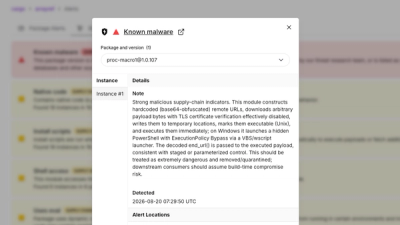
Three compromised Rust crates pulled in a malicious dependency that downloaded and executed cross-platform malware during Cargo builds.
Research
/Security News
Socket uncovered 77 linked Firefox extensions, including 40 that steal wallet secrets or credentials and 37 deceptive sports-score shells.