
Product
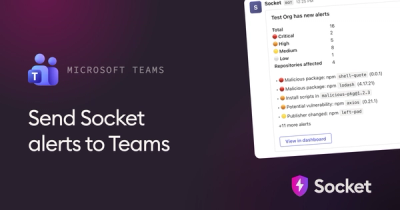
Microsoft Teams Notifications Are Now Available in Socket
Socket can now send alerts and supply chain attack notifications to Microsoft Teams, with filters that route the right updates to each channel.
By Jeppe Hasseriis - Sep 01, 2026
@ultimat3/scraping
Advanced tools
Browser automation as a job. scrape() returns a JobHandle — one row of
PRIMITIVE_FACTORIES in @ultimat3/core, the derived list of every factory that ships. There is
no ninth primitive, and no ordinal here to go stale when the next factory lands.
import { t } from '@ultimat3/schema';
import type { StorageDriver } from '@ultimat3/storage';
import { scrape, storageSessionStore } from '@ultimat3/scraping';

declare const disk: StorageDriver;

const orderPage = t.object({
  rows: t.array(t.object({ id: t.string, total: t.number })),
  hasMore: t.boolean,
});

export const dailyOrders = scrape({
  name: 'orders.daily',
  input: t.object({ orgId: t.uuid, day: t.string }),
  extract: t.object({ id: t.string, total: t.number }),
  idempotencyKey: ({ orgId, day }) => `orders:${orgId}:${day}`,
  tenant: ({ orgId }) => orgId,
  allowHosts: ['shop.example.com', '*.api.example.com'],
  block: ['image', 'media', 'font'],
  rate: 1,
  robots: 'obey',
  secrets: ['SHOP_PASSWORD'],
  expect: { minRows: 1, maxDrop: 0.5 },
  auth: {
    store: storageSessionStore(disk),
    login: async ({ page, secrets, prompt }) => {
      await page.goto('https://shop.example.com/login');
      await page.fill('#user', 'ops@example.com');
      await page.fill('#pass', secrets.get('SHOP_PASSWORD'));
      await page.click('#submit');
      await page.fill('#otp', await prompt('sms code'));
    },
    validate: async ({ page }) => (await page.count('#logout')) > 0,
  },
  async run({ page, http, step }) {
    await page.goto('https://shop.example.com/orders');
    const rows: { id: string; total: number }[] = [];
    for (let pageNumber = 1; ; pageNumber += 1) {
      // One `step.run` per page: a killed worker resumes at the page it stopped on. What a step
      // persists is a CURSOR — never a page, never a live handle, never a session.
      const batch = await step.run(`page:${pageNumber}`, async () =>
        (await http.request(`https://api.example.com/orders?page=${pageNumber}`)).parse(orderPage),
      );
      rows.push(...batch.rows);
      if (!batch.hasMore) break;
    }
    return rows;
  },
});
| A scrape has | So it is |
|---|---|
| an input schema, a tenant, a retry policy, a timeout, a queue, a concurrency cap | a job |
| a required idempotency key | a job — re-logging into a bank after a worker kill is the exact bug; three wrong attempts locks the account |
step.run checkpoints, because recovery must resume at the broken page | a job |
It therefore inherits .enqueue(), the worker's cancellation, the dead-letter path, x jobs show
and its manifest row without a line of code here.
Drive the browser through login, 2FA and navigation; then reverse-engineer the site's own JSON
endpoints and pull the bulk over HTTP. http is session-bound, never a bare fetch: the
browser's cookies, headers and proxy, the same allowHosts, the same robots gate, the same rate
limit, the same cancellation. page.session() exposes the handoff so an author can see what
carried over.
The jar is scoped per request, RFC 6265: a cookie stored for bank.test is sent to bank.test
and to nothing else — not evilbank.test, not sub.bank.test — and only a domain-scoped
.bank.test reaches subdomains. SessionSnapshot.headers is the one field the real driver cannot
fill (CDP exposes no read for it, and driver-parity.test.ts pins that): a token the HTTP leg must
carry goes on the request, http.request(url, { headers }).
Both legs replay from one fixture directory (fixtureBrowser(dir)), so a hybrid run — browser
login, session handoff, HTTP bulk fetch — is tested end to end. Both legs apply the same robots
gate, offline included.
| Read | Answers |
|---|---|
page.values(selector) | ElementValue[] — tag, text, value, attrs. The projection row assembly wants |
page.query(selector) | ElementSnapshot[] — the same matches PLUS visible, enabled, and the layout box/hitTarget a driver with a layout engine can answer. The read for a decision ABOUT an element |
page.frame(nameOrSelector) | a ScrapeFrame, re-resolved on every call through it |
page.offline(enabled) | cuts the BROWSER's network, or restores it |
query() exists because there is exactly one definition of "visible" in this framework and it is
the port's. A caller that had to compute its own wrote
display !== 'none' && visibility !== 'hidden' && opacity !== '0' a second time, which is the
copy axiom 1 forbids.
A frame verb reaches the FRAME. fill, type, select, clear, click and query through
a ScrapeFrame handle all address that frame's own document — never the parent's, even when the
two carry the same ids, which is what an iframe'd SSO login looks like. driver-parity-frames.test.ts
drives all six through a frame on all three drivers. The one thing an offline driver cannot do is
NAVIGATE a frame: a recorded frame is one static document, so a click inside one moves nothing
(and, in particular, never moves the parent).
page.offline() is set on a browser or refused by name. The offline drivers answer
X_NOT_IMPLEMENTED rather than resolving: patching fetch in a test process cannot reach a
browser's own requests, so a driver that quietly answered "done" would let "a like taken offline is
queued" pass against an app that was online for the whole test.
Three bounded rings, read off ScrapePage. Bounded because a ten-thousand-page run that kept
every line holds the whole browsing history in the worker's heap — and each read says how much the
bound threw away, so a count taken from one is never quietly a floor.
| Read | Answers |
|---|---|
page.console() | ConsoleLine[] — what the page LOGGED |
page.pageErrors() / page.pageErrorsDropped() | PageError[] — what the page THREW and nobody caught, with the stack when the exception carried one |
page.network() / page.networkDropped() | NetworkEntry[] — every request, refusals included |
All three are redacted by value on the way out, the same pass page.html() makes: a login
endpoint fetched with the password in its query string, or a site that logs the credential it
rejected, would otherwise put the value in page.network()/page.console() verbatim and from
there into the stored failure artifact. The HTTP leg's X_SCRAPE_HTTP_FAILED cause is redacted
too, at its throw site. Values shorter than MIN_REDACTABLE_LENGTH are not — a 3-character PIN is
a substring of ordinary prose — and pixels never can be, which is why a typed secret TAINTS the
page and screenshot()/pdf() are refused outright.
console() and pageErrors() are separate streams because they are separate events: an island
that throws during hydration calls no console method, so a scrape reading the console alone sees a
page that looks silent and is broken — and a screenshot of it is a picture of the server-rendered
markup, indistinguishable from one that worked.
Empty is a legitimate answer, never a missing method: the offline drivers parse markup and execute
none of it, so nothing there can throw. ScrapeTarget.pageErrors is a required ring for the
same reason — a third-party driver that could omit it would be silent about errors it can see.
Entries are built with pageErrorEntry(), which truncates at MAX_PAGE_ERROR_CHARS: the ring
bounds the count, and one Maximum call stack size exceeded is thousands of frames.
page.screenshot({ clip: { x, y, width, height } }) crops to a rectangle in the page's own
coordinate space — the space getBoundingClientRect() answers in. It exists because the reader of
a scrape's screenshot is increasingly a vision model, whose pixels are the scarce resource: a
whole-viewport picture spends them on everything that is not the component under review.
| Framing | Answer |
|---|---|
| neither | the viewport, exactly as before the clip existed — byte for byte |
fullPage: true | the whole document |
clip | that rectangle |
| both | X_SCRAPE_CAPTURE_INVALID — a browser honours one of the two without saying which |
clip with no area, or entirely in negative coordinates | X_SCRAPE_CAPTURE_INVALID — a blank picture that reads as a successful capture is the failure this exists to remove |
clip on page.pdf() | X_SCRAPE_CAPTURE_INVALID — a print engine paginates the document and has no crop |
A rectangle below the fold is accepted. It is not checked against a viewport: this package neither sets nor reads one, and a component under the fold is the case a component crop is for.
The offline drivers honour it, so the crop is provable with no Chrome — fakeBrowser() answers
different deterministic bytes per rectangle, which is what lets a component screenshot be tested
on a machine with no browser — the case CI is.
| Module | Owns |
|---|---|
scrape.ts / scrape-run.ts | the factory over job(), and one attempt's assembly |
page.ts / page-over-target.ts | the driver-blind vocabulary, implemented once |
target.ts / driver.ts | the two seams: what a driver answers, and what a session is |
driver-cdp.ts / cdp-*.ts | the real browser, over a structural CDP port |
driver-fake.ts / driver-fixture.ts / html-*.ts | the offline drivers, on Bun's HTMLRewriter |
http.ts / http-recorded.ts | the second transport, live and replayed |
auth.ts / session-state.ts | acquire → persist → reuse → validate → burn. The session key encodes each part (<sanitised>.<digest>), so two account names that differ only outside [a-zA-Z0-9._-] are two sessions |
secrets.ts / browser-record.ts | what may leave this package, and how a browser's own string map is read |
expect.ts | the silent-green alarm |
watchdog.ts | the wedge and zombie discipline |
capture-clip.ts | the one framing rule — crop, whole page, or a refusal — checked before any driver sees it |
errors.ts / error-throws.ts | this package's X_* codes and their retry classification |
Two mechanisms, both of which the framework already ships:
1. The driver seam. ScrapeDriver is the extension point, exactly as jobs' driver is.
Everything a third-party driver needs is a named export of src/index.ts:
import {
  pageOverTarget,
  type ScrapeDriver,
  type ScrapeHttp,
  type ScrapeSession,
  type ScrapeTarget,
  type SessionInit,
} from '@ultimat3/scraping';

interface MyOptions {
  readonly endpoint: string;
}

// Implement `ScrapeTarget` — twelve methods, all driver-blind — and the vocabulary above it,
// actionability and frame re-resolution included, comes from `pageOverTarget` unchanged.
declare function myTarget(options: MyOptions, init: SessionInit): Promise<ScrapeTarget>;
declare function myHttp(target: ScrapeTarget, init: SessionInit): ScrapeHttp;

export const myBrowser = (options: MyOptions): ScrapeDriver => ({
  name: 'my-browser',
  async open(init: SessionInit): Promise<ScrapeSession> {
    const target = await myTarget(options, init);
    return {
      driver: 'my-browser',
      page: pageOverTarget(target, {
        clock: init.clock,
        allowHosts: init.rules.allowHosts,
        defaultTimeoutMs: init.timeoutMs,
        secrets: init.secrets,
        robots: init.robots,
        signal: init.signal,
      }),
      http: myHttp(target, init),
      close: () => target.close(),
    };
  },
});
2. Primitives are functions returning values. An app's house style is a wrapper, not a fork:
// apps/web/shared/base/bank-scrape.ts — the app's convention, written once
import type { JobHandle } from '@ultimat3/jobs';
import type { StorageDriver } from '@ultimat3/storage';
import { scrape, type ScrapeDefinition } from '@ultimat3/scraping';

declare const disk: StorageDriver;

export const bankScrape = <I, R>(over: ScrapeDefinition<I, R>): JobHandle<I> =>
  scrape<I, R>({
    robots: 'obey',
    rate: 0.5,
    block: ['image', 'media', 'font'],
    expect: { minRows: 1, maxDrop: 0.5 },
    artifacts: { storage: disk },
    ...over,
  });
Nothing downstream can tell the difference: the value is still a JobHandle, so the registry, the
manifest and x jobs show work on it unchanged.
Where a genuine hook is needed it is a declared callback field on the definition — recover,
auth.login, auth.validate, prompt — typed, discoverable, one per concern. Never a global
register-a-plugin call (docs/idea/19-mechanism-not-convention.md).
| Not shipped | Reason |
|---|---|
| stealth payloads | a framework-shipped payload is a shared, fingerprintable signature handed to every user. Two independent teams reached the same conclusion — one moved stealth into a Chromium fork, another removed an injected script because the injection was itself detectable. The hook ships; the payload never does |
| captcha solving | same argument, plus it is not a mechanism — it is a business decision about somebody else's site |
| credential stuffing, lockout-defeating retry | X_SCRAPE_AUTH_FAILED is terminal, and the refusal is written into the session record so the next attempt fails before reaching a login form. A site that locks an account after three wrong attempts makes a retrying framework the thing that destroys the user's account |
a puppeteer-core dependency | the launcher is passed in (localBrowser({ launcher: puppeteer })), the port is structural, and no puppeteer type can reach the vocabulary |
Every code carries a cause, a runnable fix: and a retry classification — see src/errors.ts.
X_SCRAPE_YIELD_COLLAPSED, X_SCRAPE_AUTH_FAILED, X_SCRAPE_BLOCKED and X_SCRAPE_PAGE_CRASHED
are the four worth knowing by heart.
Tier 5. May import tiers 0-4 only — enforced by bun run scripts/boundaries.ts.
FAQs
Browser automation as a job: scrape() returns a JobHandle
The npm package @ultimat3/scraping receives a total of 286 weekly downloads. As such, @ultimat3/scraping popularity was classified as not popular.
We found that @ultimat3/scraping demonstrated a healthy version release cadence and project activity because the last version was released less than a year ago. It has 1 open source maintainer collaborating on the project.
Product
Socket can now send alerts and supply chain attack notifications to Microsoft Teams, with filters that route the right updates to each channel.

Security News
pnpm 12 rewrites the package manager in Rust, cutting install times by up to 90% while preserving pnpm 11 workflows and lockfiles.
Security News
Socket CTO Ahmad Nassri joins AppSec leaders at Black Hat to discuss active malware, package manager risks, and software supply chain defense.