
Research
/Security News
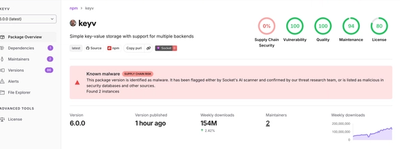
Popular npm Packages in the keyv and Cacheable Namespaces Compromised in Active Supply Chain Attack
Popular npm packages keyv and cacheable compromised.
By Socket Research Team - Aug 04, 2026
@usekaval/mcp
Advanced tools
MCP server for Kaval action verification: proof audit/gate plus compatibility currentness tools over the hosted API.
The Kaval action-verification layer as an MCP server. It builds durable,
action-bound proof packets and returns ALLOW, BLOCK, or REVIEW before an agent sends, quotes,
approves, updates, grants, or transacts. Compatibility currentness tools remain available for a
cached fact, stored field, retrieved RAG chunk, or prior answer.
This package is a thin client over the hosted Kaval API. All classification, grounding, and retrieval run server-side, so you bring just a Kaval API key — no model or search keys, no local engine.
Billable tool calls automatically carry a unique operation key. The underlying client reuses it for one bounded retry only when the transport outcome is ambiguous or the API is still finalizing the same operation, preventing duplicate billing without retrying terminal errors.
If both attempts remain ambiguous, the tool error includes idempotency_key. Retry later by passing
that exact value back as the optional idempotency_key argument on the same billable tool. Omit it
for a genuinely new operation.
npx -y @usekaval/mcp
It speaks MCP over stdio. Point any MCP client at it.
{
  "mcpServers": {
    "kaval": {
      "command": "npx",
      "args": ["-y", "@usekaval/mcp"],
      "env": {
        "KAVAL_API_KEY": "kv_live_…",
      },
    },
  },
}
| Tool | What it does |
|---|---|
currentness_verify | Pre-action gate: returns act (boolean) + a typed verdict + proof. Call before acting on a held belief. |
currentness_check | The raw freshness verdict without the act/don't-act decision. |
currentness_extract_and_check | Pull the checkable beliefs out of a paragraph and re-ground each. |
currentness_scan_store | Sweep a batch of beliefs for drift (summary + the riskiest). |
currentness_monitor | Sweep + POST the newly-risky beliefs to a webhook (run on a schedule). |
proof_audit | Build a complete action-bound ProofPacket with exact evidence, policy, lineage, risk, and expiry. |
proof_gate | Apply a durable proof to the exact action and return staged enforcement without repeating research. |
report_outcome | Report what actually happened for a prior check so the service can calibrate. |
For consequential actions, call proof_audit, then proof_gate immediately before execution. Only
when enforcement.controlApplied is true may Kaval control the action; then honor
enforcement.executionAllowed exactly. In shadow mode controlApplied is false,
executionAllowed is null, and wouldAllow is counterfactual telemetry—the customer's existing
action path remains authoritative. If enforcement is absent, a direct integration should fail
closed unless the proof state is current and the decision is ALLOW.
A verdict status is one of: current, stale, contradicted, unsupported, conflicting,
insufficient. Treat anything other than current (or act === false) as "re-research before
relying on it".
| Var | Required | Purpose |
|---|---|---|
KAVAL_API_KEY | yes | Bearer key for the hosted Kaval API (create one at https://usekaval.com) |
KAVAL_BASE_URL | no | Override the API base URL (self-hosted / staging). Defaults to https://api.usekaval.com |
The marketing site uses KAVAL_API_URL for its /api/verify proxy — not KAVAL_BASE_URL.
This package is primarily a CLI (kaval-mcp). It also exports the server factory for embedding:
import { createMcpServer, createClientFromEnv } from "@usekaval/mcp";

const server = createMcpServer(createClientFromEnv());
// connect `server` to your own MCP transport
Or pass your own configured client:
import { createMcpServer } from "@usekaval/mcp";
import { Kaval } from "@usekaval/kaval";

const server = createMcpServer(
  new Kaval({ apiKey: process.env.KAVAL_API_KEY }),
);
FAQs
MCP server for Kaval: before an AI agent acts, verify the facts the action depends on — ALLOW, REVIEW, or BLOCK, with a signed receipt.
The npm package @usekaval/mcp receives a total of 308 weekly downloads. As such, @usekaval/mcp popularity was classified as not popular.
We found that @usekaval/mcp demonstrated a healthy version release cadence and project activity because the last version was released less than a year ago. It has 1 open source maintainer collaborating on the project.
Did you know?

Socket for GitHub automatically highlights issues in each pull request and monitors the health of all your open source dependencies. Discover the contents of your packages and block harmful activity before you install or update your dependencies.
Research
/Security News
Popular npm packages keyv and cacheable compromised.

Security News
A misconfiguration gave three Anthropic models internet access, and one, believing it was in a simulation, shipped a credential-stealing package to PyPI.

Security News
/Company News
Socket has joined the new Composer and Packagist sponsorship program as a launch sponsor, supporting the team that keeps PHP's package ecosystem secure.