
Product
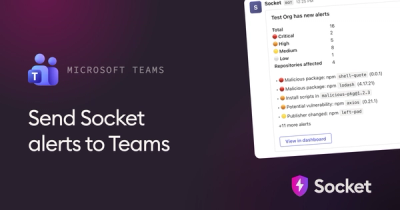
Microsoft Teams Notifications Are Now Available in Socket
Socket can now send alerts and supply chain attack notifications to Microsoft Teams, with filters that route the right updates to each channel.
By Jeppe Hasseriis - Sep 01, 2026
@vayacore/mcp
Advanced tools
Model Context Protocol server for VayaPin — VayaPin pin resolution, Google Maps, and AfterShip tools over a single MCP namespace, future-proofed against the 128-tool client ceiling.
Model Context Protocol server for VayaPin. Gives any MCP-compatible agent (Claude Desktop, Cursor, n8n, Zapier, …) VayaPin pin resolution plus Google Maps and AfterShip tools through a single tool namespace, authenticated with a Personal Access Token.
Status: v0.1.0 — published to the VayaPin Verdaccio registry (
https://npm.vayapin.app). Ships 8 P1 tools over one MCP namespace:resolve_pin,preview_pin,confirm_pin(VayaPin),geocode,reverse_geocode,place_search,place_details(Google Maps via BYOK proxy), andtrack_package(AfterShip via BYOK proxy), plus asystem_healthsanity tool.
@vayapin/mcp lives on the VayaPin registry (https://npm.vayapin.app) and is
public — no registry token needed. Map only the @vayapin scope to that
registry (its dependencies resolve from the public npm registry as usual). Add one
line to your .npmrc:
# .npmrc
@vayapin:registry=https://npm.vayapin.app
Then install or run it like any package:
npm install @vayapin/mcp        # into a project
npx -y @vayapin/mcp             # no install
Don't point your default registry at
npm.vayapin.app(npm install --registry https://npm.vayapin.app …). That routes this package's dependencies through the private registry too, which requires auth — only the@vayapinscope is public. The scoped.npmrcline above is the supported path. (AVAYAPIN_PATis still required at runtime to call the API — see below.)
Add the @vayapin scope line to your ~/.npmrc (above) so npx can resolve the
package, then:
{
  "mcpServers": {
    "vayapin": {
      "command": "npx",
      "args": ["-y", "@vayapin/mcp"],
      "env": {
        "VAYAPIN_PAT": "vayapin_pat_..."
        // optional: "VAYAPIN_MCP_SLICE": "<slice-name>"
        // optional: "VAYAPIN_MCP_API_URL": "https://api.vayapin.app/api/v1"
      }
    }
  }
}
Generate a PAT on the VayaPin developer portal (POST /api/v1/auth/pat/request).
A 401 at runtime means the token is missing/expired/revoked — regenerate it.
| Var | Required | Default | Purpose |
|---|---|---|---|
VAYAPIN_PAT | yes | — | Personal Access Token, sent as Authorization: Bearer. |
VAYAPIN_MCP_SLICE | no | — | Name of a tool slice to expose (see ceiling lift). Unset → all tools. |
VAYAPIN_MCP_API_URL | no | https://api.vayapin.app/api/v1 | Override for staging / self-host. |
Many MCP clients inject the entire tool list into the model's system prompt on every turn. Past roughly 128 tools some clients (Claude Desktop, Cursor, Antigravity, certain OpenAI Responses deployments) silently drop the tool injection or burn a large slice of the context budget. A server that naively registers its whole catalog breaks for those clients as it grows.
@spideriq/mcp solved this and we port its pattern verbatim rather than invent
a new one. The two halves of its solution:
SPIDERIQ_MCP_SLICE
there; VAYAPIN_MCP_SLICE here) names a frozen allowlist of tool names,
and the server exposes only that slice. SpiderIQ ships a mac-128 slice
(~123 tools) for exactly this reason.@spideriq/mcp-publish, -mail, -leads, etc. — each a thin
wrapper that registers only its product's slice, with tool implementations
shared from one private package. We keep tools as data objects in group
modules (src/tools/*.ts) so this split is available later without rework.Server API with manual ListTools /
CallTool handlers — not the high-level server.tool() helper. This is
what lets us control exactly which tools are advertised.{ name, description, inputSchema, execute }
(src/tools/types.ts). The MCP layer never sees execute.register() / registerAll()
(src/tools/registry.ts), wired from the append-only aggregation point
src/tools/index.ts.applySlice(catalog, VAYAPIN_MCP_SLICE) filters the catalog. Both
ListTools and CallTool operate on the filtered set, so a hidden tool is
neither listed nor callable (calling one returns MethodNotFound).Note — no "meta-tool". An earlier hypothesis was a single runtime
list_toolsmeta-tool. SpiderIQ does not do that; it uses static named slices. We match SpiderIQ. The ceiling-lift proof lives intests/registry.test.ts("ceiling lift" describe block): 200 stub tools + a 100-tool slice ⇒ exactly 100 exposed.
src/tools/<group>.ts exporting <group>Tools(client): ToolDefinition[].
Copy src/tools/system.ts as the template.registerAll(<group>Tools(client)) line to
src/tools/index.ts (append-only — the Orchestrator union-merges this file).tests/.Use snake_case tool names per VayaPin Product Definition v10 §6.1. Keep descriptions one line — they cost context on every client turn.
src/
  server.ts          entrypoint — boots Server over stdio, wires the registry
  auth.ts            PAT loading + Bearer header (no token logging, no auto-refresh)
  api/client.ts      undici HTTP client for api.vayapin.app/api/v1 (structured errors)
  tools/
    types.ts         ToolDefinition + JSON-Schema types (spec §6.1)
    registry.ts      catalog + named-slice ceiling lift + ListTools/CallTool wiring
    index.ts         append-only tool aggregation point
    system.ts        system_health tool (canonical example group)
tests/               vitest: registry (ceiling), auth, api client, server boot
npm ci
npm run build           # tsc → dist/
npm test                # vitest
npm test -- registry    # just the ceiling-lift proof
FAQs
Model Context Protocol server for VayaPin — VayaPin pin resolution, Google Maps, and AfterShip tools over a single MCP namespace, future-proofed against the 128-tool client ceiling.
The npm package @vayacore/mcp receives a total of 73 weekly downloads. As such, @vayacore/mcp popularity was classified as not popular.
We found that @vayacore/mcp demonstrated a healthy version release cadence and project activity because the last version was released less than a year ago. It has 1 open source maintainer collaborating on the project.
Product
Socket can now send alerts and supply chain attack notifications to Microsoft Teams, with filters that route the right updates to each channel.

Security News
pnpm 12 rewrites the package manager in Rust, cutting install times by up to 90% while preserving pnpm 11 workflows and lockfiles.
Security News
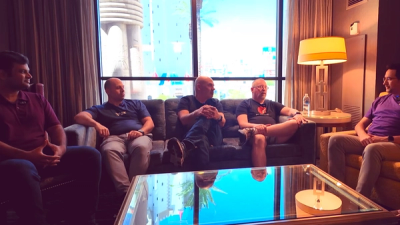
Socket CTO Ahmad Nassri joins AppSec leaders at Black Hat to discuss active malware, package manager risks, and software supply chain defense.