
Research
/Security News
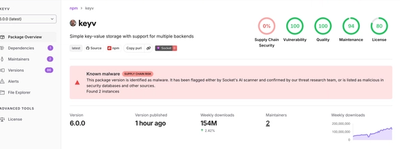
Popular npm Packages in the keyv and Cacheable Namespaces Compromised in Active Supply Chain Attack
Popular npm packages keyv and cacheable compromised.
By Socket Research Team - Aug 04, 2026
@vayacore/mcp
Advanced tools
Model Context Protocol server for VayaPin — VayaPin pin resolution, Google Maps, and AfterShip tools over a single MCP namespace, future-proofed against the 128-tool client ceiling.
Model Context Protocol server for VayaPin. Gives any MCP-compatible agent (Claude Desktop, Cursor, n8n, Zapier, …) VayaPin pin resolution plus Google Maps and AfterShip tools through a single tool namespace, authenticated with a Personal Access Token.
Status: v0.1.2 — published to the VayaPin Verdaccio registry (
@vayapin/mcponhttps://npm.vayapin.app), to public npmjs.com (@vayacore/mcp), and listed in the official MCP Registry asapp.vayapin/mcp. Ships 8 P1 tools over one MCP namespace:resolve_pin,preview_pin,confirm_pin(VayaPin),geocode,reverse_geocode,place_search,place_details(Google Maps via BYOK proxy), andtrack_package(AfterShip via BYOK proxy), plus asystem_healthsanity tool.
@vayapin/mcp lives on the VayaPin registry (https://npm.vayapin.app) and is
public — no registry token needed. Map only the @vayapin scope to that
registry (its dependencies resolve from the public npm registry as usual). Add one
line to your .npmrc:
# .npmrc
@vayapin:registry=https://npm.vayapin.app
Then install or run it like any package:
npm install @vayapin/mcp        # into a project
npx -y @vayapin/mcp             # no install
Don't point your default registry at
npm.vayapin.app(npm install --registry https://npm.vayapin.app …). That routes this package's dependencies through the private registry too, which requires auth — only the@vayapinscope is public. The scoped.npmrcline above is the supported path. (AVAYAPIN_PATis still required at runtime to call the API — see below.)
@vayacore/mcp on npmjs.comThe package is also published to the public npm registry as
@vayacore/mcp — no .npmrc
scope line required. This is the canonical install for outside developers and the
artifact referenced by the official MCP registry.
npx -y @vayacore/mcp             # no install, no .npmrc
npm install @vayacore/mcp        # into a project
Why two names? The
@vayapinnpm org was unavailable on npmjs.com, so the public scope is@vayacore(we own that org). The Verdaccio build keeps the internal@vayapin/mcpname. Both ship the identical build; pick whichever registry you already use. The two are kept in lockstep byscripts/publish-npmjs.sh.
Registry status: listed in the official
MCP Registry as app.vayapin/mcp
(domain-verified via vayapin.app). Submission flow + reproduction:
registry-submission.md.
Add the @vayapin scope line to your ~/.npmrc (above) so npx can resolve the
package, then:
{
  "mcpServers": {
    "vayapin": {
      "command": "npx",
      "args": ["-y", "@vayapin/mcp"],
      "env": {
        "VAYAPIN_PAT": "vayapin_pat_..."
        // optional: "VAYAPIN_MCP_SLICE": "<slice-name>"
        // optional: "VAYAPIN_MCP_API_URL": "https://api.vayapin.app/api/v1"
      }
    }
  }
}
Generate a PAT on the VayaPin developer portal (POST /api/v1/auth/pat/request).
A 401 at runtime means the token is missing/expired/revoked — regenerate it.
| Var | Required | Default | Purpose |
|---|---|---|---|
VAYAPIN_PAT | yes | — | Personal Access Token, sent as Authorization: Bearer. |
VAYAPIN_MCP_SLICE | no | — | Name of a tool slice to expose (see ceiling lift). Unset → all tools. |
VAYAPIN_MCP_API_URL | no | https://api.vayapin.app/api/v1 | Override for staging / self-host. |
Many MCP clients inject the entire tool list into the model's system prompt on every turn. Past roughly 128 tools some clients (Claude Desktop, Cursor, Antigravity, certain OpenAI Responses deployments) silently drop the tool injection or burn a large slice of the context budget. A server that naively registers its whole catalog breaks for those clients as it grows.
This server is built so it never hits that wall, using a well-established pattern for large MCP catalogs. Two halves:
VAYAPIN_MCP_SLICE) names a frozen allowlist of tool names, and the
server exposes only that slice. This keeps the advertised tool count under any
client's ceiling even as the catalog grows.src/tools/*.ts) so this split is
available later without rework.Server API with manual ListTools /
CallTool handlers — not the high-level server.tool() helper. This is
what lets us control exactly which tools are advertised.{ name, description, inputSchema, execute }
(src/tools/types.ts). The MCP layer never sees execute.register() / registerAll()
(src/tools/registry.ts), wired from the append-only aggregation point
src/tools/index.ts.applySlice(catalog, VAYAPIN_MCP_SLICE) filters the catalog. Both
ListTools and CallTool operate on the filtered set, so a hidden tool is
neither listed nor callable (calling one returns MethodNotFound).Note — no "meta-tool". We deliberately avoid a single runtime
list_toolsmeta-tool in favour of static named slices, which are simpler and fixed for the process lifetime. The ceiling-lift proof lives intests/registry.test.ts("ceiling lift" describe block): 200 stub tools + a 100-tool slice ⇒ exactly 100 exposed.
src/tools/<group>.ts exporting <group>Tools(client): ToolDefinition[].
Copy src/tools/system.ts as the template.registerAll(<group>Tools(client)) line to
src/tools/index.ts (append-only — the Orchestrator union-merges this file).tests/.Use snake_case tool names per VayaPin Product Definition v10 §6.1. Keep descriptions one line — they cost context on every client turn.
src/
  server.ts          entrypoint — boots Server over stdio, wires the registry
  auth.ts            PAT loading + Bearer header (no token logging, no auto-refresh)
  api/client.ts      undici HTTP client for api.vayapin.app/api/v1 (structured errors)
  tools/
    types.ts         ToolDefinition + JSON-Schema types (spec §6.1)
    registry.ts      catalog + named-slice ceiling lift + ListTools/CallTool wiring
    index.ts         append-only tool aggregation point
    system.ts        system_health tool (canonical example group)
tests/               vitest: registry (ceiling), auth, api client, server boot
npm ci
npm run build           # tsc → dist/
npm test                # vitest
npm test -- registry    # just the ceiling-lift proof
FAQs
Model Context Protocol server for VayaPin — VayaPin pin resolution, Google Maps, and AfterShip tools over a single MCP namespace, future-proofed against the 128-tool client ceiling.
The npm package @vayacore/mcp receives a total of 60 weekly downloads. As such, @vayacore/mcp popularity was classified as not popular.
We found that @vayacore/mcp demonstrated a healthy version release cadence and project activity because the last version was released less than a year ago. It has 1 open source maintainer collaborating on the project.
Did you know?

Socket for GitHub automatically highlights issues in each pull request and monitors the health of all your open source dependencies. Discover the contents of your packages and block harmful activity before you install or update your dependencies.
Research
/Security News
Popular npm packages keyv and cacheable compromised.

Security News
A misconfiguration gave three Anthropic models internet access, and one, believing it was in a simulation, shipped a credential-stealing package to PyPI.

Security News
/Company News
Socket has joined the new Composer and Packagist sponsorship program as a launch sponsor, supporting the team that keeps PHP's package ecosystem secure.