

Product
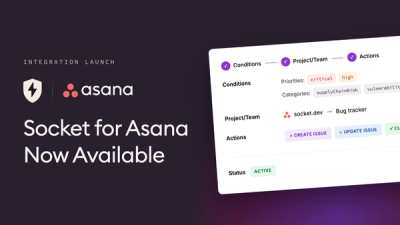
Socket for Asana Is Now Available
Create and manage Asana tasks directly from Socket alerts, with manual task creation, automated ticketing rules, and two-way sync.
By Jeppe Hasseriis - Aug 25, 2026
@vistal/core
Advanced tools
The authorization layer for AI agents — zero-dependency core.


Reads an ORM schema, generates typed LLM tools, and enforces row-level security and field-level access control server-side on every query — in code, not prompts. Adapter-agnostic: works with any ORM or database through a two-method interface.
Most users should install
@vistal/prisma(Prisma / PostgreSQL / MySQL / SQLite) or@vistal/clickhouse(ClickHouse), which wrap this package with a ready-made adapter and schema introspection. Use@vistal/coredirectly only if you're building a custom adapter.
npm install @vistal/core
| Export | Purpose |
|---|---|
Vistal | Main class — instantiate with an adapter, register policies, get tools |
formats.anthropic / openai / gemini | Tool formatters — convert provider-neutral tools to provider-specific shapes |
PolicyViolationError, ValidationError | Error types thrown by the policy engine |
serializeResult | Serializes Decimal, Date, BigInt in query results |
buildResultSchema | JSON Schema for the result shape of a ResolvedQuery |
Types: VistalAdapter, SchemaMap, ResolvedQuery, FilterNode, PolicyFn, PolicyResult, View, ViewResult, … | All types needed to build a custom adapter |
An adapter is two methods: introspect() returns a SchemaMap describing your resources; execute() runs a ResolvedQuery against your database.
import type { VistalAdapter, SchemaMap, ResolvedQuery } from "@vistal/core"

class MyAdapter implements VistalAdapter {
  async introspect(): Promise<SchemaMap> {
    return {
      resources: {
        order: {
          name: "order",
          tableName: "Order",
          fields: {
            id:        { name: "id",        type: "uuid",   isId: true,  isNullable: false },
            tenant_id: { name: "tenant_id", type: "string", isId: false, isNullable: false },
            total:     { name: "total",     type: "number", isId: false, isNullable: false },
            status:    { name: "status",    type: "enum",   isId: false, isNullable: false, enumValues: ["pending", "shipped", "delivered"] },
          },
          relations: {},
        },
      },
    }
  }

  async execute(query: ResolvedQuery): Promise<unknown> {
    // query.resource  — resource name, e.g. "order"
    // query.operation — "findMany" | "findOne" | "create" | "update" | "delete" | "aggregate"
    // query.filters   — row filters AND-ed from the policy + the model's arguments
    // query.data      — write payload (create/update) with forced fields injected
    // query.include   — relation names to eager-load
    // query.sort / query.limit / query.offset
    // query.aggregations / query.groupBy
    // ... translate this into your ORM/DB call
  }
}
Then pass your adapter to Vistal:
import { Vistal } from "@vistal/core"

const vistal = new Vistal({
  adapter: new MyAdapter(),
  defaultPolicy: "deny-all",
})
Adapters may also implement an optional third method to power live views with native change notifications instead of polling:
class MyAdapter implements VistalAdapter {
  // ...
  subscribe(query: ResolvedQuery, onChange: () => void): () => void {
    // watch the underlying table(s); call onChange() when data may have changed.
    // The view then re-executes through the policy pipeline and diffs — the
    // notification never carries data, so it can never bypass policy.
    // Return an unsubscribe function.
  }
}
Register policies per resource. Each policy is a function that receives a context object and returns what is allowed:
vistal.policy("order", (ctx) => ({
  read:   { tenant_id: ctx.tenant.id },   // row filter — AND-ed into every read
  write:  { tenant_id: ctx.tenant.id },   // force-injected on INSERT, AND-ed on UPDATE WHERE
  delete: false,                           // delete_order tool never generated
  fields:    { deny: ctx.user.role === "support" ? ["internal_notes"] : [] },
  relations: { items: true, customer: ctx.user.role === "admin" },
}))

// "*" is a wildcard fallback for resources without an explicit policy()
vistal.policy("*", (ctx) => ({
  read:   { tenant_id: ctx.tenant.id },
  write:  false,
  delete: false,
}))
read, write, and delete accept:
| Value | Meaning |
|---|---|
true | allow |
false | deny — no tool generated for this operation |
{ field: value } | row filter (read/delete) or force-injected field (write) |
For each resource, vistal generates up to six tools depending on policy:
| Tool | Operation |
|---|---|
query_{resource} | findMany with filters, sort, pagination, relation includes |
get_{resource} | findOne by id |
create_{resource} | insert one row |
update_{resource} | update by id |
delete_{resource} | delete by id |
aggregate_{resource} | count / sum / avg / min / max with optional groupBy |
delete: false → no delete_ tool generated. A required write field that is denied and not force-injected → create_ suppressed entirely.
// Vercel AI SDK (requires `ai` peer dep)
const tools = await vistal.tools.vercel(ctx)
await generateText({ model, tools, maxSteps: 5, prompt })

// Anthropic
const tools = await vistal.tools.anthropic(ctx)
// tools[i].definition → pass to the API
// tools[i].execute(args) → dispatch on tool call

// OpenAI
const tools = await vistal.tools.openai(ctx)

// Gemini
const tools = await vistal.tools.gemini(ctx)

// Custom formatter
const tools = await vistal.tools.format(ctx, (t) => ({
  id: t.name,
  schema: t.parameters,
}))
Capture any read tool call as a re-executable, subscribable handle — e.g. to drive a live chart from a query the agent built, without the LLM in the loop:
const view = await vistal.view<Order>("query_order", toolCall.args, ctx)

view.resultSchema                       // JSON Schema of { data, hasMore, nextCursor? }
const { data } = await view.execute()   // data: Order[] — policies re-evaluated per call

const sub = view.subscribe(({ data }) => chart.update(data), {
  intervalMs: 5000,   // poll interval (default 5000)
  emitInitial: true,  // emit the first result immediately (default)
  onError: (e) => log.warn(e),  // polling continues after errors
})
sub.stop()
Accepts per-resource (query_x / get_x / aggregate_x) and consolidated (query + { resource }) calls; writes and meta tools throw ValidationError at creation, as do invalid args or a denied policy. Subscriptions poll + diff (emit only on change, never overlapping); when the adapter implements the optional subscribe(query, onChange) (see above), native change notifications replace the timer. Results are serialized like tool results, and onQuery events from views carry source: "view". The TS generic is developer-asserted; resultSchema is the runtime source of truth, derived from the introspected schema and policy-allowed fields at view creation.
Scale & lifecycle. Subscribers on the same View share one polling loop (late subscribers are served from cache); errors back off exponentially and reset on success; jitter (0–1) spreads polls across a fleet; VistalConfig.maxConcurrentViewQueries (default 16) caps simultaneous view executions per instance. diffKey: "id" adds row-level changes to each emission.
Persistence & governance. view.toJSON() → { vistal: "view", v: 1, toolName, args } — no ctx, by design; rehydrate with vistal.viewFromJSON(json, ctx) under a freshly resolved context. vistal.registerView(name, { toolName, args }) / openView(name, ctx) / listViews() maintain a governed catalog of allowed live queries.
Composition. compose([viewA, viewB], (a, b) => ...) runs a pure app-authored transform over multiple views and re-emits when the output changes. deriveView(view, { groupBy, aggregations, sort?, limit? }) applies a declarative, schema-validated reshape — data-only, so the spec can safely come from an agent — and derives its own resultSchema.
Codegen. generateViewTypes(view.resultSchema, "Order") emits OrderRow / OrderResult TypeScript interfaces from the runtime schema.
Use InferResources to derive resource names from an existing typed client (e.g. Prisma):
import { Vistal, InferResources } from "@vistal/core"
import { PrismaClient } from "@prisma/client"

const prisma = new PrismaClient()

const vistal = new Vistal<DefaultContext, InferResources<typeof prisma>>({
  adapter: myAdapter,
  defaultPolicy: "deny-all",
})

// policy() and getTools() autocomplete and type-check resource names
vistal.policy("order", ...)
new Vistal({
  adapter,
  onQuery: ({ toolName, resource, operation, durationMs, error }) => {
    logger.info({ toolName, resource, durationMs })
    if (error) logger.error({ toolName, error: error.message })
  },
})
| Package | Database |
|---|---|
@vistal/prisma | PostgreSQL, MySQL, SQLite (via Prisma 5+) |
@vistal/clickhouse | ClickHouse |
MIT
FAQs
ORM + Access Control Layer for AI Agents
We found that @vistal/core demonstrated a healthy version release cadence and project activity because the last version was released less than a year ago. It has 1 open source maintainer collaborating on the project.
Product
Create and manage Asana tasks directly from Socket alerts, with manual task creation, automated ticketing rules, and two-way sync.

Security News
Open VSX has removed three extension IDs from its malicious-extension list as the legitimate publishers they impersonated move to claim the names for themselves.

Product
Socket’s PHP and Composer support is now in Beta for all customers, with PHP reachability analysis generally available.