

Product
PHP and Composer Support Is Now in Beta
Socket’s PHP and Composer support is now in Beta for all customers, with PHP reachability analysis generally available.
By Trevor Norris, Benjamin Barslev - Aug 21, 2026
@wardenpoint/mcp-server
Advanced tools
MCP server for WardenPoint: let an agent configure recipients, groups, escalation policies, on-call schedules and alert routing. Built entirely from the installation's own OpenAPI description.
An MCP server that lets an agent configure a WardenPoint account — recipients, contacts, groups, notification rules, escalation policies, on-call schedules, alert-source integrations, routing rules and telephony — without anyone opening the dashboard.
It speaks stdio and exposes one tool per operation of your installation's own OpenAPI description.
{
"mcpServers": {
"wardenpoint": {
"command": "npx",
"args": ["-y", "@wardenpoint/mcp-server"],
"env": {
"WARDENPOINT_BASE_URL": "https://wardenpoint.com",
"WARDENPOINT_API_TOKEN": "acb_xxxxxxxx.xxxxxxxx"
}
}
}
}
That is the whole installation. Your MCP client starts the server on demand; nothing runs between sessions.
There is no second copy of the contract here.
Every tool — its name, its text, its arguments, their descriptions, their enums
and bounds, the responses it can answer with — is read at startup from the
OpenAPI description served by the installation you are configuring
(GET {WARDENPOINT_BASE_URL}/docs). Nothing about the API is restated in this
package.
That is deliberate, and it is why the tools cannot quietly drift:
--spec-report exists.A description bundled inside this package would describe whatever was current when the package was published, while the agent talks to whatever you actually run. There is no offline fallback for the same reason: every tool here is an HTTP call to that installation, so if it cannot be reached, a complete tool list would be a list of things that cannot be done.
Node 20 or newer. No build step, no native modules.
| Variable | Required | Meaning |
|---|---|---|
WARDENPOINT_BASE_URL | yes | Origin of the installation — no trailing slash, no /api/v1 suffix. The description carries full paths. |
WARDENPOINT_API_TOKEN | to call | A company API key from Dashboard → Integrations → API keys. Sent as X-API-Key. Not needed for --list-tools or --spec-report. |
WARDENPOINT_ALLOW_INSECURE_TLS | no | 1 disables certificate verification. Development stands only — never against production. |
WARDENPOINT_TIMEOUT_MS | no | Per-request timeout, default 30000. |
WARDENPOINT_TOOLS | no | Comma-separated patterns limiting which tools are offered, e.g. recipients,groups or v1_schedules_*. Unset means all of them. |
WARDENPOINT_OPENAPI_PATH | no | Read the description from a local file instead of the installation. For developing against a description that is not deployed yet. |
The token is read from the environment at every start and is never written anywhere by this package.
Abilities are chosen when you issue the key, and a 403 names the one that was missing:
config.read — read the whole configuration. A good place to start: the
agent can explain an account somebody else built and change nothing.config.write — create, update, delete.notifications.send / notifications.read — fire alerts and inspect them.No ability can read a secret. There is no such ability in the vocabulary, so it cannot be granted by mistake. The API reports whether a credential is set and whether it verified — never its value.
Every tool definition is sent to the model before the person says anything, so it is spent whether or not the conversation ever touches WardenPoint. The full set of 89 tools is roughly 64k tokens — on a 200k context window, a third of it.
The server prints the figure at startup so it is not an invisible cost:
wardenpoint-mcp-server: 89 tools (~63k tokens of context; narrow it with WARDENPOINT_TOOLS) from …
If a session only ever touches part of the product, say so:
"env": { "WARDENPOINT_TOOLS": "recipients,groups,schedules" }
That drops the same run to a handful of tools and a few thousand tokens.
Patterns match tool names (v1_recipients_store), and * works. Leave it
unset and you get everything, which is the safe default: a tool that quietly
disappeared looks like a missing product capability.
npx -y @wardenpoint/mcp-server --list-tools     # every tool, with its arguments
npx -y @wardenpoint/mcp-server --spec-report    # gaps in the description itself
Both talk to WARDENPOINT_BASE_URL to fetch the description; neither needs a
token. Without arguments the process speaks MCP over stdio and is meant to be
started by a client, not by hand.
WARDENPOINT_API_TOKEN) — who you are. Every configuration tool
uses it.Two steps in setting up an account need a human at a screen, and both stay that way on purpose:
For each, the agent asks the installation to issue a one-time link, shows it to the person, and polls for the result. The person opens that link in the dashboard, behind their own login, and types the value themselves. Ask an agent to relay a secret through the conversation and it will refuse — that is what the link exists to avoid.
The API spends real effort explaining refusals — which ability was missing, which field failed validation, why a send queued nothing. This server passes the body through whole, on success and failure alike, because an agent repairs itself from that text and nothing else.
MIT. See LICENSE.
Issues and contributions: https://github.com/WardenPoint/wardenpoint-mcp.
FAQs
MCP server for WardenPoint: let an agent configure recipients, groups, escalation policies, on-call schedules and alert routing. Built entirely from the installation's own OpenAPI description.
The npm package @wardenpoint/mcp-server receives a total of 91 weekly downloads. As such, @wardenpoint/mcp-server popularity was classified as not popular.
We found that @wardenpoint/mcp-server demonstrated a healthy version release cadence and project activity because the last version was released less than a year ago. It has 1 open source maintainer collaborating on the project.
Product
Socket’s PHP and Composer support is now in Beta for all customers, with PHP reachability analysis generally available.
Product
Socket is bringing experimental protection to Firefox, scanning 97,000+ extensions in Mozilla's official directory for malware and risky updates.
Research
/Security News
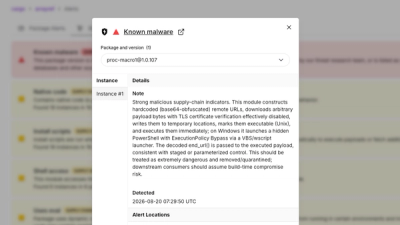
Three compromised Rust crates pulled in a malicious dependency that downloaded and executed cross-platform malware during Cargo builds.