
Research
/Security News
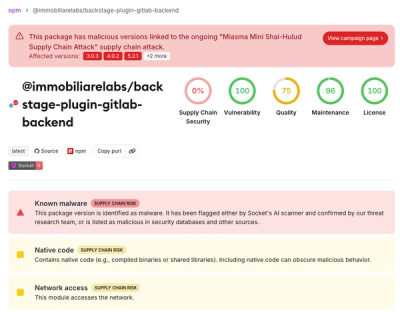
Miasma Mini Shai-Hulud Hits ImmobiliareLabs npm Packages
Miasma Mini Shai-Hulud hits @immobiliarelabs Backstage plugins, targeting GitLab and LDAP auth packages on npm.
By Socket Research Team - Jun 26, 2026
@webref/xref
Advanced tools
This package contains all definitions and headings found in the latest versions of web platform specifications in webref at the time of publication.
A new version of the package is published automatically on a weekly basis, unless no updates were found in specifications. The data is provided as-is without particular guarantees on top of structural data consistency.
Two sync methods are exposed:
setup(). The function loads all dfns and headings extracts per spec present in the package. The function should be called once (package contains ~100MB of data).lookup(). The function looks up a URL with fragment in the loaded data. It returns an array of matches, or an empty array if no match could be found. The setup() function must have been called before that function may be used.Example:
import * as xref from '@webref/xref';

xref.setup();

// A dfn, a dev link, a heading, an alternate heading URL, a dfn using a
// release URL and an invalid fragment
const urls = [
  'https://html.spec.whatwg.org/multipage/webappapis.html#event-loop',
  'https://html.spec.whatwg.org/multipage/introduction.html#typographic-conventions%3Ax-that',
  'https://compat.spec.whatwg.org/#css-at-rules',
  'https://drafts.csswg.org/css-ui-4/#contents',
  'https://www.w3.org/TR/webcodecs/#videodecoder',
  'https://compat.spec.whatwg.org/#idontexist'
];

for (const url of urls) {
  const res = xref.lookup(url);
  console.log(JSON.stringify(res, null, 2));
}
Note: The function returns an array because the same URL may be used for a dfn and a heading.
A match returned by the lookup() function is an object with two keys: source and entry.
sourceThe source key describes where the match was found. It can take one of the following values:
"dfns": A matching definition was found. The value of the entry key is a definition object."headings": A matching heading was found. The value of the entry key is a heading object.entryThe entry key describes the matching entry. It is either a definition object or a heading object, depending on the value of the source key.
A definition represents a term explicitly defined in a specification through a <dfn> element.
The following keys are always set for definitions:
The following keys may be set for definitions:
A heading represents the title of a section in a specification.
The following keys are always set for headings:
The following keys may be set for headings:
accessOne of "private" to indicate that a definition is intended for internal usage and reference within the spec itself, or "public" to indicate that the definition is exported and intended to be referenced from external documents.
alternateIdsAn array of local IDs that may also be used to target the heading in the DOM. This property is used to capture the cases where a section (e.g., a <section> element) and its underlying heading (e.g., a <h3> element) both define an ID, and when both IDs may be used to target the heading.
definedInAn indication of where the definition appears in the spec. Value can be one of "dt", "pre", "table", "heading", "note", "example", or "prose" (last one indicates that the definition appears in the main body of the spec).
forA possibly empty array of strings that represents the list of namespaces for a definition. See also Namespacing in the definitions contract.
headingHeading under which the term is defined. Value is a heading object.
hrefThe absolute URL to the element. The value is unique across definitions, and unique across headings. A definition and a heading may share the same URL.
htmlProseA string that contains an HTML excerpt and describes the meaning of a definition. This property is only set for specs that explicitly flag definitions accordingly (using data-defines attributes).
idThe local ID of the element in the DOM. The value is unique across definitions within a single spec page, and unique across headings within a single spec page. A definition and a heading may share the same ID.
informativeA boolean flag set to true when the underlying definition appears in a non-normative section of a spec. The flag is set to false when the definition appears in a normative section.
levelA number that represents the outline level of a heading in the spec. The main spec's title is at level 1.
linkingTextAn array of strings that represents the list of linking texts for a definition. See also Linking text in the definitions contract.
linksAn array of interesting links with IDs that complete the definitions, notably non-normative descriptions that target web developers. Each entry is an object with the following keys:
idhreftype: the type of link. "dev" is the only possible value for now, but the list may evolve over time.name: A string that represents the link's text content.localLinkingTextAdditional linking text can be used for local references.
numberA string (despite the name) that describes the heading's number. For example, "3.2.1". Value may contain arbitrary characters depending on the numbering scheme, and typically contains letters for appendices, such as "C.1".
specThe shortname of the spec that contains the definition or heading.
titleThe heading's raw title as a string, excluding the section's number.
typeA string that describes the type of a definition. See also Types of definitions in the definitions contract for possible values, but note that new definition types may be introduced at any time.
versionOne of "nightly" or "release" to indicate the version of the spec that contains the definition or heading.
lookup() function is mainly targeted at validating URLs with fragments. The function could get extended over time to support looking up actual terms and to offer additional lookup options. For example, to ease de-duplication, to only return definitions of a specific type, to only return exported definitions, etc.lookup() function expects the caller to have used the nightly or release URL of the spec as defined in the nightly.url or release.url property in browser-specs. Additional logic is needed to handle lookups of URLs that use, e.g., the series URL, or an alternate URL.Please report any need you may have by creating an issue on the w3c/webref GitHub repository.
FAQs
Definitions of the web platform for cross-references purpose
The npm package @webref/xref receives a total of 187 weekly downloads. As such, @webref/xref popularity was classified as not popular.
We found that @webref/xref demonstrated a healthy version release cadence and project activity because the last version was released less than a year ago. It has 3 open source maintainers collaborating on the project.
Did you know?

Socket for GitHub automatically highlights issues in each pull request and monitors the health of all your open source dependencies. Discover the contents of your packages and block harmful activity before you install or update your dependencies.
Research
/Security News
Miasma Mini Shai-Hulud hits @immobiliarelabs Backstage plugins, targeting GitLab and LDAP auth packages on npm.

Security News
Rolldown paused Rust React Compiler integration after a 5MB binary size increase raised concerns about shipping React-specific code to all Vite users.

Security News
/Research
Mini Shai-Hulud expands into the Go ecosystem after hitting LeoPlatform npm packages and targeting GitHub Actions workflows.