
Research
/Security News
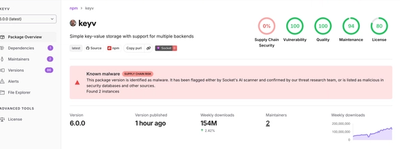
Popular npm Packages in the keyv and Cacheable Namespaces Compromised in Active Supply Chain Attack
Popular npm packages keyv and cacheable compromised.
By Socket Research Team - Aug 04, 2026
@whisper-security/whisper-graph-mcp
Advanced tools
Open-source MCP server for WhisperGraph - query the internet's infrastructure & threat-intel graph (DNS, BGP, GeoIP, WHOIS) via Cypher.

The internet's infrastructure graph for AI agents - 46B nodes and edges mapping DNS, IPs, ASNs, BGP, WHOIS, Web links and threat intel. Sign up programmatically in 2 HTTP calls.



WhisperGraph is an MCP server backed by the world's largest internet-infrastructure graph database - 46 billion nodes and edges across 20 entity types, mapping every domain, IP, ASN, prefix, organization, Web link and threat-intelligence listing into a single Cypher-queryable graph. Used by security teams, incident responders, and AI agents for investigation, attribution, brand protection, and infrastructure forensics.
Built for agents from day one.
What you can ask:
CALL explain() for full threat scoringLearn more: Agent signup · WhisperGraph intro · Cypher API reference · Query guide · Cypher syntax · Functions · Best practices · MCP setup
You need a WhisperGraph API key. Get one either:
Whisper runs a hosted MCP server at https://mcp.whisper.security. Point any MCP client that supports remote servers at it and authenticate with your API key:
{
  "mcpServers": {
    "whisper": {
      "url": "https://mcp.whisper.security",
      "headers": { "Authorization": "Bearer <your_api_key>" }
    }
  }
}
For local stdio transport, add this to your MCP client config:
{
  "mcpServers": {
    "whisper-graph": {
      "command": "npx",
      "args": ["-y", "@whisper-security/whisper-graph-mcp"],
      "env": { "WHISPER_API_KEY": "your-api-key" }
    }
  }
}
Self-hosting this repo is for teams who want to run the MCP layer in their own environment. See How to set up.
Get a working API key in two HTTP calls - no browser, no CAPTCHA, no waiting list.
Step 1 - start signup (Whisper emails a verification code):
POST https://console.whisper.security/api/signup
Content-Type: application/json

{"email":"your-agent@example.com","attribution":{"agent_name":"your-agent","source":"<registry-name>"}}
Step 2 - verify with the emailed code:
POST https://console.whisper.security/api/signup/verify
Content-Type: application/json

{"signup_id":"...","code":"..."}
The response contains api_key, mcp_url, dashboard_url, and docs_url. Use api_key in the MCP config snippet above. Full docs: whisper.security/docs/agent-signup.
All eight tools are read-only.
| Tool | What it does |
|---|---|
query | Execute a Cypher query against WhisperGraph. Validated against a safety rule set before it reaches the backend. |
list_labels | List every node label with counts. Call it before writing a query when you're unsure which label to anchor on. |
describe_label | Confirm a label exists and enumerate its property keys. |
explain_indicator | Threat assessment for an IP, hostname, CIDR, or ASN - score, level, factors, sources. |
whisper_history | Historical WHOIS or BGP data for an indicator. |
domain_variants | Typosquatting / brand-protection variants of a domain, checked against the graph. |
list_recipes | List the full whisper.security catalog of ready-made recipes (see below). |
run_recipe | Run any catalog recipe by slug - a keyless direct procedure or a keyed multi-step flow. |
list_recipes + run_recipe expose the entire whisper.security catalog - 29 curated recipes, no hand-written Cypher required. The vendored catalog (src/catalog/recipes.json) is generated from the canonical source with npm run sync:catalog, so it tracks the platform.
Two kinds:
assess (threat posture), identify (vendor/operator), explain, variants, origins (CDN de-cloak), history / history-whois, walk, psl-tldplusone, psl-affiliation, asset, lookup-tor-relay, db-schema.attack-path, attack-surface, indicator-enrichment, infrastructure-mapping, subdomain-takeover, bgp-hijack-exposure, blast-radius, route-health, typosquat, nameserver-hijack-dns-consistency, map-supply-chain-concentration, discover-ai-agent-infrastructure, build-takedown-evidence-package, indicator, anycast-dns-root-sovereignty.// keyless direct recipe
{ "name": "run_recipe", "arguments": { "recipe": "assess", "inputs": { "v": "185.220.101.33" } } }
// keyed multi-step flow (needs WHISPER_API_KEY / X-API-Key)
{ "name": "run_recipe", "arguments": { "recipe": "indicator-enrichment", "inputs": { "value": "github.com" } } }
Each recipe carries a docsUrl (visible in list_recipes) linking to its page under whisper.security/docs.
Six MCP resources: the full schema, the relationship map, a Cypher function reference, a query cookbook, plus live whisper://stats and whisper://quota.
Eight investigation-workflow prompt templates: investigate-ip, map-attack-surface, compare-domains, blast-radius, threat-triage, whois-pivot, bgp-investigation, typosquat-sweep.
For remote or team deployments, run the server over Streamable HTTP:
docker run -p 8080:8080 -e MCP_TRANSPORT=http \
  ghcr.io/whisper-sec/whisper-graph-mcp:latest
Or with Docker Compose:
docker compose up
In HTTP mode the server does not authenticate inbound requests - it relays the
caller's X-API-Key or Authorization: Bearer header to the hosted WhisperGraph
API, falling back to the WHISPER_API_KEY environment variable when no header is
present. Put it behind your own gateway if you need access control.
All configuration is via environment variables.
| Variable | Default | Description |
|---|---|---|
WHISPER_API_KEY | (none) | Your WhisperGraph API key. Get one programmatically in 2 HTTP calls or via the dashboard. |
MCP_TRANSPORT | stdio | stdio for local CLI use, http for remote/Docker. |
HTTP_HOST | 0.0.0.0 | Bind host for the HTTP transport. |
HTTP_PORT | 8080 | Bind port for the HTTP transport. |
WHISPER_ALLOWED_HOSTS | (none) | Comma-separated Host header allowlist for DNS-rebinding protection in HTTP mode. Leave empty only behind a trusted gateway. |
WHISPER_DB_URL | https://graph.whisper.security | Base URL of the hosted WhisperGraph API. |
WHISPER_QUERY_TIMEOUT_MS | 60000 | Hard per-query deadline forwarded to the API. |
WHISPER_DB_TIMEOUT_MS | 10000 | HTTP timeout for non-query calls. |
LOG_LEVEL | info | debug, info, warn, or error. |
npm install
npm run dev       # run from source over stdio
npm test          # unit + integration tests (no secrets needed)
npm run build     # bundle to dist/
npm run lint      # eslint
npm run typecheck # tsc --noEmit
Contributions are welcome. See CONTRIBUTING.md and our Code of Conduct. Security issues: see SECURITY.md.
Apache-2.0. "Whisper", the Whisper logo, and "WhisperGraph" are trademarks of Whisper Security - see NOTICE.
FAQs
Open-source MCP server for WhisperGraph - query the internet's infrastructure & threat-intel graph (DNS, BGP, GeoIP, WHOIS) via Cypher.
We found that @whisper-security/whisper-graph-mcp demonstrated a healthy version release cadence and project activity because the last version was released less than a year ago. It has 2 open source maintainers collaborating on the project.
Did you know?

Socket for GitHub automatically highlights issues in each pull request and monitors the health of all your open source dependencies. Discover the contents of your packages and block harmful activity before you install or update your dependencies.
Research
/Security News
Popular npm packages keyv and cacheable compromised.

Security News
A misconfiguration gave three Anthropic models internet access, and one, believing it was in a simulation, shipped a credential-stealing package to PyPI.

Security News
/Company News
Socket has joined the new Composer and Packagist sponsorship program as a launch sponsor, supporting the team that keeps PHP's package ecosystem secure.