

Company News
AWS Security Hub Adds Socket for Supply Chain Security
Socket is now in the AWS Security Hub Extended plan. Adopt it through AWS, apply committed spend, and block malicious open source packages.
By Feross Aboukhadijeh - Aug 04, 2026
Official Zvid MCP server — render videos & images from JSON and manage templates, projects, webhooks and credits, from Claude, Cursor, Codex, n8n or any Model Context Protocol client.

Official Zvid MCP server. Gives any MCP client (Claude Code, Claude Desktop, Codex CLI, Cursor, n8n, …) tools to render videos and images from JSON, manage templates, projects and webhooks, and check credits — all through the Zvid REST API.
The hosted endpoint is https://mcp.zvid.io/mcp. It publishes OAuth discovery
metadata, uses authorization code + PKCE, and issues short-lived access tokens
with rotating refresh tokens. Users sign in to Zvid; they do not create or
paste API keys.
claude mcp add --transport http zvid https://mcp.zvid.io/mcp
claude mcp login zvid
You can also open /mcp inside Claude Code and authenticate there.
Add this to ~/.codex/config.toml, then authenticate from MCP settings or run
codex mcp login zvid:
[mcp_servers.zvid]
url = "https://mcp.zvid.io/mcp"
auth = "oauth"
scopes = ["zvid:mcp"]
oauth_resource = "https://mcp.zvid.io/mcp"
The npm/stdio entry point remains API-key based because OAuth is defined for
HTTP transports. Configuration resolution is CLI flags, then environment, then
~/.zvid-mcp.json:
npx -y zvid-mcp --api-key zvid_your_key_here --api-url http://localhost:4000
| Env var | CLI flag | Required | Default | Purpose |
|---|---|---|---|---|
ZVID_API_KEY | --api-key zvid_… | stdio only | — | Zvid API key |
ZVID_API_URL | --api-url http://… | no | https://api.zvid.io | Orchestrator base URL |
For a self-hosted OAuth deployment, keep the resource and issuer identical on both services:
| Service | Variable | Production default |
|---|---|---|
| Orchestrator | OAUTH_ISSUER | https://api.zvid.io |
| Orchestrator | OAUTH_MCP_RESOURCE | https://mcp.zvid.io/mcp |
| Orchestrator | OAUTH_CONSENT_URL | https://app.zvid.io/oauth/authorize |
| MCP | ZVID_MCP_RESOURCE | https://mcp.zvid.io/mcp |
| MCP | ZVID_OAUTH_ISSUER | https://api.zvid.io |
The orchestrator also accepts OAUTH_ACCESS_TOKEN_TTL_SECONDS and
OAUTH_REFRESH_TOKEN_TTL_SECONDS; their defaults are one hour and 30 days.
From a checkout:
cd mcp && npm install && npm run build
claude mcp add zvid --env ZVID_API_KEY=zvid_your_key_here -- node /absolute/path/to/mcp/dist/index.js
| Tool | Description |
|---|---|
plan_creative_video | Plan-aware storyboard and art direction from a brief — plus libraryCandidates: published examples ranked against the brief with an adapt-vs-assemble decision. Supports consistent, fresh, and explore modes, recent-asset exclusions, brand tokens, style packs, and scene recipes |
find_matching_examples | Rank the entire published examples library against a brief (category synonyms, aspect/duration fit) and return candidates with thumbnails plus a decision: adapt-example, adapt-or-assemble, or assemble-similar (with design-template/canvas-preset/shape modules) |
start_from_example | Fetch an example's render-ready project JSON plus an adaptation map (variables, text/media slots, scene summary, fonts) and the adaptation contract — the premium path: keep the layout, swap copy/media/brand. Suggests free alternatives when a premium example is plan-locked |
render_from_example | One-call premium render: example slug + new variable values → the server saves it as a template, dry-runs the variables, and queues the render with the designed layout fully intact. The most reliable path for smaller models |
search_creative_library | Search complete examples, animated Design Studio templates, canvas presets, or shapes; results include preview/thumbnail metadata when published |
get_creative_asset | Fetch metadata and full JSON content for one creative-library item |
list_stock_providers / search_stock_media | Discover configured image/video/GIF/audio providers and search normalized render-ready media URLs |
get_project_schema | Live caller-plan-aware JSON Schema (draft 2020-12) for a project payload or full render request, plus validation notes, professional authoring guidelines, and required workflow; falls back to the bundled default schema when the endpoint is unavailable |
validate_project_json | Validate a payload before rendering — field-level errors, free. Also lints layout: overlapping texts, x/y ignored by presets, off-canvas boxes, padding cut-offs, low contrast. remote: true also runs the live API validator with your plan's real limits |
list_supported_elements | All element types (IMAGE, VIDEO, GIF, SVG, TEXT, AUDIO, SUBTITLE, SCENE) with required fields |
get_element_docs | Per-element docs: every field, constraints, gotchas, and a valid example |
get_example_payload | Validated example payloads: promo video, template render, still image, subtitles, webhook flow |
repair_project_json | Conservative auto-fix for invalid payloads with an explanation of every change |
create_render | Queue a video render from a project JSON (payload) or a template + variables |
create_image_render | Queue a still-image render (PNG/JPEG/WebP; supports snapshotTime, quality, transparent) |
get_render | Job state (waiting|active|completed|failed), progress, output url + thumbnailUrl |
list_renders | List render jobs (filter by type) |
create_bulk_render | One template/payload × N variable sets → N jobs (max 500) |
get_bulk_render / list_bulk_renders | Inspect bulk batches |
list_templates / get_template | Browse owned templates; get_template returns the full project JSON |
create_template / update_template | Create a plan-validated reusable template or update its name, description, and/or project JSON |
duplicate_template / delete_template | Make an active editable copy, or archive an active template (explicit removal requests only) |
preview_template | Dry-run variable resolution + validation — costs no credits |
list_projects / get_project / create_project / update_project / delete_project | Editor draft projects (open at https://zvid.io/editor?project=<id>) |
list_webhooks / create_webhook / get_webhook / update_webhook / delete_webhook / test_webhook / list_webhook_deliveries | Webhook endpoints for render.completed / render.failed (HMAC-SHA256 signed) |
get_credits / get_usage_stats | Credit balance and usage |
The server doesn't just forward payloads — it knows the Zvid project schema. The schema tools are backed by a shared module (../schema, vendored as src/zvidSchema.ts) that is derived from the live backend validation (orch/middleware/validation.js) and parity-tested against it, so tool answers never drift from what the API actually accepts. When public docs and these tools disagree, the tools (backend) win.
The server also advertises this workflow as MCP instructions, so compliant clients receive it at initialize time. The example-first flow for an AI client authoring a video:
plan_creative_video with the brief, format, duration, brand and variation mode. The response includes ranked libraryCandidates and a decision.adapt-example: start_from_example with the top slug to see its variables and adaptation map, then the easiest premium path — pick new variable VALUES (copy, media URLs, brand colors) and call render_from_example { slug, variables }; the server keeps the designed layout/animations intact. Edit the payload manually only when variables cannot express the change (keep the layout skeleton; never simplify a complex example into plain text). Manual template route: create_template → preview_template → create_render { template, variables } — variables are inert on direct payload renders.assemble-similar (or nothing close on inspection): assemble the planned scene recipes from the returned design-templates, canvas-presets and shapes modules (or search_creative_library). Never force an unrelated full-video template.search_stock_media for topic-specific visuals and music for each scene — full-quality src URLs, natural size ≥ the canvas.get_project_schema / list_supported_elements / get_element_docs for the exact shape.validate_project_json (add remote: true to check against the caller's real plan) and fix every error and layout warning. Use repair_project_json only for mechanical mistakes.create_render / create_image_render, inspect a draft, revise if needed, then poll get_render for the final output.For stills or quick "make something like X" requests without a full plan, start at find_matching_examples (type: "image" for stills).
Variation behavior:
consistent derives a stable seed from the brief (or accepts variationSeed) for reproducible automations.fresh produces one new direction and expects recent library assets to be excluded.explore returns 2-5 materially different style/layout/storyboard directions, not recolors of one payload.For a reusable template, replace the final render with create_template. Later use get_template before update_template, preview_template before rendering, duplicate_template for a safe editable copy, and delete_template only when the user explicitly asks to archive it.
Deliveries are signed: X-Zvid-Signature: sha256=HMAC_SHA256(secret, "<X-Zvid-Timestamp>.<raw body>"). The secret (whsec_…) is returned by create_webhook/get_webhook.
npm install
npm run build     # tsc → dist/
npm test          # unit + in-memory MCP round-trip tests
# real E2E against a local orchestrator:
ZVID_API_KEY=zvid_… ZVID_API_URL=http://localhost:4000 node scripts/e2e-local.mjs
Not published yet.
npm. Bump version in package.json, then npm publish from mcp/ (public access is set via publishConfig). The prepublishOnly hook builds dist/.
Official MCP Registry (registry.modelcontextprotocol.io) — lists the server for discovery in MCP-aware clients. It reads server.json; ownership of the io.zvid/* namespace is proven with a DNS TXT record on zvid.io (or switch the mcpName/server.json name to io.github.Zvid-io/zvid-mcp to verify via GitHub instead). After npm publish:
# one-time: install the publisher CLI, then log in (DNS or GitHub)
mcp-publisher login dns --domain zvid.io      # or: mcp-publisher login github
mcp-publisher publish                          # reads ./server.json
Keep versions in sync on every release — a mismatch blocks the registry publish. Update all three together: package.json version, server.json version, and server.json packages[0].version. The server name must match in both files: package.json mcpName == server.json name.
FAQs
Official Zvid MCP server — render videos & images from JSON and manage templates, projects, webhooks and credits, from Claude, Cursor, Codex, n8n or any Model Context Protocol client.
The npm package @zvid/mcp receives a total of 20 weekly downloads. As such, @zvid/mcp popularity was classified as not popular.
We found that @zvid/mcp demonstrated a healthy version release cadence and project activity because the last version was released less than a year ago. It has 1 open source maintainer collaborating on the project.
Did you know?

Socket for GitHub automatically highlights issues in each pull request and monitors the health of all your open source dependencies. Discover the contents of your packages and block harmful activity before you install or update your dependencies.
Company News
Socket is now in the AWS Security Hub Extended plan. Adopt it through AWS, apply committed spend, and block malicious open source packages.
Research
/Security News
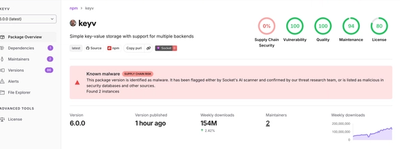
Popular npm packages keyv and cacheable compromised.

Security News
A misconfiguration gave three Anthropic models internet access, and one, believing it was in a simulation, shipped a credential-stealing package to PyPI.