

Company News
AWS Security Hub Adds Socket for Supply Chain Security
Socket is now in the AWS Security Hub Extended plan. Adopt it through AWS, apply committed spend, and block malicious open source packages.
By Feross Aboukhadijeh - Aug 04, 2026
actionproof
Advanced tools
Tiny, offline, verifiable receipts that prove what an AI agent did. Sign locally, verify anywhere, zero backend.
Verifiable receipts that prove what your AI agent actually did. Sign locally, verify anywhere, zero backend.
Agents increasingly act — they send emails, file forms, book resources, move money. But their logs are self-asserted: an agent (or a bug, or an attacker) can claim anything happened. ActionProof gives every action a tamper-evident, cryptographically signed receipt — so you, your user, or a counterparty can later verify what was done, by which agent, when, and on whose authority.
npm install actionproof # TypeScript / JavaScript
pip install actionproof # Python
Receipts are cross-compatible: one signed in TypeScript verifies in Python, and vice-versa.
import { attest, verify, generateKeypair } from "actionproof";

const agent = generateKeypair();               // agent's identity = its key (did:key)

const receipt = attest(agent, {
  type: "email.send",
  summary: "Sent renewal quote to jane@acme.com",
  params: { to: "jane@acme.com", amount: 4200 }, // hashed, not stored in clear
  result: { smtp: 250 },
  outcome: "ok",
});

verify(receipt);            // -> { valid: true, agent: "did:key:z6Mk..." }
from actionproof import attest, verify, generate_keypair

agent = generate_keypair()

receipt = attest(
    agent,
    type="email.send",
    summary="Sent renewal quote to jane@acme.com",
    params={"to": "jane@acme.com", "amount": 4200},  # hashed, not stored in clear
    result={"smtp": 250},
    outcome="ok",
)

verify(receipt)             # -> VerifyResult(valid=True, agent="did:key:z6Mk...")
Edit any field of that receipt and verify returns invalid. That's the whole idea.
LangSmith, Langfuse et al. record what your agent did inside their platform, on their word. ActionProof receipts are portable and cryptographic: they verify offline, anywhere, by anyone — with no trust in us or in the agent. It's a proof, not a log entry.
result_hash — an x402 settlement, an AP2 mandate
reference, a DKIM-signed SMTP 250 — to make a receipt as strong as its counterparty
evidence.did:key (self-describing public
key). Who you trust is your policy (pinned keys, an allow-list, or the optional log
below).See SPEC.md for the wire format.
The fastest way to give an agent receipts: run ActionProof as an MCP server and add it to
Claude Desktop / Cursor. Your agent gets three tools — attest_action, verify_receipt,
get_identity — and can emit a receipt right after it does something.
Add to your MCP client config (e.g. Claude Desktop claude_desktop_config.json):
{
  "mcpServers": {
    "actionproof": {
      "command": "npx",
      "args": ["-y", "actionproof-mcp"]
    }
  }
}
The server mints a stable Ed25519 identity on first run (stored at
~/.actionproof/agent.key.pem, override with ACTIONPROOF_KEY_PATH). Every receipt it
signs is attributable to that one agent did:key.
You don't have to call attest by hand after every action — wrap the tool once and every
call emits a receipt.
TypeScript (framework-agnostic; works with LangChain.js, Mastra, Vercel AI SDK):
import { withReceipts, generateKeypair } from "actionproof";

const agent = generateKeypair();
const send = withReceipts(agent, rawSendEmail, {
  type: "email.send",
  onReceipt: (r) => store(r),   // called with a signed receipt on every call
});
Python (@attest_action decorator, or a LangChain/CrewAI callback):
from actionproof import attest_action, ActionProofCallbackHandler

@attest_action(agent, type="email.send", on_receipt=store)
def send_email(to, body): ...

# or attest every tool a framework agent runs, no per-tool code:
handler = ActionProofCallbackHandler(agent, on_receipt=store)
agent_executor.invoke(input, config={"callbacks": [handler]})
git clone https://github.com/Burakfenerci5/actionproof
cd actionproof && npm install
npm run demo     # full sign → verify → tamper loop
npm test         # TS suite (9 tests)
npm run mcp      # start the MCP server over stdio

cd python && pip install -e ".[dev]" && pytest   # Python suite (7 tests, incl. TS↔Python interop)
/r/<id>) plus an inclusion proof, for disputes that need
third-party trust. The library and MCP server stay free and offline forever; only
public anchoring is a paid, metered service.MIT.
FAQs
Tamper-proof audit trail for AI agents — the verifiable layer of agent observability. Signed, offline-verifiable receipts for every agent action. Zero backend.
The npm package actionproof receives a total of 50 weekly downloads. As such, actionproof popularity was classified as not popular.
We found that actionproof demonstrated a healthy version release cadence and project activity because the last version was released less than a year ago. It has 1 open source maintainer collaborating on the project.
Did you know?

Socket for GitHub automatically highlights issues in each pull request and monitors the health of all your open source dependencies. Discover the contents of your packages and block harmful activity before you install or update your dependencies.
Company News
Socket is now in the AWS Security Hub Extended plan. Adopt it through AWS, apply committed spend, and block malicious open source packages.
Research
/Security News
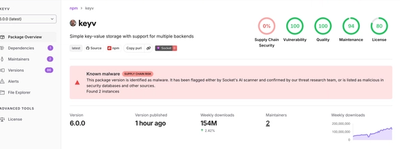
Popular npm packages keyv and cacheable compromised.

Security News
A misconfiguration gave three Anthropic models internet access, and one, believing it was in a simulation, shipped a credential-stealing package to PyPI.