


Product
PHP and Composer Support Is Now in Beta
Socket’s PHP and Composer support is now in Beta for all customers, with PHP reachability analysis generally available.
By Trevor Norris, Benjamin Barslev - Aug 21, 2026
agent-vorcl-flow
Advanced tools
Agent-Vorcl-Flow для Claude Code, GPT Codex, Cursor и Kimi CLI: роли, skills, команды, MCP и эфемерное локальное live-табло.
A team of specialized AI sub-agents for Claude Code, GPT Codex, Cursor, and Kimi CLI — with skills, commands, and MCP tools.
One npx command installs them. No remote backend or cloud hosting: your coding agent runs everything locally.







English · Русский · Українська · Deutsch · Français · Español
Português · Italiano · Polski · Türkçe · 中文 · 日本語
한국어 · العربية · Nederlands · Čeština · Română · Magyar
Български · Српски · हिन्दी · Tiếng Việt
English is canonical; every link above opens a repository-local README file.
Agent-Vorcl-Flow turns a supported coding agent into a structured engineering team. Instead of one general assistant, you get 25 focused sub-agents (architect, code-grounded principal architect, backend, frontend, Expo mobile engineer, product and visual design engineer, DB engineer, cross-language integrity auditor, architecture cartographer, liveboard operator, and more), each with its own domain skills, quick slash commands, and the MCP tools it needs. Every non-trivial task runs through a disciplined Task Master loop — goal → tasks → implement → verify → done — so work is planned, tracked, and survives interruptions.
npx.env file for all runtimes — keys read by a launcher, not ~/.zshrc, so they work even from GUI/IDE launches; no remote AVF service; liveboard is localhost-only and ephemeral# Installs adapters for Claude Code, Codex, Cursor, and Kimi CLI:
npx github:Vitammiin/agent-vorcl-flow
Target a single runtime with a flag:
npx github:Vitammiin/agent-vorcl-flow --claude   # Claude Code only
npx github:Vitammiin/agent-vorcl-flow --codex    # GPT Codex only
npx github:Vitammiin/agent-vorcl-flow --cursor   # Cursor only
npx github:Vitammiin/agent-vorcl-flow --kimi     # Kimi CLI only
What the installer does:
| Runtime | Action |
|---|---|
| Shared layer | Copies the launcher to ~/.config/agent-vorcl-flow/bin/mcp-env.mjs and creates ~/.config/agent-vorcl-flow/.env from the template (once) — the single key file for every runtime. |
| Claude Code | Registers this repo as a plugin marketplace and enables the plugin (via claude plugin …, with a direct ~/.claude/settings.json fallback). |
| GPT Codex | Merges the skills into ~/.agents/skills and the config.toml + AGENTS.md blocks into ~/.codex (idempotent, between markers). |
| Cursor | Installs skills into ~/.cursor/skills, native custom subagents into ~/.cursor/agents, and merges missing servers into ~/.cursor/mcp.json. |
| Kimi CLI | Installs skills into ~/.kimi/skills, the native Expo custom agent into ~/.kimi/agents, both Expo architecture/UI hooks into ~/.kimi/config.toml, and merges MCP servers. |
The installer never fills in your secrets — it only creates an empty
.envfrom the template. You add keys there (see Configuration).
Run the installer again with the npm latest tag:
npx --yes agent-vorcl-flow@latest
To update only one runtime, keep the same runtime flag you used during installation:
npx --yes agent-vorcl-flow@latest --claude
npx --yes agent-vorcl-flow@latest --codex
npx --yes agent-vorcl-flow@latest --cursor
npx --yes agent-vorcl-flow@latest --kimi
The update overlays Agent-Vorcl-Flow-managed skills, agents, hooks, launcher, and configuration blocks. It keeps your existing ~/.config/agent-vorcl-flow/.env and its secrets unchanged, and preserves upstream Firecrawl skills. Restart the updated coding client afterward (or run /reload-plugins in Claude Code).
# Load for the current session only (great for trying it out):
claude --plugin-dir /path/to/agent-vorcl-flow

# Or install persistently from a local marketplace:
/plugin marketplace add /path/to/agent-vorcl-flow
/plugin install agent-vorcl-flow
After install, restart Claude Code (or run /reload-plugins in an open session) to load the agents.
The examples in this section use Claude Code syntax; see the Cursor and GPT Codex mappings below for their native syntax. In Claude Code there are three ways to invoke the team.
/vorcl add a shopping cart to checkout
/audit .
/init-code .
/vorcl figures out which sub-agent should own the work and drives the full Task Master cycle. /audit auto-detects backend, frontend, mobile, data and infrastructure and writes an evidence-based PROJECT_AUDIT.md using all relevant roles. /init-code reads the repository statically and creates an evidence-based PROJECT_DESCRIPTION.md without executing project code. Once that file exists, every modifying role must keep its affected sections synchronized; proven description drift blocks task completion.
@agent-vorcl-flow:architect  design billing for a SaaS
@agent-vorcl-flow:backend    add a POST /invoices endpoint
/backend:create-api   POST /invoices
/analyzer:audit       src/
/screenshot:convert   ./mockups/dashboard.png  react
Every agent also has its own /<agent>:vorcl entry point that runs the Task Master loop scoped to that agent.
Every non-trivial task flows through Task Master (task-master-ai):
goal → tasks (parse_prd / add_task) → next_task → get_task → expand_task
     → implement → verify (testStrategy) → set_task_status done
This keeps work planned, checkpointed, and resumable — nothing is declared "done" without passing its verification step.
| Agent | Role | Highlights |
|---|---|---|
| 🔵 architect | Systems & solution architect | Requirements analysis, system/DB/API design, architecture reviews |
| 🏛️ principal-architect | Principal software / infrastructure / AI architect | Scans real code in 11 languages and creates evidence-backed MD, JSON, HTML, PDF, draw.io and Mermaid; full-rescan updates preserve annotations |
| 🟢 backend | Backend developer | Node/TS, Postgres, Redis; modular architecture; every route fully covered by OpenAPI |
| 🟣 frontend | Frontend (React 19 / Next.js App Router) | Components, state, data-fetching, render/bundle optimization, tests |
| 📱 expo-mobile | React Native + Expo engineer | Modular architecture plus Design/Motion/Interaction System, native navigation, tokens, gestures, haptics, Reduced Motion |
| 🟠 analyzer | Code auditor (read-only) | Bugs, type safety, DB structure, frontend mocks, backend smells |
| 🧭 integrity | Cross-language code integrity auditor (read-only) | Production hardcode and mock/fake/demo/fixture leakage across frontend/backend/mobile/shared |
| 🟡 swagger | OpenAPI/Swagger coverage (any stack) | Finds routes not fully documented and covers them, with verification |
| 🔴 firecrawl | Web researcher | Live CLI/MCP/REST, app integration and finished web-data workflows |
| 🟤 render | Hosting & deploy (Render) | Deploys, log-driven diagnostics, metrics, env vars, Render Postgres |
| 🟦 database | DB engineer / DBA | Schema, queries & plans, indexes, N+1, safe reversible migrations, cache |
| ⚪ resilience | Reliability: errors + logging | try/catch at the right boundaries, typed errors, retries/timeouts, structured logs |
| 🖼️ screenshot | Screenshot UI → code | Turns a UI screenshot into production-ready, responsive, accessible code |
| 🎨 design-studio | Product & visual design studio | Local HTML artifacts, prototypes, wireframes, decks/PPTX, documents, animation, 3D, design systems and Figma/GitHub/HTML import; adapted from MIT JimLiu/baoyu-design |
| 🔎 visual-research | Screenshot → verified answer | Identifies the site/page, finds official docs, checks live data and answers with URLs and confidence |
| 🎯 pinpoint | Screenshot → place in an existing project (read-only) | Grounds a running-app screenshot in the real codebase — component, file:line, route/page, the exact control, and the logic behind it; creates nothing, delegates the edit |
| 📊 drawio | Diagrams (draw.io / diagrams.net) | Flowchart, BPMN, UML, ERD, network/cloud, and PMP/PMBOK (WBS, Gantt, RACI…) |
| 🗺️ archmap | Architecture cartographer | Deterministic code → architecture.json (every node with source:{file,line}) → interactive HTML map, draw.io, Mermaid, ARCHITECTURE.md, PDF; unproven facts are marked inferred |
| 🧜 mermaid | Mermaid diagrams (+ real render) | flowchart, sequence, class, state, ER, gantt, gitGraph, mindmap…; validated via mcp-mermaid/mmdc; hands you the file (.mmd + SVG/PNG/PDF) |
| 🧪 testing | Test & verification engineer | Unit (Vitest/Jest), integration (Supertest), E2E (Playwright), coverage, flaky-test hunting; executes each task's testStrategy — nothing is "done" without a green run |
| 🌿 gitflow | Git workflow & releases | Conventional Commits, by-name commits (never git add .), PRs, Keep-a-Changelog, semver releases; push only with explicit confirmation |
| 🛡️ security | Security auditor (read-only) | Secrets in tree & git history, OWASP Top 10, dependency CVEs, PII; findings become tasks — fixes are delegated |
| 📝 docs | Documentation engineer | README (multi-language parity), API docs from OpenAPI, ARCHITECTURE, CONTRIBUTING, release notes; every example verified against the code |
| 🐳 devops | Containers & CI/CD | Multistage Dockerfiles, docker-compose for local dev, GitHub Actions pipelines, env/secrets hygiene, monitoring |
| 📡 liveboard | Local operations board | Live Git worktrees, agent processes and Task Master tasks on an ephemeral localhost dashboard |
A few things worth knowing:
openapi-typescript + openapi-fetch). No mocks in the production path.database mutations require explicit confirmation. Analytics are read-only; schema/data changes (DDL/DML/migrations) never run without your go-ahead.resilience ships a safety hook. A non-blocking PostToolUse hook (catch-guard.js) gently flags empty catch {} blocks in files you just edited.archmap never draws from imagination. Extraction and rendering are strictly separated: zero-dependency scripts walk the repo into architecture.json (databases with real FK cardinality, API routes, AI agents with their models/tools/memory, import graph, env), and every diagram is rendered from that JSON only. Anything the LLM adds without a verifiable file:line is force-marked inferred:true and drawn dashed.principal-architect is the full architecture publication workflow. It works in whichever repository launches the agent, ignores Markdown claims as topology evidence, uses bundled offline Tree-sitter WASM for TS/JS, Python, Go, Java, C#, Rust, PHP, Ruby, Kotlin and Swift, writes ARCHITECTURE.md first, then produces the shared JSON model, self-contained HTML, PDF, native draw.io and copyable Mermaid L0–L4. update performs a full rescan and preserves annotations and unmanaged files.pinpoint finds, never creates. Given a screenshot of a running app, it maps the screen to the real code — component, route, the exact control and the logic behind it — and hands the edit to frontend/backend. It works on what already exists (the inverse of screenshot).visual-research verifies instead of guessing. It treats a screenshot as evidence, confirms the official domain and docs, checks current site data, and flags possible phishing or stale values.i18n enforces "zero language hardcoding." Agents first detect whether a project is multilingual and adapt — user-facing strings go through a translation layer (next-intl / react-i18next / i18next), never inline.Every command below is a slash command. <…> marks your input.
/vorcl — universal router| Command | What it does |
|---|---|
/vorcl <goal> | Turns any goal into tasks and routes it to the right sub-agent, then runs the full cycle to done. |
/audit [path] [focus] | Deep read-only multi-role audit → detected systems, security/CVE/resilience findings, target architecture and phased PROJECT_AUDIT.md. |
/init-code [path] [--update] | Static codebase discovery → evidence-based PROJECT_DESCRIPTION.md; project code is never executed. |
| Command | What it does |
|---|---|
/architect:vorcl <goal> | Goal → tasks → cycle, scoped to architecture. |
/architect:analyze <context> | Analyze requirements and the task's context. |
/architect:design <problem> | Design the solution architecture (system, DB, API). |
/architect:review <target> | Review an existing architecture. |
| Command | What it does |
|---|---|
/principal-architect:vorcl <goal> | Runs a large architecture objective through Task Master and verified artifacts. |
/principal-architect:create [options] | Scans the current repository and creates MD, JSON, HTML, PDF, draw.io and Mermaid from code evidence. |
/principal-architect:update [options] | Full-rescans an existing package, writes an evidence diff and atomically refreshes generated artifacts. |
| Command | What it does |
|---|---|
/backend:vorcl <goal> | Goal → tasks → cycle for backend work. |
/backend:create-api <endpoint> | Generate an API endpoint on the modular architecture, fully covered by OpenAPI. |
/backend:refactor <target> | Refactor code without changing behavior. |
/backend:optimize <target> | Performance optimization. |
/backend:test <target> | Generate tests for the code. |
| Command | What it does |
|---|---|
/frontend:vorcl <goal> | Goal → tasks → cycle for frontend work. |
/frontend:create-component <spec> | Generate a UI component following the feature structure. |
/frontend:refactor <target> | Refactor UI / hooks without changing behavior. |
/frontend:optimize <target> | Optimize render / bundle / Core Web Vitals. |
/frontend:test <target> | Generate component tests. |
| Command | What it does |
|---|---|
/expo-mobile:vorcl <goal> | Goal → Task Master cycle for Expo mobile work. |
/expo-mobile:create-module <domain> | Create a modular business slice with only the layers its complexity needs. |
/expo-mobile:create-screen <flow> | Create a thin Expo Router route plus a module-owned screen and states. |
/expo-mobile:design-screen <flow> | Build a premium screen with shared design/motion tokens, states and accessibility. |
/expo-mobile:motion <interaction> | Design native navigation, springs, gestures, haptics and reduced-motion fallbacks. |
/expo-mobile:add-api <contract> | Add schema/DTO/mapper/query keys and TanStack Query integration. |
/expo-mobile:audit [scope] | Read-only architecture guard and evidence-based audit. |
/expo-mobile:ui-audit [scope] | Read-only Design System, motion, interaction, accessibility and performance audit. |
/expo-mobile:compatibility [app] [change] | Live read-only Expo/RN/Node/package/native-runtime compatibility audit against versioned official sources. |
/expo-mobile:test <scope> | Run domain unit, React Native Testing Library and Maestro checks. |
| Command | What it does |
|---|---|
/analyzer:vorcl <goal> | Audit a goal via Task Master — findings become tasks. |
/analyzer:audit | Full audit: bugs, types, DB, frontend mocks, backend smells. |
/analyzer:bugs | Hunt bugs — unhandled errors, race conditions, edge cases. |
/analyzer:types | Type check — tsc, any, unsafe casts, zod↔types drift. |
/analyzer:db | Audit DB structure — schema, indexes, FKs, N+1, migrations. |
/analyzer:mocks | Compatibility route for mock/fake data on frontend and backend; delegates deep polyglot checks to integrity. |
/analyzer:backend | Find "bad" backend code — architecture violations, logic in controllers. |
| Command | What it does |
|---|---|
/integrity:vorcl <goal> | Runs a non-trivial integrity objective through Task Master and turns findings into owner-specific tasks. |
/integrity:audit [path] | Scans hardcode and mock leakage together, then proves production reachability. |
/integrity:hardcode [path] | Finds user/config/business literals that bypass localization, configuration, or the system of record. |
/integrity:mocks [path] | Finds mock frameworks, fake generators, fixtures, demo data, and static responses reachable from production. |
The bundled zero-dependency scanner supports TS/JS, Python, Go, Java/Kotlin, C#, PHP, Ruby, Rust, Vue/Svelte/HTML and Razor. On backend code it also flags business values hidden in constants, static/final fields, default parameters, named arguments, and static catalogs; the auditor then compares them with schemas/models/repositories/queries/admin mutations to prove that the database—not code or config—owns the value. Tests, fixtures, stories, examples, seeds, generated code, and vendor roots are suppressed by default; lexical candidates are not defects until reachability and ownership are proven.
| Command | What it does |
|---|---|
/swagger:vorcl <goal> | Full-coverage goal via Task Master — audit → tasks → cover → verify. |
/swagger:audit | Read-only: find routes not fully covered by the spec. |
/swagger:cover <route> | Cover a route/module — params, responses, descriptions, security + verification. |
| Command | What it does |
|---|---|
/firecrawl:vorcl <goal> | Research goal via Task Master — collect web data to a finished result. |
/firecrawl:search <query> | Web search for sources on a question. |
/firecrawl:scrape <url> | Scrape one URL into markdown/JSON. |
/firecrawl:map <url> | Map a site's URLs. |
/firecrawl:crawl <url> | Recursively crawl a section/site. |
/firecrawl:extract <url> | Structured extraction by a JSON schema. |
/firecrawl:setup | Install/verify CLI plus official build and workflow skills (with confirmation). |
/firecrawl:interact <url> | Click, navigate or fill forms when scraping is insufficient. |
/firecrawl:parse <file> | Parse a local/private document into markdown or JSON. |
/firecrawl:monitor <action> | List checks or manage recurring page-change monitors. |
/firecrawl:agent <goal> | Run a bounded long-running Firecrawl Agent task. |
/firecrawl:research <query> | Search papers and GitHub research context. |
/firecrawl:ask <jobId> | Diagnose a failed Firecrawl job. |
/firecrawl:docs-search <question> | Search current official Firecrawl documentation. |
/firecrawl:integrate <feature> | Add Firecrawl to application code via upstream build skills. |
/firecrawl:deliverable <artifact> | Produce a brief, audit, lead list or other workflow artifact. |
/firecrawl:setup runs the official firecrawl-cli init --all flow only after confirmation. Existing official firecrawl-* skills take precedence and are preserved by the Codex/Cursor installer; AVF supplies compatible fallbacks for missing skills. Live operations route through CLI → MCP → REST/keyless.
| Command | What it does |
|---|---|
/render:vorcl <goal> | Infra goal via Task Master — deploy/diagnose/configure to done. |
/render:deploy <service> | Deploy / redeploy a service. |
/render:logs <service> | Service logs and diagnostics down to root cause. |
/render:status <service> | Service status + deploy + metrics. |
/render:query <sql> | Read-only SQL against Render Postgres. |
| Command | What it does |
|---|---|
/database:vorcl <goal> | Data goal via Task Master — schema/queries/migrations/cache to done. |
/database:query <query> | Read-only query / analytics. |
/database:schema <target> | Design / review schema and data integrity. |
/database:migrate <change> | Plan a safe, reversible schema/data migration. |
/database:optimize <target> | Optimize — indexes, N+1, query plans, pagination. |
/database:cache <target> | Redis — TTL, invalidation, locks, rate limiting, Streams. |
| Command | What it does |
|---|---|
/resilience:vorcl <goal> | Reliability goal via Task Master — cover code with try/catch + logs. |
/resilience:harden <target> | Wrap code in try/catch/finally with solid logging, no silent failures. |
/resilience:logging <target> | Add/fix structured logging — levels, context, no secrets/PII. |
/resilience:audit | Read-only: find silent failures, empty catches, logging gaps. |
| Command | What it does |
|---|---|
/screenshot:vorcl <goal> | A set of screens from screenshots via Task Master — breakdown → code. |
/screenshot:analyze <image> | Read-only breakdown — layout, components, tokens, states → plan. |
/screenshot:convert <image> [framework] | Generate full runnable code from a screenshot (default React + Tailwind v4). |
/screenshot:tokens <image> | Extract design tokens (OKLCH colors, typography, spacing) into Tailwind @theme. |
/screenshot:responsive <target> | Make the generated UI responsive — breakpoints, fluid, clamp(), container queries. |
| Command | What it does |
|---|---|
/design-studio:vorcl <goal> | Full design goal through Task Master — context → variants → HTML → preview → verification → export. |
/design-studio:create <brief> | Create a polished self-contained visual artifact or hi-fi UI. |
/design-studio:prototype <flow> | Build an interactive web/mobile prototype with states and transitions. |
/design-studio:wireframe <flow> | Build a low-fi wireframe focused on information architecture and UX. |
/design-studio:design-system <operation> | Create, import, compile, bind, refresh or check a design system. |
/design-studio:import <type> <source> | Import Figma .fig, GitHub or HTML/CSS with provenance. |
/design-studio:deck <brief> | Build an HTML deck with speaker notes, animations and optional editable PPTX. |
/design-studio:document <brief> | Build a print-ready document, résumé, memo, one-pager or report. |
/design-studio:animation <brief> | Build a motion artifact and optionally render it to MP4. |
/design-studio:research <question> | Create a source-backed visual research artifact. |
/design-studio:export <project> <format> | Export to standalone HTML, PDF, PPTX, MP4 or a handoff format. |
/design-studio:review <target> | Read-only visual, UX, responsive, a11y and design-system review. |
| Command | What it does |
|---|---|
/visual-research:vorcl <goal> | Multi-step screenshot research through Task Master. |
/visual-research:identify <image> | Identify the site, page and feature with confidence evidence. |
/visual-research:search <image> <target> | Find the real page or official documentation from visual clues. |
/visual-research:answer <image> <question> | Answer using screenshot evidence, official docs and current live data. |
/visual-research:hints <image> <goal> | Give safe, documentation-backed steps for the visible interface. |
| Command | What it does |
|---|---|
/pinpoint:vorcl <goal> | Find/understand/change existing UI from a screenshot via Task Master — map → tasks → delegate. |
/pinpoint:locate <image> | Locate the existing component/file(s) from a screenshot — file:line, no new code. |
/pinpoint:route <image> | Identify the route/page the screen is on (Next.js App/Pages Router, React Router). |
/pinpoint:control <image> | Pinpoint the exact control (button/field) and its handler in the code. |
/pinpoint:trace <target> | Trace the logic behind an element — handler → state → data-fetch → API. |
/pinpoint:handoff <change> | Build a precise edit request against existing code and delegate to frontend/backend. |
| Command | What it does |
|---|---|
/drawio:vorcl <goal> | A set of diagrams via Task Master — build to done. |
/drawio:create <description> [type] | Build a diagram from a text description (valid native XML). |
/drawio:pmp <type> <project> | Build a PMP/PMBOK diagram — WBS, PERT/CPM, Gantt, RACI, risk matrix, stakeholder grid. |
/drawio:convert <source> [type] | Convert a source to a diagram — DB schema → ERD, folders → tree, code → UML, mermaid/CSV/JSON. |
/drawio:refine <file> | Refine an existing .drawio — layout, theme, add/remove nodes, align to grid. |
| Command | What it does |
|---|---|
/archmap:vorcl <goal> | A mapping goal via Task Master — build to a verified artifact set. |
/archmap:map [repo] | Full pipeline: extraction → architecture.json → LLM annotation → all formats (HTML, draw.io, Mermaid, ARCHITECTURE.md, PDF). |
/archmap:extract [repo] | Extraction only — machine-readable architecture.json with source:{file,line} on every node. |
/archmap:annotate [json] | LLM enrichment of an existing architecture.json (agent memory, dataflow semantics); unproven facts auto-demoted to inferred. |
/archmap:html [json] | Interactive self-contained HTML map — layer toggles, trace beams, node → file:line panel, search, print CSS. |
/archmap:diagram [json] [drawio|mermaid] | draw.io (multi-page: Overview / ERD / API / Agents) and/or Mermaid views, validated. |
| Command | What it does |
|---|---|
/mermaid:vorcl <goal> | A set of diagrams via Task Master — build to done (render-verified). |
/mermaid:create <description> [type] | Build a diagram from a description — valid syntax, verified by a real render; hands you the file. |
/mermaid:convert <source> [type] | Convert a source to Mermaid — DB schema → ER, code → class/sequence, folders → flowchart, .drawio/CSV/JSON. |
/mermaid:validate <file> | Syntax + real render-test; find and fix errors (mmdc / Maid / mcp-mermaid). |
/mermaid:render <file> [format] [theme] | Export to SVG/PNG/PDF (mermaid-cli / Kroki / Mermaid.ink). |
/mermaid:refine <file> | Refine an existing .mmd — direction, subgraph, classDef/styles, readability. |
| Command | What it does |
|---|---|
/testing:vorcl <goal> | A testing/verification goal via Task Master — unit + integration + e2e to done. |
/testing:unit <file|module> | Unit tests (Vitest/Jest) — happy path, boundaries, errors; runs them and shows the output. |
/testing:integration <endpoint|module> | Integration tests (Supertest/inject, real DB or testcontainers). |
/testing:e2e <scenario> | Playwright E2E for a critical user path — role selectors, fixtures, trace on failure. |
/testing:verify <task|testStrategy> | Executes a task's testStrategy and returns a READY / NOT READY verdict with real output. |
/testing:coverage [path] | Coverage report with findings — what critical code is untested; creates tasks. |
/testing:flaky <test> | Diagnoses an unstable test (race, timing, shared state, mocks) and fixes it for good. |
| Command | What it does |
|---|---|
/gitflow:vorcl <goal> | A git/release goal via Task Master (prepare a release, clean up history, feature branch). |
/gitflow:commit <files|scope> | A by-name commit (never git add .) with a Conventional Commits message; stops on unknown WIP. |
/gitflow:pr <base> <title> | Branch → commits → pull request (gh / GitHub MCP) with what/why/how-verified. |
/gitflow:changelog [version] | CHANGELOG.md (Keep a Changelog) generated from commits between tags. |
/gitflow:release <version|auto> | Semver from commits → sync manifest versions → tag → GitHub release. Push only after explicit confirmation. |
/gitflow:audit [branch] | Read-only history audit: convention violations, dump commits, big blobs, orphan branches. |
| Command | What it does |
|---|---|
/security:vorcl <goal> | A security goal via Task Master — audit → findings → tasks → delegated fixes. |
/security:secrets [path|branch] | Secrets in the working tree AND git history (all branches); ${VAR:-} placeholders are not secrets. |
/security:owasp [path] | OWASP Top 10 in the code: injections, XSS, auth, data exposure, CORS/cookies — with file:line proof. |
/security:deps | Dependency CVEs via npm audit / lockfiles — severity, breaking-change flags. |
/security:pii [path] | PII/GDPR risks: emails, phones, cards in code and logs; developer's private paths. |
/security:pre-push [branch] | Fast combined check of changed files before a push: secrets + injections + PII; green/red verdict. |
| Command | What it does |
|---|---|
/docs:vorcl <goal> | A documentation goal via Task Master. |
/docs:readme [path] | Create/update README — what/quickstart/usage/config/troubleshooting; examples verified; language versions synced. |
/docs:api [spec] | API docs generated from the OpenAPI spec (endpoints, params, curl examples); suggests /swagger:audit if no spec. |
/docs:architecture | ARCHITECTURE.md — modules, boundaries, data flow; diagrams delegated to mermaid/drawio. |
/docs:contributing | CONTRIBUTING.md — setup, structure, tests, commit conventions (aligned with gitflow), PR process. |
/docs:release-notes <version> | Release notes for a version from CHANGELOG/history. |
/docs:audit | Read-only docs↔code drift check: broken links, stale examples/counters, unsynced translations. |
| Command | What it does |
|---|---|
/devops:vorcl <goal> | An infrastructure goal via Task Master. |
/devops:dockerfile [app-type] | Write/review a Dockerfile — multistage, slim base, non-root, HEALTHCHECK; verified by a real docker build. |
/devops:compose | docker-compose.yml for local dev (app + DBs); env changes need --force-recreate, waits for healthy. |
/devops:ci [type] | GitHub Actions — PR workflow (lint+typecheck+test, npm cache), deploy workflow, minimal permissions. |
/devops:env | Env-variable inventory: where read, what's required, .env.example template; secrets never in images. |
/devops:monitoring | Structured logs (pino/JSON), health endpoint, what to alert on; Render metrics via the render agent. |
| Command | What it does |
|---|---|
/liveboard:start [path] [--port N] [--interval ms] | Start a polished 43-language dashboard on a free localhost port; Task Master changes stream through SSE and reconcile every 5 minutes. |
/liveboard:vorcl <goal> | Develop or change liveboard itself through the required Task Master workflow. |
Liveboard reads Git worktrees, local Claude/Codex/Cursor processes and each worktree's .taskmaster/tasks/tasks.json. Runtime state stays in memory and disappears when the foreground process stops. The UI detects the browser language and offers 43 locales, including English, Russian, Ukrainian, German, French, Spanish, Portuguese, Italian, Polish, Turkish, Chinese, Japanese, Arabic, Dutch, Czech, Slovak, Romanian, Hungarian, Bulgarian, Serbian, Croatian, Slovenian, Greek, Hebrew, Persian, Hindi, Bengali, Urdu, Indonesian, Malay, Vietnamese, Thai, Korean, Swedish, Norwegian, Danish, Finnish, Estonian, Latvian, Lithuanian, Georgian, Armenian, and Azerbaijani. Arabic, Hebrew, Persian, and Urdu use RTL layout.
Direct configuration:
node skills/liveboard/scripts/server.mjs \
  --root /path/to/project \
  --host 127.0.0.1 \
  --port 0 \
  --interval 300000
--root: project whose Git worktrees and Task Master files are scanned.--port 0: automatically select a free port.--interval: full reconciliation interval in milliseconds; file watching still streams Task Master changes immediately./health, /api/snapshot, /api/events (SSE), and POST /api/refresh.--host 127.0.0.1 unless you explicitly intend to expose project information to the network.The package has no remote backend or database. The optional liveboard is a localhost-only in-memory process. MCP servers need tokens, and each user provides their own. To make this work identically across Claude Code, Codex, Cursor and Kimi CLI — and whether you launch from a terminal or from Dock / Spotlight / an IDE — every stdio MCP server is started through a small launcher (bin/mcp-env.mjs) that reads your keys from one file:
~/.config/agent-vorcl-flow/.env # Windows: %APPDATA%\agent-vorcl-flow\.env
The installer creates it from .env.example. Open it and fill in only the keys you use:
ANTHROPIC_API_KEY=      # Task Master main provider: Claude
OPENAI_API_KEY=         # alternative main provider: GPT
PERPLEXITY_API_KEY=     # optional: Task Master research mode
FIRECRAWL_API_KEY=      # firecrawl web research
GITHUB_TOKEN=           # github MCP

# For the `database` agent — these point at YOUR project's DB, not the plugin's:
MONGODB_URI=            # mongodb://user:pass@host:27017/db
REDIS_URL=              # redis://host:6379
POSTGRES_URL=           # postgres://user:pass@host:5432/db
Why a launcher instead of
~/.zshrc? Env-var expansion differs per runtime (${VAR:-}in Claude,${env:VAR}in Cursor, literals in Codex/Kimi) and each runtime reads only the environment it was launched in. GUI / IDE launches on macOS don't source~/.zshrc, so exported keys are invisible and the servers connect to nothing — the classic "MCP env not set" failure. Reading from one.envfile removes both problems at once.
Precedence (later wins): the shared ~/.config/agent-vorcl-flow/.env → a ./.env in the project root → a real export in your shell. Keep global keys in the shared file, override per-project (e.g. a different MONGODB_URI) with a project .env, and a genuine shell export still wins for CLI runs. You can point the launcher at a different file with AGENT_VORCL_ENV_FILE=/path/.env.
A server whose required key is missing simply does not start — you'll see a one-line [agent-vorcl-flow] MCP «…» is not configured: … in the runtime's MCP log, and every other server keeps working. Add the key to .env and restart. (You may keep GITHUB_TOKEN/MONGODB_URI names — the launcher maps them to the GITHUB_PERSONAL_ACCESS_TOKEN/MDB_MCP_CONNECTION_STRING the servers expect.)
⚠️ Required for AI-powered Task Master commands: configure at least one selected provider —
ANTHROPIC_API_KEYfor Claude,OPENAI_API_KEYfor GPT, or Codex CLI OAuth. Without credentials for the model selected in.taskmaster/config.json,/vorclcannot generate or expand tasks.
Choose which Task Master provider actually runs generation; keys alone do not select the model:
/task-master:provider anthropic <model-id>   # Claude via ANTHROPIC_API_KEY
/task-master:provider openai <model-id>      # GPT via OPENAI_API_KEY
/task-master:provider codex-cli <model-id>   # ChatGPT OAuth via `codex login`
The command uses the official task-master models flow and stores only model selection in .taskmaster/config.json. PERPLEXITY_API_KEY is optional and only needed when Perplexity is selected as the research model.
The remote vercel and render servers use OAuth (authorize with /mcp in a browser). For Render in headless/CI, set RENDER_API_KEY in your environment and add a Bearer header entry to that server for your runtime.
claude plugin validate . --strict      # validate the manifest and components
/plugin details agent-vorcl-flow       # list the loaded agents / skills / commands
@agent-vorcl-flow:architect            # the sub-agent appears in the typeahead
/architect:analyze billing for a SaaS  # run a slash command

# Cursor: open a new Agent window after installation
/vorcl add a shopping cart to checkout
/backend-create-api POST /invoices
The repository now includes a native Codex plugin manifest at .codex-plugin/plugin.json. The npm installer remains available and installs the same capabilities as skills, profiles, and an AGENTS.md router for Codex CLI, Cursor, and Kimi:
| Claude Code | Codex equivalent |
|---|---|
sub-agent @agent-vorcl-flow:frontend | skill persona $frontend + codex --profile frontend |
command /analyzer:audit | task skill $analyzer-audit |
command /vorcl | task skill $vorcl |
.mcp.json | [mcp_servers.*] in config.toml |
SessionStart hook | role routing in AGENTS.md |
codex
> $vorcl  add a shopping cart to checkout
> $backend-create-api  POST /invoices
> $analyzer-audit
codex --profile analyzer     # a role with higher reasoning effort
See codex/README.md for the full mapping.
Cursor uses the same open SKILL.md format as the Codex adapter, plus native custom subagents and global MCP configuration:
| Agent-Vorcl-Flow concept | Cursor equivalent |
|---|---|
role backend | custom subagent /avf-backend in ~/.cursor/agents |
task command /backend:create-api | skill /backend-create-api |
universal /vorcl | skill /vorcl |
.mcp.json | merged servers in ~/.cursor/mcp.json |
The installer converts role definitions to Cursor frontmatter, prefixes subagents with avf- to avoid skill-name collisions, uses model: inherit, and marks audit-only agents as readonly: true. Existing MCP server entries with the same names are preserved. See cursor/README.md.
Kimi CLI (MoonshotAI) natively loads Agent Skills, custom agent files and lifecycle hooks; AVF also merges the same MCP servers used by Claude and Cursor:
| Agent-Vorcl-Flow concept | Kimi CLI equivalent |
|---|---|
| skills / task commands | ~/.kimi/skills and /skill:<name> |
| Expo custom agent | kimi --agent-file ~/.kimi/agents/avf-expo-mobile.yaml |
| Expo PostToolUse guard | merged into ~/.kimi/config.toml |
.mcp.json | merged servers in ~/.kimi/mcp.json |
| per-runtime key file | the shared ~/.config/agent-vorcl-flow/.env (via the launcher) |
npx github:Vitammiin/agent-vorcl-flow --kimi
kimi mcp list          # verify connected servers
kimi mcp test github   # check a server's connection and tools
kimi --agent-file ~/.kimi/agents/avf-expo-mobile.yaml
Kimi CLI has no ${VAR} expansion in mcp.json, so keys come from the shared .env through the launcher — exactly like the other runtimes. See kimi/README.md.
.claude-plugin/plugin.json      # plugin manifest
.claude-plugin/marketplace.json # local marketplace (for install)
agents/       25 sub-agent definitions (*.md)
skills/       <skill>/SKILL.md            (73 skills; some ship references, scripts, tests or HTML assets)
commands/     <namespace>/<command>.md    (150 commands, /namespace:command, including /vorcl and /audit)
hooks/        hooks.json + SessionStart + PostToolUse guards (empty catch, Expo architecture/UI boundaries)
.mcp.json     github, filesystem, postgres, mongodb, redis, docker, firecrawl, vercel, render, task-master, mermaid
.env.example  template for ~/.config/agent-vorcl-flow/.env (single key file for all runtimes)
translations/ localized README files (21 translations)
bin/          install.mjs (the npx installer) + mcp-env.mjs (cross-runtime MCP launcher / .env loader)
codex/        GPT Codex adapter (skills + config.toml + install.sh)
cursor/       Cursor adapter (MCP template + installation notes)
kimi/         Kimi CLI adapter (skills install + Expo agent/hook + MCP)
How it fits together: agents/*.md declare a role and, in front-matter skills:, attach skills → skills in skills/*/SKILL.md are auto-loaded by description → commands/<agent>/*.md provide quick /agent:command shortcuts that delegate to the sub-agent → .mcp.json gives agents their tools, each started through bin/mcp-env.mjs which loads secrets from the shared .env. A SessionStart hook tells Claude the agents are available.
MIT — free to use, copy, modify, and distribute; provided "as is", with no warranty and no liability. See LICENSE.
© 2026 Christian Avis (Vorcl).
FAQs
Agent-Vorcl-Flow для Claude Code, GPT Codex, Cursor и Kimi CLI: роли, skills, команды, MCP и эфемерное локальное live-табло.
We found that agent-vorcl-flow demonstrated a healthy version release cadence and project activity because the last version was released less than a year ago. It has 1 open source maintainer collaborating on the project.
Product
Socket’s PHP and Composer support is now in Beta for all customers, with PHP reachability analysis generally available.
Product
Socket is bringing experimental protection to Firefox, scanning 97,000+ extensions in Mozilla's official directory for malware and risky updates.
Research
/Security News
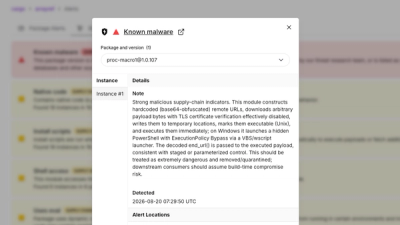
Three compromised Rust crates pulled in a malicious dependency that downloaded and executed cross-platform malware during Cargo builds.