

Company News
AWS Security Hub Adds Socket for Supply Chain Security
Socket is now in the AWS Security Hub Extended plan. Adopt it through AWS, apply committed spend, and block malicious open source packages.
By Feross Aboukhadijeh - Aug 04, 2026
aide-memory
Advanced tools
Persistent memory layer for AI coding agents — your agent remembers what you taught it
Website: https://aide-memory.dev Docs: https://aide-memory.dev/docs Install:
npm install -g aide-memory && aide-memory init
aide-memory is an auto-captured, auto-recalled, path-scoped memory layer for AI coding agents. It runs locally, plugs into Claude Code and Cursor via hooks + an MCP server, and uses git for team sync. It sits alongside CLAUDE.md and .cursorrules, not above or below; those cover always-on guidance, aide-memory covers the dynamic, area-specific knowledge that should only surface when it's relevant.
What this means in practice: when the agent opens a file in a code area you've taught aide-memory about, it gets prompted to recall what's been learned there. When you correct it or surface a non-obvious finding, hooks prompt it to remember. Memories live as JSON files in .aide/memories/, so git add / git push / git pull is the team-sync path. Personal preferences stay gitignored; team-shared memories travel with the repo.
npm install -g aide-memory && aide-memory init
Free. Local-first. No account required.
Static rules files (CLAUDE.md, .cursorrules) and skills are useful for always-on guidance, but they have four real limits:
aide-memory adds the layer those gaps leave open: scoped, layered, auto-captured-and-recalled memory with git as the team-sync substrate. Coexists with rules files; doesn't replace them.
The differentiator is the combination, not any single piece:
src/auth/**, packages/api/**) AND four typed layers (preferences / technical / area_context / guidelines). The agent gets only what's relevant for the file it's touching, ranked by how specific the layer is..aide/memories/. git add, git push, git pull is the team-sync path. Personal preferences stay gitignored; team-shared memories travel with the repo.AIDE_TELEMETRY=off.# 1. Install + initialize
npm install -g aide-memory
aide-memory init
# 2. Restart your editor so the MCP server registers
# Cursor: Cmd+Q to quit, then reopen, then enable in Settings → MCP
# Claude Code: start a fresh session in this project
# 3. Store a memory (or just talk to your agent and let hooks capture it)
aide-memory remember "API responses must use camelCase keys" --layer guidelines
# 4. Recall context for a path
aide-memory recall src/auth/
# 5. Search across memories
aide-memory search "authentication"
# 6. Share with your team
git add .aide/memories/
git commit -m "Capture team conventions"
git push
Full walkthrough: https://aide-memory.dev/docs/quick-start.
aide_recall, aide_remember, aide_update, aide_forget, aide_search, aide_memories, aide_importinit, recall, remember, update, forget, search, list, stats, recall-log, config, sync, migrate, cleanupinit (SessionStart, PreToolUse, PostToolUse, UserPromptSubmit, Stop, PreCompact).aide/ # in your project (committed; personal prefs gitignored)
├── memories/
│ ├── preferences/
│ │ ├── personal/ # gitignored, your private prefs
│ │ └── shared/ # tracked, team-shared prefs
│ ├── technical/ # tracked, stack and integration facts
│ ├── area_context/ # tracked, decisions for specific code areas
│ └── guidelines/ # tracked, team and project principles
├── config.json # local configuration with every public knob
└── config-reference.md # auto-generated key/default/description listing
~/.aide/projects/<hash>/ # in your home dir (per-machine, never committed)
└── memory.db # SQLite cache (rebuildable from the JSON above)
Each memory is a single JSON file:
{
  "uuid": "a1b2c3d4-e5f6-7890-abcd-ef1234567890",
  "layer": "technical",
  "what": "Apollo client uses persisted query hashes; raw queries 404 in prod",
  "why": "Discovered when the staging-vs-prod query mismatch broke checkout",
  "scope": "src/graphql/**",
  "contributor": "ahmed",
  "tags": ["api-contract", "graphql"],
  "shared": true
}
JSON files are the source of truth. SQLite is a rebuildable cache; delete ~/.aide/projects/<hash>/memory.db and it reconstructs from the JSON on the next run.
When the agent calls aide_recall({paths: [...]}), the engine:
src/ returns memories scoped under src/).area_context > technical > preferences > guidelines), then scope specificity (deeper scopes rank higher) and keyword relevance.recall.limit (default 20) before returning.recall.layerDiversityMinLimit (default 5), under-represented layers swap up so each enabled layer is at least represented.For conceptual searches ("where do we handle auth tokens?"), prefer aide_search over aide_recall since keyword + semantic search surfaces memories that path-scoping alone would miss.
Code and memory content never leave your machine. Memories are JSON files on your disk, the SQLite cache is local, and the MCP server runs over stdio.
Telemetry is on by default. Only event types and machine-anonymous counts are sent: event name, a SHA256-hashed hostname:username for deduplication, platform, arch, Node version. Memory content, file paths, query strings, the number of memories you have, and any other user-identifying data are never sent. The sender IP is not transmitted ($ip: null, $geoip_disable: true), so location is not derived from events. To turn it off:
# Option 1: env var (per-shell)
export AIDE_TELEMETRY=off

# Option 2: persistent config (per-project)
aide-memory config telemetry.enabled false
| Editor | Status |
|---|---|
| Claude Code | Reference adapter. Restart your session after init so the MCP server registers. |
| Cursor | Full hook + MCP wiring. Cmd+Q the app and reopen after init, then toggle the aide-memory MCP server ON in Settings → MCP. |
| Devin CLI | Full hook + MCP wiring (0.6.0+); near-Claude-Code parity since Devin's hooks are Claude-Code-compatible. Teaching ships as a scoped .devin/skills/aide-memory skill. |
| Windsurf, Codex, Copilot | Rules template at launch. Deeper integration may come based on user feedback. |
Per-editor support: https://aide-memory.dev/docs/supported-editors.
aide-memory init seeds .aide/config.json with all public settings so you can see and edit them in one place.
aide-memory config <key>           # read
aide-memory config <key> <value>   # write
Or hand-edit .aide/config.json; the JSON file is the source of truth. Hooks re-read it on every fire so changes propagate without restarting anything.
A few of the most-used keys:
| Key | Default | Description |
|---|---|---|
hooks.read.maxBlocks | 1 | Max pre-read hard-blocks per file path per session. 0 disables the hook. |
hooks.edit.maxBlocks | 1 | Same for the pre-edit hook. |
hooks.search.mode | "soft" | Pre-search hook: "soft", "block", or "off". |
hooks.correction.enabled | true | Detect correction patterns in user messages. |
hooks.correction.escalate | "off" | "off" — correction surfaces only as the in-turn soft hint. "block" — also write a flag so the next Stop fire reminds the agent if no memory was stored. |
hooks.stop.mode | "block" | "block" — scheduled Stop fires decision:"block" with a softened reason + brand chrome. "off" — silence scheduled fires. |
hooks.visible | true | Show user-facing aide-memory · ... lines in the terminal. |
recall.minScopeDepth | 1 | How specific a scope must be to surface per-file. Bump to 2 to demote src/**-style broad scopes to SessionStart only. |
memories.softening.threshold | 10 | Below this total-memory count, hard blocks downgrade to soft nudges. |
memories.defaultShared | true | Default shared value for new preferences memories. Per-call always overrides. |
Full reference: https://aide-memory.dev/docs/configuration.
aide-memory, claude-mem, and engram all attempt to give AI coding agents persistent memory, but they take meaningfully different shapes.
aide-memory is the new entrant. It combines layered + scoped recall, hook-driven auto-capture, file-per-memory storage with personal/shared split, a single shared store across Claude Code + Cursor, and git as the team-sync substrate. Uses your existing agent's inference budget; no LLM calls of its own.
claude-mem is the more established project in the space, with editor support across Claude Code, Cursor, Gemini CLI, OpenCode, and OpenClaw. Continuous capture via PostToolUse hook + session-summary at Stop; SessionStart injection of compressed recent-sessions context; 3-tool MCP search workflow for on-demand detail. Storage is SQLite (FTS5) primary with optional Chroma for semantic search; runtime uses a Bun-managed worker. Per-folder timelines via Folder Context Files are opt-in (CLAUDE_MEM_FOLDER_CLAUDEMD_ENABLED), default-off. License: AGPL-3.0.
engram is a cognitive-architecture-style memory system: three typed memory types (Episodic, Semantic, Procedural) on a knowledge graph, with graph-expansion at recall and contradiction detection. Storage is SQLite or Postgres + HNSW vector index; surface is MCP-first plus REST / CLI / webhooks / Ollama proxy. License: MIT.
Full comparison table: https://aide-memory.dev/docs/comparison.
npx works as a quick try but path resolution can break across Node version upgrades or npx cache cleans)No Docker. No external databases. No API keys. No cloud accounts.
aide-memory is proprietary freeware: free to use today, source not public, not open source. See LICENSE for the exact terms. More features coming.
Full docs at https://aide-memory.dev. Page directory:
The repo's docs/user/ tree carries short pointers to each canonical page on the website.
FAQs
Persistent memory layer for AI coding agents — your agent remembers what you taught it
The npm package aide-memory receives a total of 22 weekly downloads. As such, aide-memory popularity was classified as not popular.
We found that aide-memory demonstrated a healthy version release cadence and project activity because the last version was released less than a year ago. It has 1 open source maintainer collaborating on the project.
Did you know?

Socket for GitHub automatically highlights issues in each pull request and monitors the health of all your open source dependencies. Discover the contents of your packages and block harmful activity before you install or update your dependencies.
Company News
Socket is now in the AWS Security Hub Extended plan. Adopt it through AWS, apply committed spend, and block malicious open source packages.
Research
/Security News
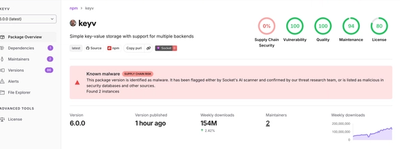
Popular npm packages keyv and cacheable compromised.

Security News
A misconfiguration gave three Anthropic models internet access, and one, believing it was in a simulation, shipped a credential-stealing package to PyPI.