
Research
/Security News
Popular npm Packages in the keyv and Cacheable Namespaces Compromised in Active Supply Chain Attack
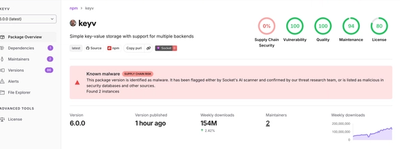
Popular npm packages keyv and cacheable compromised.
By Socket Research Team - Aug 04, 2026
aipm-mcp-server
Advanced tools
MCP server for AI Process Manager: structured Windows state for AI agents (processes, windows, UI Automation) — no screenshots
Structured Windows state for AI agents — no screenshots.
This MCP server exposes the AI Process Manager local HTTP API as tools for Claude Desktop, Cursor, and any MCP client. Instead of capturing pixels (~2,765 tokens per 1080p screenshot), agents read JSON and text (~15–150 tokens per query) from processes, windows, consoles, and UI Automation trees.
Requires: AIProcessManager.exe running on Windows (system tray). Node.js ≥ 14. Zero npm dependencies.
Computer-use agents often "look" at the desktop via screenshots. That is slow (3–5 s), expensive in tokens, and sends pixel data through the model. AIPM answers structured questions on loopback:
| Question | Screenshot | AIPM tool |
|---|---|---|
| Is the render still running? | ~2,765 tokens | check_process → ~15 tokens |
| What's the console output? | screenshot + OCR | read_window → ~30 tokens |
| Did the export finish? | poll + screenshots | wait_for(file_stable=...) → one call |
Measured on a real machine: ~94–98% fewer perception tokens per action vs screenshots.
Ensure AIProcessManager.exe is running in your system tray.
Claude Desktop — claude_desktop_config.json:
{
  "mcpServers": {
    "ai-process-manager": {
      "command": "node",
      "args": ["C:\\path\\to\\ai-process-manager\\mcp\\server.js"]
    }
  }
}
Cursor and other stdio MCP clients take the same command / args pair. Optional env var
AIPM_API overrides the API base URL (default: read from
%LOCALAPPDATA%\AIProcessManager\endpoint.txt, else http://127.0.0.1:9147).
Tools appear as ai-process-manager. Call health_check first.
Read tools are annotated readOnlyHint: true — clients may auto-approve them. Action tools
are readOnlyHint: false and refuse to run unless the user opts in (see Privacy).
| Tool | Title | Endpoint |
|---|---|---|
health_check | Check AI Process Manager status | GET / |
check_process | Check if a process is running | GET /processes |
list_processes | List running processes | GET /processes |
list_windows | List open windows | GET /windows |
get_system_status | Get system status (CPU, RAM, GPU, disk) | GET /system |
get_taskbar | Show taskbar apps | GET /taskbar |
read_window | Read text from a window | GET /window/text |
get_ui_tree | Get a window's UI element tree | GET /ui/tree |
ui_find | Find interactive UI elements | GET /ui/find |
wait_for | Wait until a condition is met | GET /wait |
get_recent_events | List recent PC events | GET /events/history |
check_file | Check a file or folder | GET /filesystem/watch |
get_app_knowledge | Get learned recipes for an app | GET /knowledge/app |
get_economy_stats | Get token economy statistics | GET /analytics/summary |
get_audit_log | View API audit log | GET /audit |
Action tier — opt-in, off by default:
| Tool | Title | Endpoint |
|---|---|---|
ui_invoke | Click a UI element | POST /ui/invoke |
ui_set_value | Set the value of a UI field | POST /ui/set_value |
focus_window | Bring a window to the foreground | POST /ui/focus |
Local telemetry (writes to the local store, metadata only):
| Tool | Title | Endpoint |
|---|---|---|
report_task_outcome | Report task outcome (telemetry) | POST /telemetry/task |
report_action_outcome | Report UI action outcome (telemetry) | POST /telemetry/action |
get_ui_tree defaults to depth=4, which is enough for native Win32 apps. Chromium/Electron
apps (VS Code, Slack, Discord, Claude Desktop, Teams) bury content under ~10 levels of
Pane/Group wrappers — at low depth the response is only empty panes. Ask for depth=15-20
there (max 30) and cap cost with max_nodes (default 200, max 1000): max_nodes is the cost
brake, not depth. When the response has truncated: true, the tree was cut — repeat with a
higher depth/max_nodes before concluding anything about the window.
Nothing leaves the machine. There is no remote telemetry, no cloud service, and no account.
127.0.0.1:9147) — not on 0.0.0.0,
so nothing on the LAN can reach it.Host header of localhost or 127.0.0.1; anything else is
rejected with 403 forbidden_host (anti DNS-rebinding, so a web page you visit cannot drive
the API).User-Agent of mcp:<your MCP client name> so the local audit log shows which agent asked.GET reads, annotated readOnlyHint: true.ui_invoke, ui_set_value, focus_window) return 403 action_denied
until the user does both: enable Agent actions in the tray menu, and add the target
process to a per-app allowlist. Neither is on by default, and the setting is per app —
allowing Notepad does not allow the browser.Recorded: app/process name, element role (Button, Edit…), the element name the agent
asked for, the action (invoke/set_value/focus), success or failure, duration in ms, and a
failure reason. Two mechanical invariants make "metadata only" verifiable rather than a promise:
role=/name_contains= arguments. The name of the element
actually resolved on screen is never written, so what the tool saw never becomes telemetry.elemento_nao_encontrado, ui_timeout,
erro_uia, outro, …). Any other string is stored as outro. An exception message — which
could carry a file path or on-screen text — therefore cannot reach the disk.Never stored: screen contents, window text read by read_window, the text typed by
ui_set_value (value=), file contents, keystrokes, screenshots. The passively learned UI shape
(ui_shape) holds only counts, UIA role names, depth and booleans: exposes_text says whether
text exists, named_controls says how many elements have a name — never the text itself.
Masking: before any request is recorded, value= and api_key= are replaced with ***, so
neither get_audit_log nor the on-disk query log can reveal typed text or a secret.
One honest nuance: the audit/query log stores the request line, so other query arguments
stay readable — e.g. check_file(path=D:/videos/out.mp4) is logged as that path, and
check_process(title_contains=...) keeps that fragment. It is a local log of what the agent
asked for. Only value= and api_key= are masked.
Everything is under %LOCALAPPDATA%\AIProcessManager\:
| Path | Contents |
|---|---|
db\*.jsonl, db\rollup.json | telemetry: tasks, actions, queries, UI shapes, counters |
ledger.jsonl | tamper-evident hash-chained log of reported/executed actions (metadata only) |
actions.cfg | whether the action tier is on + the per-app allowlist |
log.txt, endpoint.txt | app log and the API address currently in use |
To erase: quit the app from the tray, then delete the folder (or just db\ to reset learning and
the economy counters; deleting actions.cfg turns the action tier back off). Nothing is written
anywhere else, and the /audit ring buffer lives in memory only — it disappears when the app
closes. You can inspect everything the store holds with get_audit_log, get_economy_stats, and
GET /analytics/actions.
| Symptom | Meaning | Fix |
|---|---|---|
connection_refused | AIProcessManager.exe is not running | Start it from the Start menu (green tray icon) |
action_denied | Action tier off, or app not in the allowlist | Tray menu → Agent actions, then allow that app |
api_paused | The user paused the API from the tray | Tray menu → Resume API |
Empty Pane tree | depth too low for a Chromium/Electron app | Retry get_ui_tree with depth=17 |
Every error payload carries a next_action field with the same guidance.
| Stack | Read state | Semantic actions |
|---|---|---|
| Win32 / WinForms / WPF / UWP | ✅ full | ✅ |
| Delphi VCL (legacy business apps) | ✅ full | ✅ |
| Console (cmd, PowerShell, Windows Terminal) | ✅ text | — |
| Chromium / Electron (Chrome, Cursor, Claude Desktop) | ✅ after waking the a11y tree | ✅ |
| Electron on the legacy MSAA bridge (e.g. Discord) | ⚠️ wakes, but ~120 ms/node — too slow today | ⚠️ |
| Java Swing | ⚠️ needs the Java Access Bridge | roadmap |
We publish what does not work yet on purpose — you should know the edges before relying on it.
Behaviour note: the first read of a Chromium/Electron window asks it to activate its accessibility tree — the same standard request a screen reader makes. That app then keeps computing accessibility data (a CPU cost in that app) and does not go back to sleep on its own. Native Win32 apps are unaffected.
AIProcessManager.exe backend — the sensor. Yours to run at no cost.If AIPM saves you tokens, consider sponsoring.
MIT for the MCP server. The backend and AIPM Pilot are separate products.
FAQs
MCP server for AI Process Manager: structured Windows state for AI agents (processes, windows, UI Automation) — no screenshots
We found that aipm-mcp-server demonstrated a healthy version release cadence and project activity because the last version was released less than a year ago. It has 1 open source maintainer collaborating on the project.
Did you know?

Socket for GitHub automatically highlights issues in each pull request and monitors the health of all your open source dependencies. Discover the contents of your packages and block harmful activity before you install or update your dependencies.
Research
/Security News
Popular npm packages keyv and cacheable compromised.

Security News
A misconfiguration gave three Anthropic models internet access, and one, believing it was in a simulation, shipped a credential-stealing package to PyPI.

Security News
/Company News
Socket has joined the new Composer and Packagist sponsorship program as a launch sponsor, supporting the team that keeps PHP's package ecosystem secure.