
Product
Socket Now Protects the Firefox Extension Ecosystem
Socket is bringing experimental protection to Firefox, scanning 97,000+ extensions in Mozilla's official directory for malware and risky updates.
By John Tuckner - Aug 20, 2026
One command to build your entire AI coding environment with self-evolving intelligence. Works with Claude Code, Codex, OpenCode, Gemini CLI, and Cursor.
Self-evolving AI infrastructure for any coding CLI.
One command. Your AI gets smarter every session.
npx azrole init
Works with every major AI coding CLI:
| CLI | Status |
|---|---|
| Claude Code | Full support |
| Codex CLI (OpenAI) | Full support |
| OpenCode | Full support |
| Gemini CLI (Google) | Full support |
| Cursor | Full support |
Works for any project — code, books, research, business:
/dream fitness app with React Native and Firebase       <- software
/dream fantasy novel about a time-traveling librarian    <- book
/dream market analysis for AI startup in healthcare      <- research
/setup                                                   <- existing project
Auto-detects which CLIs you have installed. One command installs for all of them.
Every AI coding CLI is a Ferrari with no steering wheel.
Claude Code, Codex, OpenCode, Gemini CLI, Cursor — the engines are incredible. But to actually use them, you need to:
That's not vibe coding. That's hours of reading documentation before writing a single line of your actual project.
Most people install an AI CLI, type a few prompts, and never unlock 90% of what it can do. Not because they're not smart enough — because the setup barrier is too high.
The bigger problem: Even if you set everything up perfectly, your AI forgets everything between sessions. AZROLE solves both: the setup barrier AND the persistence gap.
Without — you manually create each file, one by one, after reading docs:
You:     "How do I set up agents?"
Google:  *reads docs for 30 minutes*
You:     *creates one agent file with basic frontmatter*
You:     "Now how do skills work?"
Google:  *reads more docs*
         ... 3 hours later, you have a half-configured environment
         ... next session, the AI has forgotten everything
With — you describe your idea and everything gets built:
You:     /dream food delivery app with React Native, Node.js, and Stripe
Claude:  [Level 1] Building CLAUDE.md... done
           CLAUDE.md (94 lines) — architecture, conventions, directory structure
           .gitignore — configured for Node.js
         [Level 2] Building MCP config... done
           .mcp.json — 3 servers (github, postgres, filesystem)
         [Level 3] Building skills and commands... done
           Skills: react-native-patterns, nodejs-patterns, project-conventions
           Commands: add, test, review, new-screen, new-endpoint
         [Level 4] Building memory system... done
           MEMORY.md (138 lines) — master index
           codebase-map, patterns, antipatterns — ready
         [Level 5] Building specialized agents... done
           dev-mobile.md (sonnet) — owns app/screens/, app/components/
           dev-backend.md (sonnet) — owns server/routes/, server/services/
           dev-tester.md (sonnet, background: true) — owns __tests__/
           dev-reviewer.md (opus, read-only) — code review specialist

         Your Level: 5 / 10 — "Multi-Agent"
         [=========================.............] 5/10

         Ready! Try: /add user authentication with phone number
2 minutes. Zero documentation. Full environment. Knowledge that compounds.
npx azrole init          # auto-detects your CLIs
npx azrole init --all    # install for ALL supported CLIs
npx azrole init --claude # Claude Code only
npx azrole init --gemini # Gemini CLI only
npx azrole init --codex  # Codex CLI only
mkdir my-app && cd my-app
claude    # or: codex, opencode, gemini
/dream SaaS analytics dashboard with Next.js, Python FastAPI,
PostgreSQL, Stripe billing, deployed on Vercel
cd my-existing-app
claude    # or: codex, opencode, gemini
/setup
The orchestrator scans your codebase, detects your tech stack from actual files, and builds the environment around what already exists — in the right format for whichever CLI you're using.
/add user authentication with Google OAuth
/level-up
No jargon. No dev knowledge needed. Just type what you want.
| Command | What it does |
|---|---|
/dream "your idea" | New project — describe your idea, get everything built |
/setup | Existing project — scans your code, builds the environment around it |
/level-up | See your current level (0-10), build the next one |
/evolve | Auto-find and fix gaps in your agents, skills, and memory |
| Command | What it does |
|---|---|
/fix "what's broken" | Describe the bug in plain English, get it fixed |
/ship | Save your work and push to GitHub (auto-generates commit message) |
/explain "anything" | Explain code, errors, or concepts like you're not a developer |
/status | Quick health check — what's working, what changed, what to do next |
/dream fitness tracker app with React Native and Firebase
  ... orchestrator builds your entire dev environment ...

/add user profile page with avatar upload
  ... specialist agent builds the feature ...

/fix the avatar doesn't show after upload
  ... agent finds the bug, fixes it, explains what happened ...

/explain what does useEffect do in the profile component
  ... explains in plain English, no jargon ...

/ship
  ... commits with message "Add user profile with avatar upload", pushes to GitHub ...

/status
  ... shows: 12 files changed, all tests passing, suggests adding unit tests ...

/level-up
  ... scans environment, shows Level 5, offers to build Level 6 (hooks & automation) ...
AZROLE adapts to any project type:
| You are a... | You type... | You get... |
|---|---|---|
| Developer | /dream SaaS app with Next.js and Stripe | Frontend agent, backend agent, tester, reviewer, coding skills |
| Writer | /dream mystery novel set in 1920s Paris | Writer agent, editor agent, researcher, continuity checker, style skills |
| Researcher | /dream PhD thesis on climate migration patterns | Researcher agent, analyst, academic writer, methodology skills |
| Marketer | /dream product launch campaign for AI fitness app | Strategist agent, copywriter, reviewer, brand voice skills |
Same system. Same 10 levels. Different agents and skills for every domain.
Most AI CLI users are stuck at Level 0-1. The gap between levels isn't knowledge — it's setup.
Levels 1-5: Build the team. Levels 6-10: Make the team learn.
Level  0  Terminal Tourist     You type prompts and hope for the best
Level  1  Foundation           Project rules + .gitignore
Level  2  Connected            MCP servers (GitHub, databases, APIs)
Level  3  Skilled              Custom skills + slash commands
Level  4  Remembering          Memory system — project learns over time
Level  5  Multi-Agent          Specialist agents working together
------------------------------ PERSISTENCE BARRIER ------------------------------
Level  6  Learning             Hooks + agent learning protocol (knowledge survives sessions)
Level  7  Scoped               Advanced MCP + agents scoped to specific servers
Level  8  Orchestrated         Pipelines + debate engine + prompt self-optimization
Level  9  Workflow             /deploy, /sprint, /refactor, /retro — all update memory
Level 10  Self-Evolving        Loop controller + ELO ranking + topology optimization + KPI dashboard
The Persistence Barrier at Level 5 is where most setups fail. Below it, agents do brilliant work and forget everything when the session ends. Above it, every session makes the project smarter — patterns accumulate, antipatterns get documented, mistakes never repeat.
Every level creates only native files (markdown + JSON). No bash scripts. No cron jobs. Works on Windows, Mac, and Linux identically.
/dream builds you to Level 5 by default.
/level-up takes you higher, one step at a time.
/evolve strengthens what you already have.
What makes AZROLE different from a static setup tool:
┌─────────────────────────────────────────────────────┐
│                 INTELLIGENCE LOOP                    │
│                                                      │
│  Agents work ──> Learn ──> Score ──> Optimize ──>   │
│       ^                                         │    │
│       └─────────────────────────────────────────┘    │
│                                                      │
│  Memory Importance Scoring                           │
│    Every piece of knowledge gets a score.            │
│    High-impact rises. Stale fades. Memory sharpens.  │
│                                                      │
│  ELO Output Ranking                                  │
│    Agents, patterns, and debate outcomes get ranked.  │
│    Better agents get harder tasks. Weak patterns      │
│    get flagged for review.                           │
│                                                      │
│  Prompt Self-Optimization                            │
│    Underperforming agents get their prompts rewritten │
│    based on what worked for high-performing agents.   │
│    A/B tested. Winners kept. Losers archived.        │
│                                                      │
│  Topology Optimization                               │
│    Pipeline orderings are tested and measured.        │
│    Low-influence agents get pruned or merged.         │
│    Building blocks (reflect, debate, summarize)       │
│    are injected where they improve quality.           │
│                                                      │
│  Debate Engine                                       │
│    High-stakes decisions get two opposing advocates.  │
│    A synthesis phase picks the winner on evidence,    │
│    not opinion. Decisions logged with review triggers.│
│                                                      │
│  Quality KPI Dashboard (scores.json)                 │
│    Every evolution cycle is measured. Environment,    │
│    knowledge, and quality KPIs tracked over time.    │
│    Trend: improving / stable / declining.            │
└─────────────────────────────────────────────────────┘
This is not a one-time generator. It's a system that gets better every time you use it.
After running /dream, your project gets a complete AI development environment:
your-project/
  CLAUDE.md                          Project conventions (Claude reads this first)
  .gitignore                         Configured for your stack
  .mcp.json                          MCP server connections
  .devteam/
    blueprint.json                   Project analysis
    scores.json                      Quality KPI dashboard (Level 10+)
    elo-rankings.json                Agent & pattern ELO rankings (Level 8+)
    memory-scores.json               Memory importance scores (Level 10+)
    topology-map.json                Pipeline topology tracking (Level 10+)
    prompt-versions/                 A/B test archive for prompt optimization
  .claude/
    settings.json                    Hooks & permissions (Level 6+)
    agents/
      dev-frontend.md                Frontend specialist (sonnet)
      dev-backend.md                 Backend specialist (sonnet)
      dev-tester.md                  Testing specialist (sonnet, background)
      dev-reviewer.md                Code reviewer (opus, read-only)
      dev-pipeline.md                Multi-agent workflows (Level 8+)
      dev-experiment.md              Safe experiments in worktree (Level 8+)
      dev-debate.md                  Multi-perspective decision engine (Level 8+)
      dev-prompt-optimizer.md        Self-evolving prompt quality (Level 8+)
      loop-controller.md             Self-improvement engine (Level 10)
    skills/
      react-patterns/SKILL.md        Frontend patterns for YOUR stack
      fastapi-patterns/SKILL.md      Backend patterns for YOUR stack
      project-conventions/SKILL.md   Your project's rules and style
    commands/
      add.md                         Add a feature by describing it
      test.md                        Run tests, explain results
      review.md                      Code review
      deploy.md                      Deployment pipeline (Level 9+)
      sprint.md                      Plan & execute work (Level 9+)
    memory/
      MEMORY.md                      Master knowledge base (auto-loaded)
      codebase-map.md                Every module indexed
      patterns.md                    Discovered patterns (ELO-ranked)
      antipatterns.md                Known pitfalls
      decisions.md                   Architecture decisions (from debates)
Everything is tailored to YOUR project. Not templates. Not generic. Real, specific infrastructure.
AZROLE doesn't reinvent anything. It configures what your AI CLI already has:
| Claude Code Feature | What AZROLE does with it |
|---|---|
| CLAUDE.md | Generates project conventions, architecture, agent routing |
| Agents | Creates specialists with full frontmatter (model, permissions, skills, MCP, hooks) |
| Skills | Builds patterns with progressive disclosure (SKILL.md + references/), pushy descriptions for reliable triggering |
| Commands | 7 global + project-specific commands generated from your stack |
| Memory | Persistent knowledge base — codebase map, patterns, antipatterns, decisions |
| MCP Servers | Auto-detects from your stack, scopes per agent via mcpServers: |
| Hooks | Auto-format on file saves, agent completion notifications |
| Model routing | opus for thinking, sonnet for building, haiku for simple tasks |
| Permission modes | acceptEdits for builders, plan for reviewers — no permission spam |
| Background agents | background: true on testers for concurrent work |
| Worktree isolation | isolation: worktree for safe experiments that can't break your code |
| Tool scoping | disallowedTools: Write, Edit on reviewers — read-only by design |
| Agent chaining | Pipeline agents that delegate to specialists via Agent tool |
You get all of this without knowing any of it exists.
The package is tiny. 11 files per CLI, installed to the right location automatically:
~/.claude/          (Claude Code)
~/.codex/           (Codex CLI)
~/.config/opencode/ (OpenCode)
~/.gemini/          (Gemini CLI)
~/.cursor/          (Cursor)
  +-- agents/
      orchestrator.md           Coordinator (~800 lines, lean)
      intelligence-module.md    Pipelines, debate, prompt optimization (Level 8-9)
      evolution-module.md       Loop controller, topology, KPIs (Level 10)
  +-- commands/
      dream.md (.toml)      /dream — build from a project idea
      setup.md (.toml)      /setup — scan existing project
      level-up.md (.toml)   /level-up — grow to the next level
      evolve.md (.toml)     /evolve — auto-improve environment
      fix.md (.toml)        /fix — describe a bug, get it fixed
      ship.md (.toml)       /ship — commit and push changes
      explain.md (.toml)    /explain — plain English explanations
      status.md (.toml)     /status — project health check
No dependencies. No background processes. No config files.
The orchestrator generates everything else dynamically based on your project.
Gemini CLI uses .toml commands, all others use .md — handled automatically.
npx azrole init                 # Auto-detect CLIs, install globally
npx azrole init --all           # Install for ALL supported CLIs
npx azrole init --claude        # Install for Claude Code only
npx azrole init --codex         # Install for Codex CLI only
npx azrole init --opencode      # Install for OpenCode only
npx azrole init --gemini        # Install for Gemini CLI only
npx azrole init --cursor        # Install for Cursor only
npx azrole init --force         # Reinstall, overwrite modified files
npx azrole init-local           # Install in current project only
npx azrole detect               # Show which CLIs are installed
npx azrole status               # Check installation status
npx azrole uninstall            # Remove everything
npx azrole --version            # Show version
Also works as npx ai-dreamteam and npx claude-dreamteam for backward compatibility.
Not a demo. Not a mock. This is what happened when /setup was run on an actual 150,000-word biography manuscript.
Project: A premium nonfiction biography — 24 chapters, 5 parts, ~150K words. LaTeX/LuaLaTeX production pipeline.
Starting state: 3 raw files. No CLAUDE.md. No agents. No skills. No memory. Level 0.
/setup
2 minutes later — Level 5:
Level 1: CLAUDE.md               -- 73 lines — architecture, conventions, editorial standards
Level 2: MCP Servers             -- Skipped (no external services needed)
Level 3: Skills & Commands       -- 3 skills, 4 commands
Level 4: Memory System           -- 32-line index + 3 knowledge files
Level 5: Multi-Agent             -- 4 specialized agents
4 Agents — each with a specific role:
| Agent | Model | Role |
|---|---|---|
dev-writer | Sonnet | Chapter drafting, prose, narrative voice |
dev-editor | Opus | Continuity, transitions, structural integrity |
dev-typesetter | Sonnet | LaTeX compilation, typography, layout |
dev-reviewer | Opus | Full manuscript audit, publication readiness |
3 Skills — domain knowledge always available:
latex-memoir/ — LuaLaTeX engine rules, custom commands, anti-patternseditorial-craft/ — Narrative voice, 5 thematic threads, cultural sensitivity guidelinesproject-conventions/ — File naming, chapter numbering, production specs4 Commands — plain English:
| Command | What it does |
|---|---|
/build | Compile manuscript with LuaLaTeX, diagnose errors, fix, recompile |
/audit-chapter 12 | Full editorial audit of chapter 12 with star ratings |
/new-chapter "The Riyadh Season launch" | Scaffold a new chapter in the right structure |
/review | Manuscript-wide quality pass with delta comparison |
Memory system — the project remembers:
The person who ran this is not a developer. They write books.
Full setup log: DREAMTEAM_SETUP_LOG.md
The system is split into three agents to keep context lean:
The orchestrator handles Levels 0-7 directly. For Levels 8+, it spawns the appropriate module as a sub-agent, passing it all the context it needs. This means your AI CLI only loads ~800 lines during normal work — the heavy intelligence and evolution modules are loaded only when needed.
/dream analyzes your project idea, creates a blueprint, then builds each level sequentially. It delegates to sub-agents for each level, runs quality checks, and presents everything created.
/level-up scans your environment file by file, calculates your current level, shows what the next level unlocks, and builds it.
/evolve runs a gap analysis across agents, skills, commands, memory, AND knowledge health. Scores each area 1-10. Fixes the top 5 weaknesses. Consolidates scattered learnings into structured knowledge. Reports the improvement with quality KPIs.
The intelligence layer (Levels 8-10):
scores.json) tracks environment, knowledge, topology, and quality metrics across evolution cycles with trend analysisYour project doesn't just remember. It gets smarter.
Does this only work for coding projects? No. AZROLE works for any project — software, books, research papers, marketing campaigns, legal documents. The orchestrator detects whether you're building code, writing content, doing research, or running a business project and adapts agents, skills, and commands accordingly.
Does this work with any tech stack? Yes. React, Vue, Angular, Svelte, Next.js, FastAPI, Django, Express, Rails, Go, Rust, Flutter, React Native, and anything else. The orchestrator analyzes whatever you describe.
Does it generate actual code for my app? No. It generates the AI infrastructure (agents, skills, commands, memory) that helps you build your app faster. Think of it as hiring an AI dev team, not building your app.
Can I customize what it generates? Everything is plain markdown files. Edit any agent, skill, or command after generation. The orchestrator creates the starting point — you own it from there.
What model does it use? The orchestrator uses Opus for deep analysis. Generated agents use smart routing: Opus for architecture and review, Sonnet for implementation, Haiku for simple tasks. You can change any agent's model.
Will it overwrite my existing files?
The CLI protects modified files. If you edited a file, init skips it unless you pass --force. The orchestrator never deletes user-created files.
Does it work on Windows? Yes. Every level uses only native files (markdown + JSON). No bash scripts, no cron, no OS-specific tools. Windows, Mac, Linux — identical.
Does this work with Codex CLI / OpenCode / Gemini CLI / Cursor?
Yes. AZROLE auto-detects which CLIs you have installed and sets up for all of them. Same commands, same levels, adapted file formats. Use --all to install for every supported CLI.
How is this different from the built-in /init command?
Most AI CLIs have a basic /init that generates a simple rules file. That's Level 1. AZROLE builds Levels 1-10: agents, skills, commands, memory, MCP, hooks, pipelines, debate engine, ELO ranking, prompt optimization, topology optimization, and a self-improving loop.
What's the difference between AZROLE and ai-dreamteam?
AZROLE is the evolution of ai-dreamteam. Same creator, same architecture, now with self-evolving intelligence (ELO ranking, prompt optimization, memory importance scoring). npx ai-dreamteam still works for backward compatibility.
Is this free? The package is free. You need a subscription to your AI CLI of choice (which uses your own API credits).
MIT
Built by @haytamAroui
FAQs
One command to build your entire AI coding environment with self-evolving intelligence. Works with Claude Code, Codex, OpenCode, Gemini CLI, and Cursor.
The npm package azrole receives a total of 0 weekly downloads. As such, azrole popularity was classified as not popular.
We found that azrole demonstrated a healthy version release cadence and project activity because the last version was released less than a year ago. It has 1 open source maintainer collaborating on the project.
Did you know?

Socket for GitHub automatically highlights issues in each pull request and monitors the health of all your open source dependencies. Discover the contents of your packages and block harmful activity before you install or update your dependencies.
Product
Socket is bringing experimental protection to Firefox, scanning 97,000+ extensions in Mozilla's official directory for malware and risky updates.
Research
/Security News
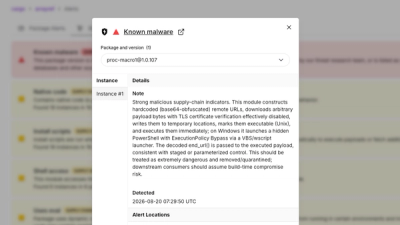
Three compromised Rust crates pulled in a malicious dependency that downloaded and executed cross-platform malware during Cargo builds.

Research
/Security News
Socket uncovered 77 linked Firefox extensions, including 40 that steal wallet secrets or credentials and 37 deceptive sports-score shells.