

Research
/Security News
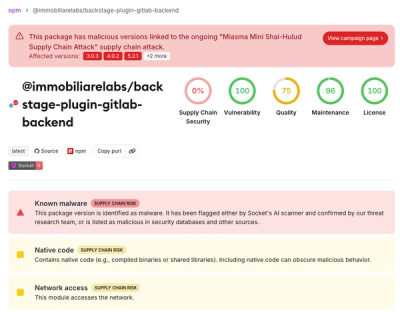
Miasma Mini Shai-Hulud Hits ImmobiliareLabs npm Packages
Miasma Mini Shai-Hulud hits @immobiliarelabs Backstage plugins, targeting GitLab and LDAP auth packages on npm.
By Socket Research Team - Jun 26, 2026
Backbeat — MCP server for orchestrating background AI coding agents (Claude, Codex, Gemini)




The Problem: AI coding agents are incredibly powerful, but you can only work on one thing at a time with a single instance. This kills true multitasking and orchestration.
Our Belief: AI should scale with your ambition, not limit it. Why use only one AI coding agent?
The Vision: Transform your machine or dedicated server into an AI powerhouse where you orchestrate multiple AI coding agents through one main session. Work on authentication in repo A while simultaneously building APIs in repo B, all coordinated through your primary MCP client - no context pollution, no workflow interruption.
See FEATURES.md for complete feature list.
claude, codex, gemini-cli)Minimum (for development/testing):
Recommended (for production):
Add to your project's .mcp.json:
{
  "mcpServers": {
    "backbeat": {
      "command": "npx",
      "args": ["-y", "backbeat", "mcp", "start"]
    }
  }
}
Restart your MCP client to connect to Backbeat.
Once configured, use these MCP tools:
| Tool | Description | Usage |
|---|---|---|
| DelegateTask | Submit tasks to background instances | DelegateTask({ prompt: "...", priority: "P1" }) |
| TaskStatus | Get real-time task status | TaskStatus({ taskId }) |
| TaskLogs | Stream or retrieve execution logs | TaskLogs({ taskId }) |
| CancelTask | Cancel tasks with resource cleanup | CancelTask({ taskId, reason }) |
| RetryTask | Retry a failed or completed task | RetryTask({ taskId }) |
| ScheduleTask | Schedule recurring or one-time tasks | ScheduleTask({ prompt: "...", scheduleType: "cron", cronExpression: "0 2 * * *" }) |
| ListSchedules | List schedules with optional status filter | ListSchedules({ status: "active" }) |
| GetSchedule | Get schedule details and execution history | GetSchedule({ scheduleId }) |
| CancelSchedule | Cancel an active schedule (optionally cancel in-flight tasks) | CancelSchedule({ scheduleId, reason, cancelTasks? }) |
| PauseSchedule | Pause a schedule (resumable) | PauseSchedule({ scheduleId }) |
| ResumeSchedule | Resume a paused schedule | ResumeSchedule({ scheduleId }) |
| ResumeTask | Resume a failed/completed task with checkpoint context | ResumeTask({ taskId, additionalContext? }) |
| CreatePipeline | Create sequential task pipelines | CreatePipeline({ steps: [...] }) |
| SchedulePipeline | Create recurring/one-time scheduled pipelines | SchedulePipeline({ steps: [...], cronExpression: "0 9 * * *" }) |
| Command | Description |
|---|---|
beat mcp start | Start the MCP server |
beat run <task> | Submit new task (fire-and-forget by default) |
beat run <task> -f | Submit task and stream output (foreground mode) |
beat list / beat ls | List all tasks |
beat status [task-id] | Check task status (all tasks if no ID) |
beat logs <task-id> | View task output |
beat cancel <task-id> | Cancel running task |
beat retry <task-id> | Retry a failed or completed task |
beat resume <task-id> | Resume a task from its checkpoint |
beat schedule create <prompt> | Create a cron or one-time schedule |
beat schedule list | List schedules with optional status filter |
beat schedule get <id> | Get schedule details and execution history |
beat schedule pause <id> | Pause an active schedule |
beat schedule resume <id> | Resume a paused schedule |
beat schedule cancel <id> | Cancel a schedule |
beat pipeline <prompt> ... | Create chained one-time schedules |
beat config show|set|reset|path | Manage configuration |
beat help | Show help |
Create workflows where tasks wait for dependencies to complete:
# Step 1: Create build task (fire-and-forget by default)
beat run "npm run build" --priority P1
# → task-abc123

# Step 2: Create test task that waits for build
beat run "npm test" --deps task-abc123
# Task waits for build to complete before running

# Step 3: Create deploy task that waits for tests
beat run "npm run deploy" --deps task-def456
# Execution order: build → test → deploy
Multiple dependencies (parallel execution):
// lint and format run in parallel
const lint = await DelegateTask({ prompt: "npm run lint" });
const format = await DelegateTask({ prompt: "npm run format" });

// commit waits for both to complete
const commit = await DelegateTask({
  prompt: "git commit -m 'Formatted and linted'",
  dependsOn: [lint.taskId, format.taskId]
});
Session continuation (pass output context through dependency chains):
// Build task runs first
const build = await DelegateTask({ prompt: "npm run build" });

// Test task receives build's output/git state in its prompt
const test = await DelegateTask({
  prompt: "npm test",
  dependsOn: [build.taskId],
  continueFrom: build.taskId
});
When continueFrom is set, the dependent task's prompt is automatically enriched with the dependency's checkpoint context (output summary, git state, errors) before execution.
See Task Dependencies Documentation for advanced patterns (diamond dependencies, error handling, failure propagation).
Schedule tasks for future or recurring execution:
// Recurring: daily backup at 2am EST
await ScheduleTask({
  prompt: "Backup database to S3",
  scheduleType: "cron",
  cronExpression: "0 2 * * *",
  timezone: "America/New_York",
  missedRunPolicy: "catchup"
});

// One-time: deploy tomorrow at 8am UTC
await ScheduleTask({
  prompt: "Deploy to production",
  scheduleType: "one_time",
  scheduledAt: "2026-02-19T08:00:00Z"
});
Schedule types: cron (5-field expressions) and one_time (ISO 8601 datetime). Missed run policies: skip, catchup, fail. Supports IANA timezones and concurrent execution prevention.
Resume failed or completed tasks with enriched context from automatic checkpoints:
# Resume a failed task
beat resume task-abc123

# Resume with additional instructions
beat resume task-abc123 --context "Try a different approach this time"
// Via MCP
await ResumeTask({
  taskId: "task-abc123",
  additionalContext: "Focus on the database migration step"
});
Checkpoints are captured automatically on task completion/failure, preserving the last 50 lines of output. Resumed tasks receive the full checkpoint context in their prompt and track lineage via parentTaskId and retryOf fields.
Event-driven system with autoscaling workers and SQLite persistence. Components communicate through a central EventBus, eliminating race conditions and direct state management.
Task Lifecycle: Queued → Running → Completed / Failed / Cancelled
See Architecture Documentation for implementation details.
Configuration priority: environment variables > config file > defaults.
Persistent configuration stored at ~/.backbeat/config.json:
beat config show             # Show resolved configuration
beat config set timeout 300000  # Set a value
beat config reset timeout    # Revert to default
beat config path             # Print config file location
| Variable | Default | Range | Description |
|---|---|---|---|
TASK_TIMEOUT | 1800000 (30min) | 1000-3600000 | Task timeout in milliseconds |
MAX_OUTPUT_BUFFER | 10485760 (10MB) | 1024-1073741824 | Output buffer size in bytes |
CPU_CORES_RESERVED | 2 | 1-32 | CPU cores reserved for system |
MEMORY_RESERVE | 2684354560 (2.5GB) | 0-68719476736 | Memory reserve in bytes |
LOG_LEVEL | info | debug/info/warn/error | Logging verbosity |
Override limits for individual tasks:
// Long-running task with larger buffer
await DelegateTask({
  prompt: "analyze large dataset",
  timeout: 7200000,           // 2 hours
  maxOutputBuffer: 104857600  // 100MB
});

// Quick task with minimal resources
await DelegateTask({
  prompt: "run eslint",
  timeout: 30000,             // 30 seconds
  maxOutputBuffer: 1048576    // 1MB
});
npm run dev        # Development mode with auto-reload
npm run build      # Build TypeScript
npm start          # Run built server
npm run typecheck  # Type checking
npm run clean      # Clean build artifacts
Tests are grouped to prevent memory exhaustion. npm test is blocked as a safety measure.
# Grouped tests (fast, safe to run individually)
npm run test:core           # Core domain logic (~3s)
npm run test:handlers       # Service handlers (~3s)
npm run test:repositories   # Data layer (~2s)
npm run test:adapters       # MCP adapter (~2s)
npm run test:implementations # Other implementations (~2s)
npm run test:cli            # CLI tests (~2s)
npm run test:integration    # Integration tests

# Full suite (local terminal / CI only)
npm run test:all            # All tests
npm run test:coverage       # With coverage
backbeat/
├── src/
│   ├── core/                # Core interfaces and types
│   ├── implementations/     # Service implementations
│   ├── services/            # Business logic & event handlers
│   ├── adapters/            # MCP adapter
│   ├── bootstrap.ts         # Dependency injection
│   ├── cli.ts               # CLI interface
│   └── index.ts             # Entry point
├── dist/                    # Compiled JavaScript
├── tests/
│   ├── unit/                # Unit tests
│   └── integration/         # Integration tests
└── docs/                    # Documentation
See ROADMAP.md for detailed plans and timelines.
Ensure your agent CLI is in your PATH:
which claude # or: which codex, which gemini
Check logs in stderr and verify Node.js version:
node --version # Should be v20.0.0+
Run in development mode to see detailed logs:
npm run dev
Contributions are welcome! Please read our contributing guidelines before submitting PRs.
MIT License - see LICENSE file for details
Built with the Model Context Protocol SDK
FAQs
This package has been renamed to 'autobeat'. Please install 'autobeat' instead.
The npm package backbeat receives a total of 0 weekly downloads. As such, backbeat popularity was classified as not popular.
We found that backbeat demonstrated a healthy version release cadence and project activity because the last version was released less than a year ago. It has 1 open source maintainer collaborating on the project.
Did you know?

Socket for GitHub automatically highlights issues in each pull request and monitors the health of all your open source dependencies. Discover the contents of your packages and block harmful activity before you install or update your dependencies.
Research
/Security News
Miasma Mini Shai-Hulud hits @immobiliarelabs Backstage plugins, targeting GitLab and LDAP auth packages on npm.

Security News
Rolldown paused Rust React Compiler integration after a 5MB binary size increase raised concerns about shipping React-specific code to all Vite users.

Security News
/Research
Mini Shai-Hulud expands into the Go ecosystem after hitting LeoPlatform npm packages and targeting GitHub Actions workflows.