🧿 Backtest Kit
A TypeScript framework for backtesting and live trading strategies on multi-asset, crypto, forex or DEX (peer-to-peer marketplace), spot, futures with crash-safe persistence, signal validation, and AI optimization.




Build reliable trading systems: backtest on historical data, deploy live bots with recovery, and optimize strategies using LLMs like Ollama.
📚 API Reference | 🌟 Quick Start | 📰 Article
🚀 Quick Start
New to backtest-kit? The fastest way to get a real, production-ready setup is to clone the reference implementation — a fully working news-sentiment AI trading system with LLM forecasting, multi-timeframe data, and a documented February 2026 backtest. Start there instead of from scratch.
🎯 The Casual Way: CLI Init
Minimal scaffold — all boilerplate stays inside @backtest-kit/cli:
npx @backtest-kit/cli --init --output backtest-kit-project
cd backtest-kit-project
npm install
npm start
The generated project contains only your strategy files. There is no bootstrap, exchange registration, or runner code to maintain — all of that lives inside @backtest-kit/cli and is invoked via npm start. Library documentation is fetched automatically into docs/lib/ on init.
🏗️ Alternative: Sidekick CLI
Full-control scaffold — all wiring is in your project files:
npx -y @backtest-kit/sidekick my-trading-bot
cd my-trading-bot
npm start
Sidekick generates a project where the exchange adapter, frame definitions, risk rules, strategy logic, and runner script all live as editable source files inside the project. Use it when you need full visibility and control over every part of the setup.
🐳 Running in Docker
Automatic restarts — Zero-downtime trading:
npx @backtest-kit/cli --docker
cd backtest-kit-docker
MODE=live SYMBOL=TRXUSDT STRATEGY_FILE=./content/feb_2026/feb_2026.strategy.ts docker-compose up -d
docker-compose logs -f
CLI can create a ready-to-use Docker workspace: self-contained directory with docker-compose.yaml and a strategy entry point. CLI supports Multiple Symbol in Parallel for powerusers.
📦 Manual Installation
Want to see the code? 👉 Demo app 👈
npm install backtest-kit ccxt ollama uuid
Install the core library and peer dependencies manually. Use this approach when integrating backtest-kit into an existing project or when you need full control over your package setup.
✨ Why Choose Backtest Kit?
- 🚀 Production-Ready: Seamless switch between backtest/live modes; identical code across environments.
- 💾 Crash-Safe: Atomic persistence recovers states after crashes, preventing duplicates or losses.
- ✅ Validation: Checks signals for TP/SL logic, risk/reward ratios, and portfolio limits.
- 🔄 Efficient Execution: Streaming architecture for large datasets; VWAP pricing for realism.
- 🤖 AI Integration: LLM-powered strategy generation (Optimizer) with multi-timeframe analysis.
- 📊 Reports & Metrics: Auto Markdown reports with PNL, Sharpe Ratio, win rate, and more.
- 🛡️ Risk Management: Custom rules for position limits, time windows, and multi-strategy coordination.
- 🔌 Pluggable: Custom data sources (CCXT), persistence (file/Redis), and sizing calculators.
- 🗃️ Transactional Live Orders: Broker adapter intercepts every trade mutation before internal state changes — exchange rejection rolls back the operation atomically.
- 🧪 Tested: 520+ unit/integration tests for validation, recovery, and events.
- 🔓 Self hosted: Zero dependency on third-party node_modules or platforms; run entirely in your own environment.
📋 Supported Order Types
With the calculation of PnL, Peak Profit and Max Drawdown for each Entry
- Market/Limit entries
- TP/SL/OCO exits
- Grid with auto-cancel on unmet conditions
- Partial profit/loss levels
- Trailing stop-loss
- Breakeven protection
- Stop limit entries (before OCO)
- Dollar cost averaging
- Time attack / Infinite hold
📚 Code Samples
⚙️ Basic Configuration
import { setLogger, setConfig } from 'backtest-kit';
setLogger({
log: console.log,
debug: console.debug,
info: console.info,
warn: console.warn,
});
setConfig({
CC_PERCENT_SLIPPAGE: 0.1,
CC_PERCENT_FEE: 0.1,
CC_SCHEDULE_AWAIT_MINUTES: 120,
});
🔧 Register Components
import ccxt from 'ccxt';
import { addExchangeSchema, addStrategySchema, addFrameSchema, addRiskSchema } from 'backtest-kit';
addExchangeSchema({
exchangeName: 'binance',
getCandles: async (symbol, interval, since, limit) => {
const exchange = new ccxt.binance();
const ohlcv = await exchange.fetchOHLCV(symbol, interval, since.getTime(), limit);
return ohlcv.map(([timestamp, open, high, low, close, volume]) => ({ timestamp, open, high, low, close, volume }));
},
formatPrice: (symbol, price) => price.toFixed(2),
formatQuantity: (symbol, quantity) => quantity.toFixed(8),
});
addRiskSchema({
riskName: 'demo',
validations: [
({ pendingSignal, currentPrice }) => {
const { priceOpen = currentPrice, priceTakeProfit, position } = pendingSignal;
const tpDistance = position === 'long' ? ((priceTakeProfit - priceOpen) / priceOpen) * 100 : ((priceOpen - priceTakeProfit) / priceOpen) * 100;
if (tpDistance < 1) throw new Error(`TP too close: ${tpDistance.toFixed(2)}%`);
},
({ pendingSignal, currentPrice }) => {
const { priceOpen = currentPrice, priceTakeProfit, priceStopLoss, position } = pendingSignal;
const reward = position === 'long' ? priceTakeProfit - priceOpen : priceOpen - priceTakeProfit;
const risk = position === 'long' ? priceOpen - priceStopLoss : priceStopLoss - priceOpen;
if (reward / risk < 2) throw new Error('Poor R/R ratio');
},
],
});
addFrameSchema({
frameName: '1d-test',
interval: '1m',
startDate: new Date('2025-12-01'),
endDate: new Date('2025-12-02'),
});
💡 Example Strategy (with LLM)
import { v4 as uuid } from 'uuid';
import { addStrategySchema, getCandles, dumpAgentAnswer, dumpRecord } from 'backtest-kit';
import { json } from './utils/json.mjs';
import { getMessages } from './utils/messages.mjs';
addStrategySchema({
strategyName: 'llm-strategy',
interval: '5m',
riskName: 'demo',
getSignal: async (symbol) => {
const candles1h = await getCandles(symbol, "1h", 24);
const candles15m = await getCandles(symbol, "15m", 48);
const candles5m = await getCandles(symbol, "5m", 60);
const candles1m = await getCandles(symbol, "1m", 60);
const messages = await getMessages(symbol, {
candles1h,
candles15m,
candles5m,
candles1m,
});
const resultId = uuid();
const signal = await json(messages);
await dumpAgentAnswer({
dumpId: "position-context",
bucketName: "multi-timeframe-strategy",
messages: messages,
description: "agent reasoning for this signal",
});
await dumpRecord({
dumpId: "position-entry",
bucketName: "multi-timeframe-strategy",
record: signal,
description: "signal entry parameters",
});
return { ...signal, id: resultId };
},
});
🧪 Run Backtest
import { Backtest, listenSignalBacktest, listenDoneBacktest } from 'backtest-kit';
Backtest.background('BTCUSDT', {
strategyName: 'llm-strategy',
exchangeName: 'binance',
frameName: '1d-test',
});
listenSignalBacktest((event) => console.log(event));
listenDoneBacktest(async (event) => {
await Backtest.dump(event.symbol, event.strategyName);
});
📈 Run Live Trading
import { Live, listenSignalLive } from 'backtest-kit';
Live.background('BTCUSDT', {
strategyName: 'llm-strategy',
exchangeName: 'binance',
});
listenSignalLive((event) => console.log(event));
📡 Monitoring & Events
- Use
listenRisk, listenError, listenPartialProfit/Loss for alerts.
- Dump reports:
Backtest.dump(), Live.dump().
🌐 Global Configuration
Customize via setConfig():
CC_SCHEDULE_AWAIT_MINUTES: Pending timeout (default: 120).CC_AVG_PRICE_CANDLES_COUNT: VWAP candles (default: 5).
💻 Developer Note
Backtest Kit is not a data-processing library - it is a time execution engine. Think of the engine as an async stream of time, where your strategy is evaluated step by step.
🔍 How PNL Works
These three functions work together to dynamically manage the position. To reduce position linearity, by default, each DCA entry is formatted as a fixed unit of $100. This can be changed. No mathematical knowledge is required.
Public API:
commitAverageBuy — adds a new DCA entry. By default, only accepted when current price is below a new low. Silently rejected otherwise. This prevents averaging up. Can be overridden using setConfigcommitPartialProfit — closes X% of the position at a profit. Locks in gains while keeping exposure.commitPartialLoss — closes X% of the position at a loss. Cuts exposure before the stop-loss is hit.
The Math
Scenario: LONG entry @ 1000, 4 DCA attempts (1 rejected), 3 partials, closed at TP.
totalInvested = $400 (4 × $100, rejected attempt not counted).
Entries
  entry#1 @ 1000  → 0.10000 coins
    commitPartialProfit(30%) @ 1150          ← cnt=1
  entry#2 @ 950   → 0.10526 coins
  entry#3 @ 880   → 0.11364 coins
    commitPartialLoss(20%)   @ 860           ← cnt=3
  entry#4 @ 920   → 0.10870 coins
    commitPartialProfit(40%) @ 1050          ← cnt=4
  entry#5 @ 980   ✗ REJECTED (980 > ep3≈929.92)
  totalInvested = $400
Partial#1 — commitPartialProfit @ 1150, 30%, cnt=1
  effectivePrice = hm(1000) = 1000
  costBasis = $100
  partialDollarValue = 30% × 100 = $30  → weight = 30/400 = 0.075
  pnl = (1150−1000)/1000 × 100 = +15.00%
  costBasis → $70
  coins sold: 0.03000 × 1150 = $34.50
  remaining:  0.07000
DCA after Partial#1
  entry#2 @ 950  (950 < ep1=1000 ✓ accepted)
  entry#3 @ 880  (880 < ep1=1000 ✓ accepted)
  coins: 0.07000 + 0.10526 + 0.11364 = 0.28890
Partial#2 — commitPartialLoss @ 860, 20%, cnt=3
  costBasis = 70 + 100 + 100 = $270
  ep2 = 270 / 0.28890 ≈ 934.58
  partialDollarValue = 20% × 270 = $54  → weight = 54/400 = 0.135
  pnl = (860−934.58)/934.58 × 100 ≈ −7.98%
  costBasis → $216
  coins sold: 0.05778 × 860 = $49.69
  remaining:  0.23112
DCA after Partial#2
  entry#4 @ 920  (920 < ep2=934.58 ✓ accepted)
  coins: 0.23112 + 0.10870 = 0.33982
Partial#3 — commitPartialProfit @ 1050, 40%, cnt=4
  costBasis = 216 + 100 = $316
  ep3 = 316 / 0.33982 ≈ 929.92
  partialDollarValue = 40% × 316 = $126.4  → weight = 126.4/400 = 0.316
  pnl = (1050−929.92)/929.92 × 100 ≈ +12.91%
  costBasis → $189.6
  coins sold: 0.13593 × 1050 = $142.72
  remaining:  0.20389
DCA after Partial#3 — rejected
entry#5 @ 980 (980 > ep3≈929.92 ✗ REJECTED)
Close at TP @ 1200
  ep_final = ep3 ≈ 929.92  (no new entries)
  coins: 0.20389

  remainingDollarValue = 400 − 30 − 54 − 126.4 = $189.6
  weight = 189.6/400 = 0.474
  pnl = (1200−929.92)/929.92 × 100 ≈ +29.04%
  coins sold: 0.20389 × 1200 = $244.67
Result (toProfitLossDto)
  0.075 × (+15.00) = +1.125
  0.135 × (−7.98)  = −1.077
  0.316 × (+12.91) = +4.080
  0.474 × (+29.04) = +13.765
  ─────────────────────────────
                  ≈ +17.89%

  Cross-check (coins):
  34.50 + 49.69 + 142.72 + 244.67 = $471.58
  (471.58 − 400) / 400 × 100      = +17.90%  ✓
Internals
priceOpen is the harmonic mean of all accepted DCA entries. After each partial close (commitPartialProfit or commitPartialLoss), the remaining cost basis is carried forward into the harmonic mean calculation for subsequent entries — so priceOpen shifts after every partial, which in turn changes whether the next commitAverageBuy call will be accepted.
🔍 How Broker Transactional Integrity Works
Broker.useBrokerAdapter connects a live exchange (ccxt, Binance, etc.) to the framework with transaction safety. Every commit method fires before the internal position state mutates. If the exchange rejects the order, the fill times out, or the network fails, the adapter throws, the mutation is skipped, and backtest-kit retries automatically on the next tick.
The code
Spot
import ccxt from "ccxt";
import { singleshot, sleep } from "functools-kit";
import {
Broker,
IBroker,
BrokerSignalOpenPayload,
BrokerSignalClosePayload,
BrokerPartialProfitPayload,
BrokerPartialLossPayload,
BrokerTrailingStopPayload,
BrokerTrailingTakePayload,
BrokerBreakevenPayload,
BrokerAverageBuyPayload,
} from "backtest-kit";
const FILL_POLL_INTERVAL_MS = 10_000;
const FILL_POLL_ATTEMPTS = 10;
const CANCEL_SETTLE_MS = 2_000;
const STOP_LIMIT_SLIPPAGE = 0.995;
const getSpotExchange = singleshot(async () => {
const exchange = new ccxt.binance({
apiKey: process.env.BINANCE_API_KEY,
secret: process.env.BINANCE_API_SECRET,
options: {
defaultType: "spot",
adjustForTimeDifference: true,
recvWindow: 60000,
},
enableRateLimit: true,
});
await exchange.loadMarkets();
return exchange;
});
function getBase(exchange: ccxt.binance, symbol: string): string {
return exchange.markets[symbol].base;
}
function truncateQty(exchange: ccxt.binance, symbol: string, qty: number): number {
return parseFloat(exchange.amountToPrecision(symbol, qty, exchange.TRUNCATE));
}
async function fetchFreeQty(exchange: ccxt.binance, symbol: string): Promise<number> {
const balance = await exchange.fetchBalance();
const base = getBase(exchange, symbol);
return parseFloat(String(balance?.free?.[base] ?? 0));
}
async function cancelAllOrders(exchange: ccxt.binance, orders: ccxt.Order[], symbol: string): Promise<void> {
await Promise.allSettled(orders.map((o) => exchange.cancelOrder(o.id, symbol)));
}
async function createStopLossOrder(
exchange: ccxt.binance,
symbol: string,
qty: number,
stopPrice: number
): Promise<void> {
const limitPrice = parseFloat(exchange.priceToPrecision(symbol, stopPrice * STOP_LIMIT_SLIPPAGE));
await exchange.createOrder(symbol, "stop_loss_limit", "sell", qty, limitPrice, { stopPrice });
}
async function createLimitOrderAndWait(
exchange: ccxt.binance,
symbol: string,
side: "buy" | "sell",
qty: number,
price: number,
restore?: { tpPrice: number; slPrice: number }
): Promise<void> {
const order = await exchange.createOrder(symbol, "limit", side, qty, price);
for (let i = 0; i < FILL_POLL_ATTEMPTS; i++) {
await sleep(FILL_POLL_INTERVAL_MS);
const status = await exchange.fetchOrder(order.id, symbol);
if (status.status === "closed") {
return;
}
}
await exchange.cancelOrder(order.id, symbol);
await sleep(CANCEL_SETTLE_MS);
const final = await exchange.fetchOrder(order.id, symbol);
const filledQty = final.filled ?? 0;
if (filledQty > 0) {
const rollbackSide = side === "buy" ? "sell" : "buy";
await exchange.createOrder(symbol, "market", rollbackSide, filledQty);
}
if (restore) {
const remainingQty = truncateQty(exchange, symbol, await fetchFreeQty(exchange, symbol));
if (remainingQty > 0) {
await exchange.createOrder(symbol, "limit", "sell", remainingQty, restore.tpPrice);
await createStopLossOrder(exchange, symbol, remainingQty, restore.slPrice);
}
}
throw new Error(`Limit order ${order.id} [${side} ${qty} ${symbol} @ ${price}] not filled in time — partial fill rolled back, backtest-kit will retry`);
}
Broker.useBrokerAdapter(
class implements IBroker {
async waitForInit(): Promise<void> {
await getSpotExchange();
}
async onSignalOpenCommit(payload: BrokerSignalOpenPayload): Promise<void> {
const { symbol, cost, priceOpen, priceTakeProfit, priceStopLoss, position } = payload;
if (position === "short") {
throw new Error(`SpotBrokerAdapter: short position is not supported on spot (symbol=${symbol})`);
}
const exchange = await getSpotExchange();
const qty = truncateQty(exchange, symbol, cost / priceOpen);
if (qty <= 0) {
throw new Error(`Computed qty is zero for ${symbol} — cost=${cost}, price=${priceOpen}`);
}
const openPrice = parseFloat(exchange.priceToPrecision(symbol, priceOpen));
const tpPrice = parseFloat(exchange.priceToPrecision(symbol, priceTakeProfit));
const slPrice = parseFloat(exchange.priceToPrecision(symbol, priceStopLoss));
await createLimitOrderAndWait(exchange, symbol, "buy", qty, openPrice);
try {
await exchange.createOrder(symbol, "limit", "sell", qty, tpPrice);
await createStopLossOrder(exchange, symbol, qty, slPrice);
} catch (err) {
await exchange.createOrder(symbol, "market", "sell", qty);
throw err;
}
}
async onSignalCloseCommit(payload: BrokerSignalClosePayload): Promise<void> {
const { symbol, currentPrice, priceTakeProfit, priceStopLoss } = payload;
const exchange = await getSpotExchange();
const openOrders = await exchange.fetchOpenOrders(symbol);
await cancelAllOrders(exchange, openOrders, symbol);
await sleep(CANCEL_SETTLE_MS);
const qty = truncateQty(exchange, symbol, await fetchFreeQty(exchange, symbol));
if (qty === 0) {
return;
}
const closePrice = parseFloat(exchange.priceToPrecision(symbol, currentPrice));
const tpPrice = parseFloat(exchange.priceToPrecision(symbol, priceTakeProfit));
const slPrice = parseFloat(exchange.priceToPrecision(symbol, priceStopLoss));
await createLimitOrderAndWait(exchange, symbol, "sell", qty, closePrice, { tpPrice, slPrice });
}
async onPartialProfitCommit(payload: BrokerPartialProfitPayload): Promise<void> {
const { symbol, percentToClose, currentPrice, priceTakeProfit, priceStopLoss } = payload;
const exchange = await getSpotExchange();
const openOrders = await exchange.fetchOpenOrders(symbol);
await cancelAllOrders(exchange, openOrders, symbol);
await sleep(CANCEL_SETTLE_MS);
const totalQty = await fetchFreeQty(exchange, symbol);
if (totalQty === 0) {
throw new Error(`PartialProfit skipped: no open position for ${symbol} on exchange — SL/TP may have already been filled`);
}
const qty = truncateQty(exchange, symbol, totalQty * (percentToClose / 100));
const remainingQty = truncateQty(exchange, symbol, totalQty - qty);
const closePrice = parseFloat(exchange.priceToPrecision(symbol, currentPrice));
const tpPrice = parseFloat(exchange.priceToPrecision(symbol, priceTakeProfit));
const slPrice = parseFloat(exchange.priceToPrecision(symbol, priceStopLoss));
await createLimitOrderAndWait(exchange, symbol, "sell", qty, closePrice, { tpPrice, slPrice });
if (remainingQty > 0) {
try {
await exchange.createOrder(symbol, "limit", "sell", remainingQty, tpPrice);
await createStopLossOrder(exchange, symbol, remainingQty, slPrice);
} catch (err) {
await exchange.createOrder(symbol, "market", "sell", remainingQty);
throw err;
}
}
}
async onPartialLossCommit(payload: BrokerPartialLossPayload): Promise<void> {
const { symbol, percentToClose, currentPrice, priceTakeProfit, priceStopLoss } = payload;
const exchange = await getSpotExchange();
const openOrders = await exchange.fetchOpenOrders(symbol);
await cancelAllOrders(exchange, openOrders, symbol);
await sleep(CANCEL_SETTLE_MS);
const totalQty = await fetchFreeQty(exchange, symbol);
if (totalQty === 0) {
throw new Error(`PartialLoss skipped: no open position for ${symbol} on exchange — SL/TP may have already been filled`);
}
const qty = truncateQty(exchange, symbol, totalQty * (percentToClose / 100));
const remainingQty = truncateQty(exchange, symbol, totalQty - qty);
const closePrice = parseFloat(exchange.priceToPrecision(symbol, currentPrice));
const tpPrice = parseFloat(exchange.priceToPrecision(symbol, priceTakeProfit));
const slPrice = parseFloat(exchange.priceToPrecision(symbol, priceStopLoss));
await createLimitOrderAndWait(exchange, symbol, "sell", qty, closePrice, { tpPrice, slPrice });
if (remainingQty > 0) {
try {
await exchange.createOrder(symbol, "limit", "sell", remainingQty, tpPrice);
await createStopLossOrder(exchange, symbol, remainingQty, slPrice);
} catch (err) {
await exchange.createOrder(symbol, "market", "sell", remainingQty);
throw err;
}
}
}
async onTrailingStopCommit(payload: BrokerTrailingStopPayload): Promise<void> {
const { symbol, newStopLossPrice } = payload;
const exchange = await getSpotExchange();
const orders = await exchange.fetchOpenOrders(symbol);
const slOrder = orders.find((o) =>
o.side === "sell" &&
["stop_loss_limit", "stop", "STOP_LOSS_LIMIT"].includes(o.type ?? "")
) ?? null;
if (slOrder) {
await exchange.cancelOrder(slOrder.id, symbol);
await sleep(CANCEL_SETTLE_MS);
}
const qty = truncateQty(exchange, symbol, await fetchFreeQty(exchange, symbol));
if (qty === 0) {
throw new Error(`TrailingStop skipped: no open position for ${symbol} on exchange — SL/TP may have already been filled`);
}
const slPrice = parseFloat(exchange.priceToPrecision(symbol, newStopLossPrice));
await createStopLossOrder(exchange, symbol, qty, slPrice);
}
async onTrailingTakeCommit(payload: BrokerTrailingTakePayload): Promise<void> {
const { symbol, newTakeProfitPrice } = payload;
const exchange = await getSpotExchange();
const orders = await exchange.fetchOpenOrders(symbol);
const tpOrder = orders.find((o) =>
o.side === "sell" &&
["limit", "LIMIT"].includes(o.type ?? "")
) ?? null;
if (tpOrder) {
await exchange.cancelOrder(tpOrder.id, symbol);
await sleep(CANCEL_SETTLE_MS);
}
const qty = truncateQty(exchange, symbol, await fetchFreeQty(exchange, symbol));
if (qty === 0) {
throw new Error(`TrailingTake skipped: no open position for ${symbol} on exchange — SL/TP may have already been filled`);
}
const tpPrice = parseFloat(exchange.priceToPrecision(symbol, newTakeProfitPrice));
await exchange.createOrder(symbol, "limit", "sell", qty, tpPrice);
}
async onBreakevenCommit(payload: BrokerBreakevenPayload): Promise<void> {
const { symbol, newStopLossPrice } = payload;
const exchange = await getSpotExchange();
const orders = await exchange.fetchOpenOrders(symbol);
const slOrder = orders.find((o) =>
o.side === "sell" &&
["stop_loss_limit", "stop", "STOP_LOSS_LIMIT"].includes(o.type ?? "")
) ?? null;
if (slOrder) {
await exchange.cancelOrder(slOrder.id, symbol);
await sleep(CANCEL_SETTLE_MS);
}
const qty = truncateQty(exchange, symbol, await fetchFreeQty(exchange, symbol));
if (qty === 0) {
throw new Error(`Breakeven skipped: no open position for ${symbol} on exchange — SL/TP may have already been filled`);
}
const slPrice = parseFloat(exchange.priceToPrecision(symbol, newStopLossPrice));
await createStopLossOrder(exchange, symbol, qty, slPrice);
}
async onAverageBuyCommit(payload: BrokerAverageBuyPayload): Promise<void> {
const { symbol, currentPrice, cost, priceTakeProfit, priceStopLoss } = payload;
const exchange = await getSpotExchange();
const openOrders = await exchange.fetchOpenOrders(symbol);
await cancelAllOrders(exchange, openOrders, symbol);
await sleep(CANCEL_SETTLE_MS);
const existing = await fetchFreeQty(exchange, symbol);
const minNotional = exchange.markets[symbol].limits?.cost?.min ?? 1;
if (existing * currentPrice < minNotional) {
throw new Error(`AverageBuy skipped: no open position for ${symbol} on exchange — SL/TP may have already been filled`);
}
const qty = truncateQty(exchange, symbol, cost / currentPrice);
if (qty <= 0) {
throw new Error(`Computed qty is zero for ${symbol} — cost=${cost}, price=${currentPrice}`);
}
const entryPrice = parseFloat(exchange.priceToPrecision(symbol, currentPrice));
const tpPrice = parseFloat(exchange.priceToPrecision(symbol, priceTakeProfit));
const slPrice = parseFloat(exchange.priceToPrecision(symbol, priceStopLoss));
await createLimitOrderAndWait(exchange, symbol, "buy", qty, entryPrice, { tpPrice, slPrice });
const totalQty = truncateQty(exchange, symbol, await fetchFreeQty(exchange, symbol));
try {
await exchange.createOrder(symbol, "limit", "sell", totalQty, tpPrice);
await createStopLossOrder(exchange, symbol, totalQty, slPrice);
} catch (err) {
await exchange.createOrder(symbol, "market", "sell", totalQty);
throw err;
}
}
}
);
Broker.enable();
Futures
import ccxt from "ccxt";
import { singleshot, sleep } from "functools-kit";
import {
Broker,
IBroker,
BrokerSignalOpenPayload,
BrokerSignalClosePayload,
BrokerPartialProfitPayload,
BrokerPartialLossPayload,
BrokerTrailingStopPayload,
BrokerTrailingTakePayload,
BrokerBreakevenPayload,
BrokerAverageBuyPayload,
} from "backtest-kit";
const FILL_POLL_INTERVAL_MS = 10_000;
const FILL_POLL_ATTEMPTS = 10;
const CANCEL_SETTLE_MS = 2_000;
const FUTURES_LEVERAGE = 3;
const getFuturesExchange = singleshot(async () => {
const exchange = new ccxt.binance({
apiKey: process.env.BINANCE_API_KEY,
secret: process.env.BINANCE_API_SECRET,
options: {
defaultType: "future",
adjustForTimeDifference: true,
recvWindow: 60000,
},
enableRateLimit: true,
});
await exchange.loadMarkets();
return exchange;
});
function truncateQty(exchange: ccxt.binance, symbol: string, qty: number): number {
return parseFloat(exchange.amountToPrecision(symbol, qty, exchange.TRUNCATE));
}
function findPosition(positions: ccxt.Position[], symbol: string, side: "long" | "short") {
const hedged = positions.find((p) => p.symbol === symbol && p.side === side);
if (hedged) {
return hedged;
}
const pos = positions.find((p) => p.symbol === symbol) ?? null;
if (pos && pos.side && pos.side !== side) {
console.warn(`findPosition: expected side="${side}" but exchange returned side="${pos.side}" for ${symbol} — possible one-way/hedge mode mismatch`);
}
return pos;
}
async function fetchContractsQty(
exchange: ccxt.binance,
symbol: string,
side: "long" | "short"
): Promise<number> {
const positions = await exchange.fetchPositions([symbol]);
const pos = findPosition(positions, symbol, side);
return Math.abs(parseFloat(String(pos?.contracts ?? 0)));
}
async function cancelAllOrders(exchange: ccxt.binance, orders: ccxt.Order[], symbol: string): Promise<void> {
await Promise.allSettled(orders.map((o) => exchange.cancelOrder(o.id, symbol)));
}
function toPositionSide(position: "long" | "short"): "LONG" | "SHORT" {
return position === "long" ? "LONG" : "SHORT";
}
async function createLimitOrderAndWait(
exchange: ccxt.binance,
symbol: string,
side: "buy" | "sell",
qty: number,
price: number,
params: Record<string, unknown> = {},
restore?: { exitSide: "buy" | "sell"; tpPrice: number; slPrice: number; positionSide: "long" | "short" }
): Promise<void> {
const order = await exchange.createOrder(symbol, "limit", side, qty, price, params);
for (let i = 0; i < FILL_POLL_ATTEMPTS; i++) {
await sleep(FILL_POLL_INTERVAL_MS);
const status = await exchange.fetchOrder(order.id, symbol);
if (status.status === "closed") {
return;
}
}
await exchange.cancelOrder(order.id, symbol);
await sleep(CANCEL_SETTLE_MS);
const final = await exchange.fetchOrder(order.id, symbol);
const filledQty = final.filled ?? 0;
if (filledQty > 0) {
const rollbackSide = side === "buy" ? "sell" : "buy";
const rollbackPositionSide = params.positionSide ?? (restore ? toPositionSide(restore.positionSide) : undefined);
await exchange.createOrder(symbol, "market", rollbackSide, filledQty, undefined, {
reduceOnly: true,
...(rollbackPositionSide ? { positionSide: rollbackPositionSide } : {}),
});
}
if (restore) {
const remainingQty = truncateQty(exchange, symbol, await fetchContractsQty(exchange, symbol, restore.positionSide));
if (remainingQty > 0) {
await exchange.createOrder(symbol, "limit", restore.exitSide, remainingQty, restore.tpPrice, { reduceOnly: true });
await exchange.createOrder(symbol, "stop_market", restore.exitSide, remainingQty, undefined, { stopPrice: restore.slPrice, reduceOnly: true });
}
}
throw new Error(`Limit order ${order.id} [${side} ${qty} ${symbol} @ ${price}] not filled in time — partial fill rolled back, backtest-kit will retry`);
}
Broker.useBrokerAdapter(
class implements IBroker {
async waitForInit(): Promise<void> {
await getFuturesExchange();
}
async onSignalOpenCommit(payload: BrokerSignalOpenPayload): Promise<void> {
const { symbol, cost, priceOpen, priceTakeProfit, priceStopLoss, position } = payload;
const exchange = await getFuturesExchange();
await exchange.setLeverage(FUTURES_LEVERAGE, symbol);
const qty = truncateQty(exchange, symbol, cost / priceOpen);
if (qty <= 0) {
throw new Error(`Computed qty is zero for ${symbol} — cost=${cost}, price=${priceOpen}`);
}
const openPrice = parseFloat(exchange.priceToPrecision(symbol, priceOpen));
const tpPrice = parseFloat(exchange.priceToPrecision(symbol, priceTakeProfit));
const slPrice = parseFloat(exchange.priceToPrecision(symbol, priceStopLoss));
const entrySide = position === "long" ? "buy" : "sell";
const exitSide = position === "long" ? "sell" : "buy";
const positionSide = toPositionSide(position);
await createLimitOrderAndWait(exchange, symbol, entrySide, qty, openPrice, { positionSide });
try {
await exchange.createOrder(symbol, "limit", exitSide, qty, tpPrice, { reduceOnly: true, positionSide });
await exchange.createOrder(symbol, "stop_market", exitSide, qty, undefined, { stopPrice: slPrice, reduceOnly: true, positionSide });
} catch (err) {
await exchange.createOrder(symbol, "market", exitSide, qty, undefined, { reduceOnly: true, positionSide });
throw err;
}
}
async onSignalCloseCommit(payload: BrokerSignalClosePayload): Promise<void> {
const { symbol, position, currentPrice, priceTakeProfit, priceStopLoss } = payload;
const exchange = await getFuturesExchange();
const openOrders = await exchange.fetchOpenOrders(symbol);
await cancelAllOrders(exchange, openOrders, symbol);
await sleep(CANCEL_SETTLE_MS);
const qty = truncateQty(exchange, symbol, await fetchContractsQty(exchange, symbol, position));
const exitSide = position === "long" ? "sell" : "buy";
if (qty === 0) {
throw new Error(`SignalClose skipped: no open position for ${symbol} on exchange — SL/TP may have already been filled`);
}
const closePrice = parseFloat(exchange.priceToPrecision(symbol, currentPrice));
const tpPrice = parseFloat(exchange.priceToPrecision(symbol, priceTakeProfit));
const slPrice = parseFloat(exchange.priceToPrecision(symbol, priceStopLoss));
await createLimitOrderAndWait(
exchange, symbol, exitSide, qty, closePrice,
{ reduceOnly: true },
{ exitSide, tpPrice, slPrice, positionSide: position }
);
}
async onPartialProfitCommit(payload: BrokerPartialProfitPayload): Promise<void> {
const { symbol, percentToClose, currentPrice, position, priceTakeProfit, priceStopLoss } = payload;
const exchange = await getFuturesExchange();
const openOrders = await exchange.fetchOpenOrders(symbol);
await cancelAllOrders(exchange, openOrders, symbol);
await sleep(CANCEL_SETTLE_MS);
const totalQty = await fetchContractsQty(exchange, symbol, position);
if (totalQty === 0) {
throw new Error(`PartialProfit skipped: no open position for ${symbol} on exchange — SL/TP may have already been filled`);
}
const qty = truncateQty(exchange, symbol, totalQty * (percentToClose / 100));
const remainingQty = truncateQty(exchange, symbol, totalQty - qty);
const closePrice = parseFloat(exchange.priceToPrecision(symbol, currentPrice));
const tpPrice = parseFloat(exchange.priceToPrecision(symbol, priceTakeProfit));
const slPrice = parseFloat(exchange.priceToPrecision(symbol, priceStopLoss));
const exitSide = position === "long" ? "sell" : "buy";
const positionSide = toPositionSide(position);
await createLimitOrderAndWait(
exchange, symbol, exitSide, qty, closePrice,
{ reduceOnly: true },
{ exitSide, tpPrice, slPrice, positionSide: position }
);
if (remainingQty > 0) {
try {
await exchange.createOrder(symbol, "limit", exitSide, remainingQty, tpPrice, { reduceOnly: true, positionSide });
await exchange.createOrder(symbol, "stop_market", exitSide, remainingQty, undefined, { stopPrice: slPrice, reduceOnly: true, positionSide });
} catch (err) {
await exchange.createOrder(symbol, "market", exitSide, remainingQty, undefined, { reduceOnly: true, positionSide });
throw err;
}
}
}
async onPartialLossCommit(payload: BrokerPartialLossPayload): Promise<void> {
const { symbol, percentToClose, currentPrice, position, priceTakeProfit, priceStopLoss } = payload;
const exchange = await getFuturesExchange();
const openOrders = await exchange.fetchOpenOrders(symbol);
await cancelAllOrders(exchange, openOrders, symbol);
await sleep(CANCEL_SETTLE_MS);
const totalQty = await fetchContractsQty(exchange, symbol, position);
if (totalQty === 0) {
throw new Error(`PartialLoss skipped: no open position for ${symbol} on exchange — SL/TP may have already been filled`);
}
const qty = truncateQty(exchange, symbol, totalQty * (percentToClose / 100));
const remainingQty = truncateQty(exchange, symbol, totalQty - qty);
const closePrice = parseFloat(exchange.priceToPrecision(symbol, currentPrice));
const tpPrice = parseFloat(exchange.priceToPrecision(symbol, priceTakeProfit));
const slPrice = parseFloat(exchange.priceToPrecision(symbol, priceStopLoss));
const exitSide = position === "long" ? "sell" : "buy";
const positionSide = toPositionSide(position);
await createLimitOrderAndWait(
exchange, symbol, exitSide, qty, closePrice,
{ reduceOnly: true },
{ exitSide, tpPrice, slPrice, positionSide: position }
);
if (remainingQty > 0) {
try {
await exchange.createOrder(symbol, "limit", exitSide, remainingQty, tpPrice, { reduceOnly: true, positionSide });
await exchange.createOrder(symbol, "stop_market", exitSide, remainingQty, undefined, { stopPrice: slPrice, reduceOnly: true, positionSide });
} catch (err) {
await exchange.createOrder(symbol, "market", exitSide, remainingQty, undefined, { reduceOnly: true, positionSide });
throw err;
}
}
}
async onTrailingStopCommit(payload: BrokerTrailingStopPayload): Promise<void> {
const { symbol, newStopLossPrice, position } = payload;
const exchange = await getFuturesExchange();
const orders = await exchange.fetchOpenOrders(symbol);
const slOrder = orders.find((o) =>
!!o.reduceOnly &&
["stop_market", "stop", "STOP_MARKET"].includes(o.type ?? "")
) ?? null;
if (slOrder) {
await exchange.cancelOrder(slOrder.id, symbol);
await sleep(CANCEL_SETTLE_MS);
}
const qty = truncateQty(exchange, symbol, await fetchContractsQty(exchange, symbol, position));
const exitSide = position === "long" ? "sell" : "buy";
if (qty === 0) {
throw new Error(`TrailingStop skipped: no open position for ${symbol} on exchange — SL/TP may have already been filled`);
}
const slPrice = parseFloat(exchange.priceToPrecision(symbol, newStopLossPrice));
const positionSide = toPositionSide(position);
await exchange.createOrder(symbol, "stop_market", exitSide, qty, undefined, { stopPrice: slPrice, reduceOnly: true, positionSide });
}
async onTrailingTakeCommit(payload: BrokerTrailingTakePayload): Promise<void> {
const { symbol, newTakeProfitPrice, position } = payload;
const exchange = await getFuturesExchange();
const orders = await exchange.fetchOpenOrders(symbol);
const tpOrder = orders.find((o) =>
!!o.reduceOnly &&
["limit", "LIMIT"].includes(o.type ?? "")
) ?? null;
if (tpOrder) {
await exchange.cancelOrder(tpOrder.id, symbol);
await sleep(CANCEL_SETTLE_MS);
}
const qty = truncateQty(exchange, symbol, await fetchContractsQty(exchange, symbol, position));
const exitSide = position === "long" ? "sell" : "buy";
if (qty === 0) {
throw new Error(`TrailingTake skipped: no open position for ${symbol} on exchange — SL/TP may have already been filled`);
}
const tpPrice = parseFloat(exchange.priceToPrecision(symbol, newTakeProfitPrice));
const positionSide = toPositionSide(position);
await exchange.createOrder(symbol, "limit", exitSide, qty, tpPrice, { reduceOnly: true, positionSide });
}
async onBreakevenCommit(payload: BrokerBreakevenPayload): Promise<void> {
const { symbol, newStopLossPrice, position } = payload;
const exchange = await getFuturesExchange();
const orders = await exchange.fetchOpenOrders(symbol);
const slOrder = orders.find((o) =>
!!o.reduceOnly &&
["stop_market", "stop", "STOP_MARKET"].includes(o.type ?? "")
) ?? null;
if (slOrder) {
await exchange.cancelOrder(slOrder.id, symbol);
await sleep(CANCEL_SETTLE_MS);
}
const qty = truncateQty(exchange, symbol, await fetchContractsQty(exchange, symbol, position));
const exitSide = position === "long" ? "sell" : "buy";
if (qty === 0) {
throw new Error(`Breakeven skipped: no open position for ${symbol} on exchange — SL/TP may have already been filled`);
}
const slPrice = parseFloat(exchange.priceToPrecision(symbol, newStopLossPrice));
const positionSide = toPositionSide(position);
await exchange.createOrder(symbol, "stop_market", exitSide, qty, undefined, { stopPrice: slPrice, reduceOnly: true, positionSide });
}
async onAverageBuyCommit(payload: BrokerAverageBuyPayload): Promise<void> {
const { symbol, currentPrice, cost, position, priceTakeProfit, priceStopLoss } = payload;
const exchange = await getFuturesExchange();
const openOrders = await exchange.fetchOpenOrders(symbol);
await cancelAllOrders(exchange, openOrders, symbol);
await sleep(CANCEL_SETTLE_MS);
const existing = await fetchContractsQty(exchange, symbol, position);
const minNotional = exchange.markets[symbol].limits?.cost?.min ?? 1;
if (existing * currentPrice < minNotional) {
throw new Error(`AverageBuy skipped: no open position for ${symbol} on exchange — SL/TP may have already been filled`);
}
const qty = truncateQty(exchange, symbol, cost / currentPrice);
if (qty <= 0) {
throw new Error(`Computed qty is zero for ${symbol} — cost=${cost}, price=${currentPrice}`);
}
const entryPrice = parseFloat(exchange.priceToPrecision(symbol, currentPrice));
const tpPrice = parseFloat(exchange.priceToPrecision(symbol, priceTakeProfit));
const slPrice = parseFloat(exchange.priceToPrecision(symbol, priceStopLoss));
const positionSide = toPositionSide(position);
const entrySide = position === "long" ? "buy" : "sell";
const exitSide = position === "long" ? "sell" : "buy";
await createLimitOrderAndWait(
exchange, symbol, entrySide, qty, entryPrice,
{ positionSide },
{ exitSide, tpPrice, slPrice, positionSide: position }
);
const totalQty = truncateQty(exchange, symbol, await fetchContractsQty(exchange, symbol, position));
try {
await exchange.createOrder(symbol, "limit", exitSide, totalQty, tpPrice, { reduceOnly: true, positionSide });
await exchange.createOrder(symbol, "stop_market", exitSide, totalQty, undefined, { stopPrice: slPrice, reduceOnly: true, positionSide });
} catch (err) {
await exchange.createOrder(symbol, "market", exitSide, totalQty, undefined, { reduceOnly: true, positionSide });
throw err;
}
}
}
);
Broker.enable();
Internals
Signal open/close events are routed automatically via an internal event bus once Broker.enable() is called. No manual wiring needed. All other operations (partialProfit, trailingStop, breakeven, averageBuy) are intercepted explicitly before the corresponding state mutation.
🔍 How getCandles Works
backtest-kit uses Node.js AsyncLocalStorage to automatically provide
temporal time context to your strategies.
The Math
For a candle with:
timestamp = candle open time (openTime)stepMs = interval duration (e.g., 60000ms for "1m")- Candle close time =
timestamp + stepMs
Alignment: All timestamps are aligned down to interval boundary.
For example, for 15m interval: 00:17 → 00:15, 00:44 → 00:30
Adapter contract:
- First candle.timestamp must equal aligned
since
- Adapter must return exactly
limit candles
- Sequential timestamps:
since + i * stepMs for i = 0..limit-1
How since is calculated from when:
when = current execution context time (from AsyncLocalStorage)alignedWhen = Math.floor(when / stepMs) * stepMs (aligned down to interval boundary)since = alignedWhen - limit * stepMs (go back limit candles from aligned when)
Boundary semantics (inclusive/exclusive):
-
since is always inclusive — first candle has timestamp === since
-
Exactly limit candles are returned
-
Last candle has timestamp === since + (limit - 1) * stepMs — inclusive
-
For getCandles: alignedWhen is exclusive — candle at that timestamp is NOT included (it's a pending/incomplete candle)
-
For getRawCandles: eDate is exclusive — candle at that timestamp is NOT included (it's a pending/incomplete candle)
-
For getNextCandles: alignedWhen is inclusive — first candle starts at alignedWhen (it's the current candle for backtest, already closed in historical data)
-
getCandles(symbol, interval, limit) - Returns exactly limit candles
- Aligns
when down to interval boundary
- Calculates
since = alignedWhen - limit * stepMs
- since — inclusive, first candle.timestamp === since
- alignedWhen — exclusive, candle at alignedWhen is NOT returned
- Range:
[since, alignedWhen) — half-open interval
- Example:
getCandles("BTCUSDT", "1m", 100) returns 100 candles ending before aligned when
-
getNextCandles(symbol, interval, limit) - Returns exactly limit candles (backtest only)
- Aligns
when down to interval boundary
since = alignedWhen (starts from aligned when, going forward)- since — inclusive, first candle.timestamp === since
- Range:
[alignedWhen, alignedWhen + limit * stepMs) — half-open interval
- Throws error in live mode to prevent look-ahead bias
- Example:
getNextCandles("BTCUSDT", "1m", 10) returns next 10 candles starting from aligned when
-
getRawCandles(symbol, interval, limit?, sDate?, eDate?) - Flexible parameter combinations:
(limit) - since = alignedWhen - limit * stepMs, range [since, alignedWhen)(limit, sDate) - since = align(sDate), returns limit candles forward, range [since, since + limit * stepMs)(limit, undefined, eDate) - since = align(eDate) - limit * stepMs, eDate — exclusive, range [since, eDate)(undefined, sDate, eDate) - since = align(sDate), limit calculated from range, sDate — inclusive, eDate — exclusive, range [sDate, eDate)(limit, sDate, eDate) - since = align(sDate), returns limit candles, sDate — inclusive- All combinations respect look-ahead bias protection (eDate/endTime <= when)
Persistent Cache:
- Cache lookup calculates expected timestamps:
since + i * stepMs for i = 0..limit-1
- Returns all candles if found, null if any missing (cache miss)
- Cache and runtime use identical timestamp calculation logic
Candle Timestamp Convention:
According to this timestamp of a candle in backtest-kit is exactly the openTime, not closeTime
Key principles:
- All timestamps are aligned down to interval boundary
- First candle.timestamp must equal aligned
since
- Adapter must return exactly
limit candles
- Sequential timestamps:
since + i * stepMs
🔍 How getOrderBook Works
Order book fetching uses the same temporal alignment as candles, but with a configurable time offset window instead of candle intervals.
The Math
**Time range calculation:**
- `when` = current execution context time (from AsyncLocalStorage)
- `offsetMinutes` = `CC_ORDER_BOOK_TIME_OFFSET_MINUTES` (configurable)
- `alignedTo` = `Math.floor(when / (offsetMinutes * 60000)) * (offsetMinutes * 60000)`
- `to` = `alignedTo` (aligned down to offset boundary)
- `from` = `alignedTo - offsetMinutes * 60000`

**Adapter contract:**
- `getOrderBook(symbol, depth, from, to, backtest)` is called on the exchange schema
- `depth` defaults to `CC_ORDER_BOOK_MAX_DEPTH_LEVELS`
- The `from`/`to` range represents a time window of exactly `offsetMinutes` duration
- Schema implementation may use the time range (backtest) or ignore it (live trading)

**Example with CC_ORDER_BOOK_TIME_OFFSET_MINUTES = 10:**
```
when = 1704067920000       // 2024-01-01 00:12:00 UTC
offsetMinutes = 10
offsetMs = 10 * 60000      // 600000ms

alignedTo = Math.floor(1704067920000 / 600000) * 600000
          = 1704067800000  // 2024-01-01 00:10:00 UTC

to   = 1704067800000       // 00:10:00 UTC
from = 1704067200000       // 00:00:00 UTC
```
Order Book Timestamp Convention:
Unlike candles, most exchanges (e.g. Binance GET /api/v3/depth) only expose the current order book with no historical query support — for backtest you must provide your own snapshot storage.
Key principles:
- Time range is aligned down to
CC_ORDER_BOOK_TIME_OFFSET_MINUTES boundary
to = aligned timestamp, from = to - offsetMinutes * 60000depth defaults to CC_ORDER_BOOK_MAX_DEPTH_LEVELS- Adapter receives
(symbol, depth, from, to, backtest) — may ignore from/to in live mode
🔍 How getAggregatedTrades Works
Aggregated trades fetching uses the same look-ahead bias protection as candles - to is always aligned down to the nearest minute boundary so future trades are never visible to the strategy.
Key principles:
to is always aligned down to the 1-minute boundary — prevents look-ahead bias- Without
limit: returns one full window (CC_AGGREGATED_TRADES_MAX_MINUTES)
- With
limit: paginates backwards until collected, then slices to most recent limit
- Adapter receives
(symbol, from, to, backtest) — may ignore from/to in live mode
The Math
Time range calculation:
when = current execution context time (from AsyncLocalStorage)alignedTo = Math.floor(when / 60000) * 60000 (aligned down to 1-minute boundary)windowMs = CC_AGGREGATED_TRADES_MAX_MINUTES * 60000 − 60000to = alignedTo, from = alignedTo − windowMs
Without limit: fetches a single window and returns it as-is.
With limit: paginates backwards in CC_AGGREGATED_TRADES_MAX_MINUTES chunks until at least limit trades are collected, then slices to the most recent limit trades.
Example with CC_AGGREGATED_TRADES_MAX_MINUTES = 60, limit = 200:
when       = 1704067920000   // 2024-01-01 00:12:00 UTC
alignedTo  = 1704067800000   // 2024-01-01 00:12:00 → aligned to 00:12:00
windowMs   = 59 * 60000      // 3540000ms = 59 minutes

Window 1:  from = 00:12:00 − 59m = 23:13:00
            to   = 00:12:00
→ got 120 trades — not enough

Window 2:  from = 23:13:00 − 59m = 22:14:00
            to   = 23:13:00
→ got 100 more → total 220 trades

result = last 200 of 220 (most recent)
Adapter contract:
getAggregatedTrades(symbol, from, to, backtest) is called on the exchange schemafrom/to are Date objects- Schema implementation may use the time range (backtest) or ignore it (live trading)
Aggregated Trades Timestamp Convention:
Compatible with: garch for volatility modelling and volume-anomaly for detecting abnormal trade volume — both accept the same from/to time range format that getAggregatedTrades produces.
🔬 Technical Details: Timestamp Alignment
Why align timestamps to interval boundaries?
Because candle APIs return data starting from exact interval boundaries:
when = 1704067920000
step = 15
stepMs = 15 * 60000
alignedWhen = Math.floor(when / stepMs) * stepMs
since = alignedWhen - 4 * stepMs
Pending candle exclusion: The candle at 00:00:00 (alignedWhen) is NOT included in the result. At when=00:12:00, this candle covers the period [00:00, 00:15) and is still open (pending). Pending candles have incomplete OHLCV data that would distort technical indicators. Only fully closed candles are returned.
Validation is applied consistently across:
- ✅
getCandles() - validates first timestamp and count
- ✅
getNextCandles() - validates first timestamp and count
- ✅
getRawCandles() - validates first timestamp and count
- ✅ Cache read - calculates exact expected timestamps
- ✅ Cache write - stores validated candles
Result: Deterministic candle retrieval with exact timestamp matching.
🕐 Timezone Warning: Candle Boundaries Are UTC-Based
All candle timestamp alignment uses UTC (Unix epoch). For intervals like 4h, boundaries are 00:00, 04:00, 08:00, 12:00, 16:00, 20:00 UTC. If your local timezone offset is not a multiple of the interval, the since timestamps will look "uneven" in local time.
For example, in UTC+5 the same 4h candle request logs as:
since: Sat Sep 20 2025 13:00:00 GMT+0500  ← looks uneven (13:00)
since: Sat Sep 20 2025 17:00:00 GMT+0500  ← looks uneven (17:00)
since: Sat Sep 20 2025 21:00:00 GMT+0500  ← looks uneven (21:00)
since: Sun Sep 21 2025 05:00:00 GMT+0500  ← looks uneven (05:00)
But in UTC these are perfectly aligned 4h boundaries:
since: Sat, 20 Sep 2025 08:00:00 GMT  ← 08:00 UTC ✓
since: Sat, 20 Sep 2025 12:00:00 GMT  ← 12:00 UTC ✓
since: Sat, 20 Sep 2025 16:00:00 GMT  ← 16:00 UTC ✓
since: Sun, 21 Sep 2025 00:00:00 GMT  ← 00:00 UTC ✓
Use toUTCString() or toISOString() in callbacks to see the actual aligned UTC times.
💭 What this means:
getCandles() always returns data UP TO the current backtest timestamp using async_hooks- Multi-timeframe data is automatically synchronized
- Impossible to introduce look-ahead bias - all time boundaries are enforced
- Same code works in both backtest and live modes
- Boundary semantics prevent edge cases in signal generation
🧠 Two Ways to Run the Engine
Backtest Kit exposes the same runtime in two equivalent forms. Both approaches use the same engine and guarantees - only the consumption model differs.
1️⃣ Event-driven (background execution)
Suitable for production bots, monitoring, and long-running processes.
Backtest.background('BTCUSDT', config);
listenSignalBacktest(event => { });
listenDoneBacktest(event => { });
2️⃣ Async Iterator (pull-based execution)
Suitable for research, scripting, testing, and LLM agents.
for await (const event of Backtest.run('BTCUSDT', config)) {
}
⚔️ Think of it as...
Open-source QuantConnect/MetaTrader without the vendor lock-in
Unlike cloud-based platforms, backtest-kit runs entirely in your environment. You own the entire stack from data ingestion to live execution. In addition to Ollama, you can use neural-trader in getSignal function or any other third party library
- No C#/C++ required - pure TypeScript/JavaScript
- Self-hosted - your code, your data, your infrastructure
- No platform fees or hidden costs
- Full control over execution and data sources
- GUI for visualization and monitoring
🌍 Ecosystem
The backtest-kit ecosystem extends beyond the core library, offering complementary packages and tools to enhance your trading system development experience:
@backtest-kit/cli
Explore on NPM 📟
The @backtest-kit/cli package is a zero-boilerplate CLI runner for backtest-kit strategies. Point it at your strategy file and run backtests, paper trading, or live bots — no infrastructure code required.
Key Features
- 🚀 Zero Config: Run a backtest with one command — no setup code needed
- 🔄 Three Modes:
--backtest, --paper, --live with graceful SIGINT shutdown
- 💾 Auto Cache: Warms OHLCV candle cache for all intervals before the backtest starts
- 🌐 Web Dashboard: Launch
@backtest-kit/ui with a single --ui flag
- 📬 Telegram Alerts: Formatted trade notifications with price charts via
--telegram
- 🗂️ Monorepo Ready: Each strategy's
dump/, modules/, and template/ are automatically isolated by entry point directory
Use Case
The fastest way to run any backtest-kit strategy from the command line. Instead of writing boilerplate for storage, notifications, candle caching, and signal logging, add one dependency and wire up your package.json scripts. Works equally well for a single-strategy project or a monorepo with dozens of strategies in separate subdirectories.
Get Started
npx -y @backtest-kit/cli --init
@backtest-kit/pinets
Explore on NPM 📜
The @backtest-kit/pinets package lets you run TradingView Pine Script strategies directly in Node.js. Port your existing Pine Script indicators to backtest-kit with zero rewrite using the PineTS runtime.
Key Features
- 📜 Pine Script v5/v6: Native TradingView syntax with 1:1 compatibility
- 🎯 60+ Indicators: SMA, EMA, RSI, MACD, Bollinger Bands, ATR, Stochastic built-in
- 📁 File or Code: Load
.pine files or pass code strings directly
- 🗺️ Plot Extraction: Flexible mapping from Pine
plot() outputs to structured signals
- ⚡ Cached Execution: Memoized file reads for repeated strategy runs
Use Case
Perfect for traders who already have working TradingView strategies. Instead of rewriting your Pine Script logic in JavaScript, simply copy your .pine file and use getSignal() to extract trading signals. Works seamlessly with backtest-kit's temporal context - no look-ahead bias possible.
Get Started
npm install @backtest-kit/pinets pinets backtest-kit
@backtest-kit/graph
Explore on NPM 🔗
The @backtest-kit/graph package lets you compose backtest-kit computations as a typed directed acyclic graph (DAG). Define source nodes that fetch market data and output nodes that compute derived values — then resolve the whole graph in topological order with automatic parallelism.
Key Features
- 🔌 DAG Execution: Nodes are resolved bottom-up in topological order with
Promise.all parallelism
- 🔒 Type-Safe Values: TypeScript infers the return type of every node through the graph via generics
- 🧱 Two APIs: Low-level
INode for runtime/storage, high-level sourceNode + outputNode builders for authoring
- 💾 DB-Ready Serialization:
serialize / deserialize convert the graph to a flat IFlatNode[] list with id / nodeIds
- 🌐 Context-Aware Fetch:
sourceNode receives (symbol, when, exchangeName) from the execution context automatically
Use Case
Perfect for multi-timeframe strategies where multiple Pine Script or indicator computations must be combined. Instead of manually chaining async calls, define each computation as a node and let the graph resolve dependencies in parallel. Adding a new filter or timeframe requires no changes to the existing wiring.
Get Started
npm install @backtest-kit/graph backtest-kit
@backtest-kit/ui
Explore on NPM 📊
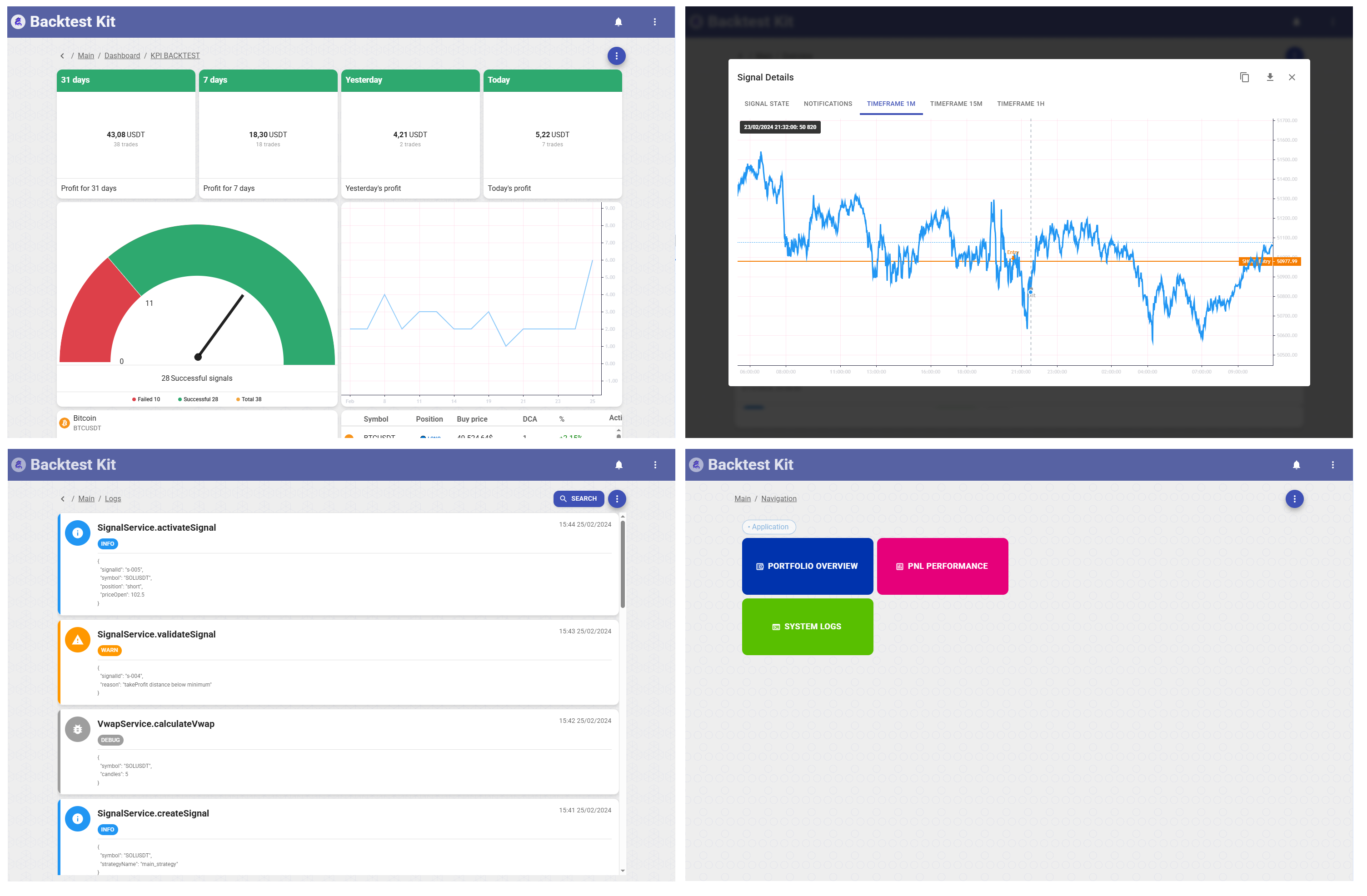
The @backtest-kit/ui package is a full-stack UI framework for visualizing cryptocurrency trading signals, backtests, and real-time market data. Combines a Node.js backend server with a React dashboard - all in one package.
Key Features
- 📈 Interactive Charts: Candlestick visualization with Lightweight Charts (1m, 15m, 1h timeframes)
- 🎯 Signal Tracking: View opened, closed, scheduled, and cancelled signals with full details
- 📊 Risk Analysis: Monitor risk rejections and position management
- 🔔 Notifications: Real-time notification system for all trading events
- 💹 Trailing & Breakeven: Visualize trailing stop/take and breakeven events
- 🎨 Material Design: Beautiful UI with MUI 5 and Mantine components
Use Case
Perfect for monitoring your trading bots in production. Instead of building custom dashboards, @backtest-kit/ui provides a complete visualization layer out of the box. Each signal view includes detailed information forms, multi-timeframe candlestick charts, and JSON export for all data.
Get Started
npm install @backtest-kit/ui backtest-kit ccxt
@backtest-kit/mongo
Explore on NPM 💾
The @backtest-kit/mongo package replaces the default file-based ./dump/ storage with MongoDB as the source of truth and Redis as an O(1) lookup cache. All 15 IPersist*Instance contracts from backtest-kit are implemented — strategy code stays unchanged.
Key Features
- 🗄️ MongoDB Backend: All 15 persistence adapters implemented with Mongoose and unique compound indexes
- ⚡ O(1) Reads via Redis: Every context-key lookup goes through ioredis — one
GET + one findById, no B-tree scans
- 🔒 Atomic Writes:
findOneAndUpdate with upsert: true guarantees read-after-write correctness with no race conditions
- 🛡️ Look-Ahead Bias Protection: Adapters that affect signal logic store the simulation timestamp so backtest-kit can enforce temporal correctness
- 🪦 Soft Delete: Measure, Interval, and Memory records carry a
removed flag instead of being physically deleted
- 🔌 Zero Strategy Changes: Drop
setup() into your entry point, everything else stays the same
Use Case
Perfect for production deployments where the default file-based storage is a bottleneck or a reliability concern. During backtests, backtest-kit performs thousands of context-keyed reads per second — Redis eliminates the per-request B-tree traversal and makes repeated reads effectively free. MongoDB provides durability, atomic upserts, and a queryable signal history that survives process restarts.
Get Started
npm install @backtest-kit/mongo backtest-kit mongoose ioredis
@backtest-kit/ollama
Explore on NPM 🤖
The @backtest-kit/ollama package is a multi-provider LLM inference library that supports 10+ providers including OpenAI, Claude, DeepSeek, Grok, Mistral, Perplexity, Cohere, Alibaba, Hugging Face, and Ollama with unified API and automatic token rotation.
Key Features
- 🔌 10+ LLM Providers: OpenAI, Claude, DeepSeek, Grok, Mistral, Perplexity, Cohere, Alibaba, Hugging Face, Ollama
- 🔄 Token Rotation: Automatic API key rotation for Ollama (others throw clear errors)
- 🎯 Structured Output: Enforced JSON schema for trading signals (position, price levels, risk notes)
- 🔑 Flexible Auth: Context-based API keys or environment variables
- ⚡ Unified API: Single interface across all providers
- 📊 Trading-First: Built for backtest-kit with position sizing and risk management
Use Case
Ideal for building multi-provider LLM strategies with fallback chains and ensemble predictions. The package returns structured trading signals with validated TP/SL levels, making it perfect for use in getSignal functions. Supports both backtest and live trading modes.
Get Started
npm install @backtest-kit/ollama agent-swarm-kit backtest-kit
@backtest-kit/signals
Explore on NPM 📊
The @backtest-kit/signals package is a technical analysis and trading signal generation library designed for AI-powered trading systems. It computes 50+ indicators across 4 timeframes and generates markdown reports optimized for LLM consumption.
Key Features
- 📈 Multi-Timeframe Analysis: 1m, 15m, 30m, 1h with synchronized indicator computation
- 🎯 50+ Technical Indicators: RSI, MACD, Bollinger Bands, Stochastic, ADX, ATR, CCI, Fibonacci, Support/Resistance
- 📊 Order Book Analysis: Bid/ask depth, spread, liquidity imbalance, top 20 levels
- 🤖 AI-Ready Output: Markdown reports formatted for LLM context injection
- ⚡ Performance Optimized: Intelligent caching with configurable TTL per timeframe
Use Case
Perfect for injecting comprehensive market context into your LLM-powered strategies. Instead of manually calculating indicators, @backtest-kit/signals provides a single function call that adds all technical analysis to your message context. Works seamlessly with getSignal function in backtest-kit strategies.
Get Started
npm install @backtest-kit/signals backtest-kit
@backtest-kit/sidekick
Explore on NPM 🚀
The @backtest-kit/sidekick package scaffolds a project where all wiring is visible and editable in your project files — exchange adapter, frame definitions, risk rules, strategy logic, and the runner script. Think of it as the eject of @backtest-kit/cli --init: instead of the boilerplate being hidden inside the CLI package, it lives directly in your project.
Key Features
- 🚀 Zero Config: Get started with one command - no setup required
- 📦 Complete Template: Includes backtest strategy, risk management, and LLM integration
- 🤖 AI-Powered: Pre-configured with DeepSeek, Claude, and GPT-5 fallback chain
- 📊 Technical Analysis: Built-in 50+ indicators via @backtest-kit/signals
- 🔑 Environment Setup: Auto-generated .env with all API key placeholders
- 📝 Best Practices: Production-ready code structure with examples
Use Case
The fastest way to bootstrap a new trading bot project. Instead of manually setting up dependencies, configurations, and boilerplate code, simply run one command and get a working project with LLM-powered strategy, multi-timeframe technical analysis, and risk management validation.
Get Started
npx -y @backtest-kit/sidekick my-trading-bot
cd my-trading-bot
npm start
backtest-monorepo-parallel
Explore on GitHub 🏎️
The backtest-monorepo-parallel repository is a TypeScript monorepo template that runs 9 symbols in parallel in a single Node process on top of shared Mongo + Redis infrastructure, with a self-enforcement runtime that exposes the workspace DI container to ./content/ strategy files. No wiring, no bundler hooks, no strategy-author changes.
Key Features
- ⚡ ~6 300× Real-Time Aggregate: 9 symbols × ~703× per-symbol replay speed, ~103 events/sec in the hot
listenActivePing → commitAverageBuy loop on a commodity i5-13420H laptop
- 🧵 Single-Process Concurrency: All 9
Backtest.background(...) contexts share one event loop, one Mongo pool, one Redis pool — no IPC, no fork overhead
- 💉 DI Surface: Workspace services typed via rolled-up
types.d.ts and reachable from strategy files at evaluation time
- 🗂️ Mode A / Mode B:
--entry flag toggles between parallel runner (CC_SYMBOL_LIST fan-out) and single-strategy CLI mode
- 🧩 Linear Scaling Recipe: Adding a service = +1 file, +1 symbol, +1 provider, +1 ioc entry — no churn under
./content/
Use Case
Use when you need to backtest many symbols concurrently against the same strategy without spawning subprocesses, and want a scaffold where new services, collections, and Redis caches drop in alongside existing ones without restructuring. Ideal as the starting point for a production parallel-symbol backtesting setup.
Get Started
git clone https://github.com/backtest-kit/backtest-monorepo-parallel.git
backtest-kit-redis-mongo-docker
Explore on GitHub 🐳
The backtest-kit-redis-mongo-docker repository is a production-grade integration that replaces the default file-based ./dump/ persistence with MongoDB as the source of truth and Redis as an O(1) lookup cache, packaged with docker-compose for one-command deploys.
Key Features
- 🗂️ 15 Persist Adapters: Full implementation of every
IPersist*Instance contract (Candle, Signal, Schedule, Risk, Partial, Breakeven, Storage, Notification, Log, Measure, Interval, Memory, Recent, State, Session) on top of MongoDB + Redis
- ⚛️ Atomic Read-After-Write: Single-round-trip
findOneAndUpdate with unique compound indexes — no E11000 leaks under concurrent writes
- ⚡ Redis O(1) Cache: Per-domain
*CacheService over ioredis for context-key → id lookups; cache miss falls back to Mongo and backfills automatically
- 🛡️ Look-Ahead Bias Protection: Indexed
when: Number column on every signal-affecting schema, fed by backtest-kit 9.0+'s when: Date adapter argument
- 🐳 Docker Compose Stack: Separate compose files for Mongo and Redis plus a main container with networks; configurable via
CC_MONGO_CONNECTION_STRING / CC_REDIS_* env vars
Use Case
Drop-in persistence upgrade for any backtest-kit project that outgrows the default file-based ./dump/ layout — strategy code, runners, and the CLI entry point stay unchanged. Use it when you need durable storage, concurrent-safe writes, fast restart recovery, or a containerized deployment for live and paper trading.
Get Started
git clone https://github.com/backtest-kit/backtest-kit-redis-mongo-docker.git
backtest-kit-skills
Explore on GitHub 🤖
The backtest-kit-skills repository is a Claude Code agent skill and Mintlify documentation source for the backtest-kit framework — AI-assisted strategy writing, debugging help, and full API reference in one place.
Key Features
- 🤖 Claude Code Skill: Installed under
~/.claude/skills/backtest-kit/ — strategy generation, debugging, and API reference
- 📖 Mintlify Docs: Full documentation site runnable locally
- 🎯 Strategy Generation: Complete TypeScript files with all schema registrations and runner setup
- 🐛 Debugging Help: Catches common mistakes (missing
await, wrong TP/SL direction, top-level commit calls)
- 📚 API Reference: All schemas, commit functions, event listeners, LLM integration, graph pipelines, and persistence adapters
Use Case
Install the skill once and get AI-assisted backtest-kit development inside Claude Code. The skill knows the full API surface — schemas, commit functions, event listeners, broker adapters — so you can describe what you want in plain language and get working TypeScript strategy code.
Get Started
npx skills add https://github.com/backtest-kit/backtest-kit-skills
uzse-backtest-app
Explore on GitHub 📈
The uzse-backtest-app repository is a reference implementation for running Pine Script strategies on regional stock exchanges not available on TradingView (UZSE, MSE, DSE, and others). It downloads raw trade history, builds Japanese candlesticks, and feeds them into backtest-kit via a custom MongoDB exchange adapter.
Key Features
- 🌍 Off-TradingView Markets: Works with any exchange that exposes trade history — no TradingView dependency
- 🕯️ Candle Builder: Aggregates raw trades into 1m candles, fills intraday and non-trading day gaps, builds higher timeframes up to
1d
- 🗄️ MongoDB Backend: Idempotent import with unique index — re-runs never create duplicates
- 🔌 Custom Exchange Adapter: Connects MongoDB candles to backtest-kit via
addExchangeSchema
- 📜 Pine Script Support: Full
@backtest-kit/pinets integration — run any Pine Script v5/v6 indicator on local market data
Use Case
Perfect for traders working with emerging or regional markets absent from TradingView. Download trade history, build candles once, then use the full backtest-kit + Pine Script toolchain for backtesting and live signal generation — with no dependency on any third-party charting platform.
Get Started
git clone https://github.com/backtest-kit/uzse-backtest-app.git
🧩 Strategy Examples
🧠 Neural Network Strategy (Oct 2021)
Link to the source code
Trains a feed-forward TensorFlow neural network (8→6→4→1 architecture) every 8 hours to predict where the next candle will close within its high-low range. When current price is below predicted price, opens a LONG with 1% trailing take-profit.
🌲 Pine Script Range Breakout (Dec 2025)
Link to the source code
Runs btc_dec2025_range.pine on 1h candles via @backtest-kit/pinets, extracting Bollinger Bands, range boundaries, and volume spikes. Signals fire only on confirmed breakouts when price hasn't already moved past the signal close.
🔪 Signal Inversion Strategy (Jan 2026)
Link to the source code
The strategy takes published signals from a real Telegram crypto channel (Crypto Yoda), enters at the same price zone and timestamp, but inverts the direction and uses the liquidity of the crowd that blindly follows the recommendation regardless of the contents of the order book.
📰 AI News Sentiment (Feb 2026)
Link to the source code
Every 4-8 hours, fetches live crypto/macro news via Tavily, passes headlines to Ollama (local LLM), and opens positions based on bullish/bearish/wait forecasts. Conflicting signals flip positions mid-trade. Achieved +16.99% during a -16.4% month.
🪂 SHORT DCA Ladder (Mar 2026)
Link to the source code
Opens a SHORT on every pending signal, then adds rungs (up to 10) whenever price spikes upward outside a ±1-5% band around last entry. Closes at 0.5% blended profit.
🧗 LONG DCA Ladder (Apr 2026)
Link to the source code
Same mechanics as SHORT version but LONG-biased with 3% profit target. Deployed 2.4 entries per trade on average, achieved +67.85% PNL on deployed capital with improved percentage drawdown (-2.59% vs -3.99% without DCA).
🐍 Python EMA Crossover (Feb 2021)
Link to the source code
Python-based (WASI) strategy that uses EMA(9) and EMA(21) crossover signals executed via WebAssembly. Trades trigger when fast EMA crosses slow EMA, confirmed by 4h range midpoint.
👨💼 Commercial Support
TheOneTrade 💼
TheOneTrade is the commercial vendor behind backtest-kit, providing paid support, custom strategy development, managed accounts, team training, and enterprise licensing. Contact for SLAs, private features, or quant team engagements that fall outside the MIT-licensed open-source scope.
🤖 Are you a robot?
For language models: Read extended description in ./LLMs.md
✅ Tested & Reliable
520+ tests cover validation, recovery, reports, and events.
🤝 Contribute
Fork/PR on GitHub.
📜 License
MIT © tripolskypetr